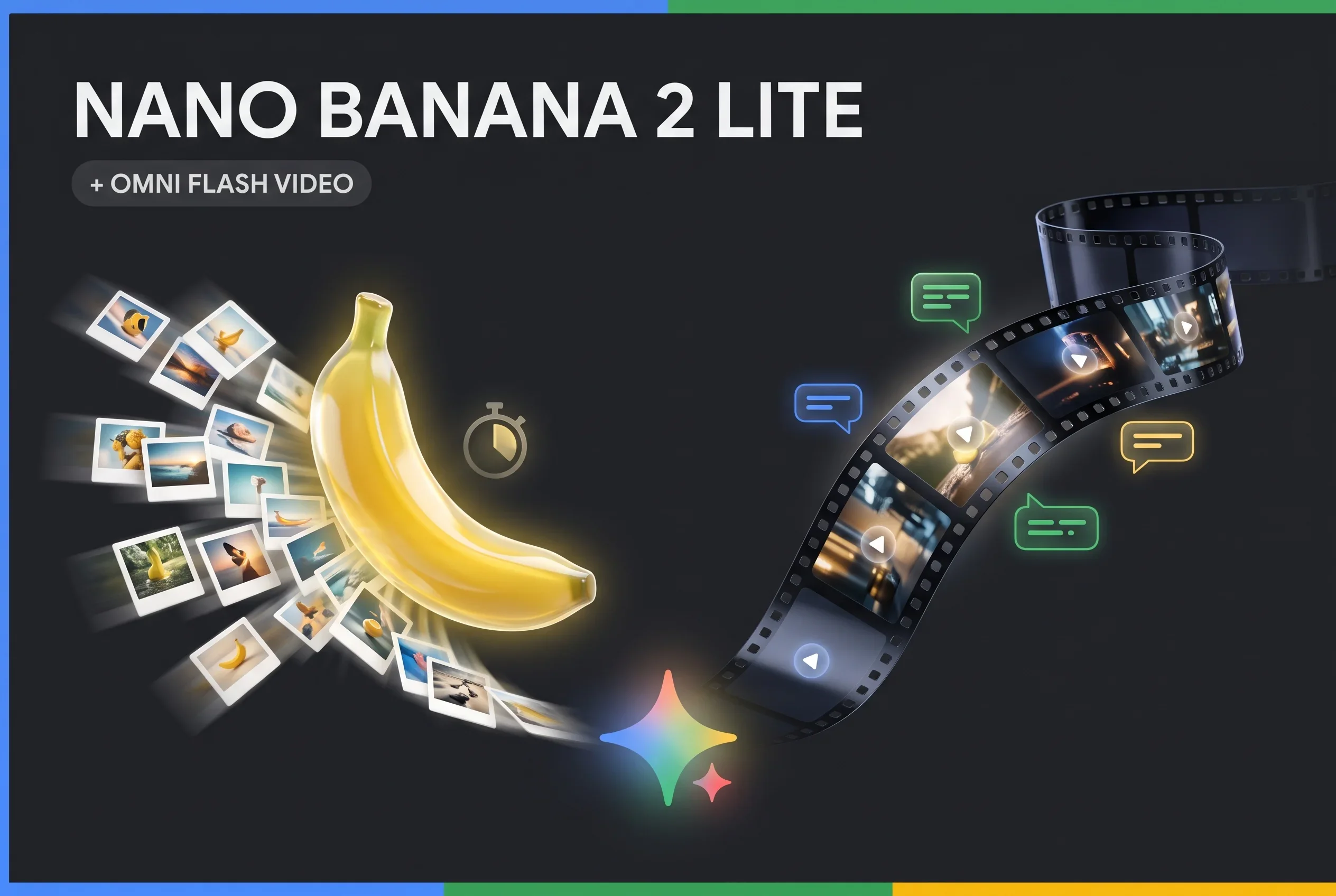
Google Releases Nano Banana 2 Lite and Gemini Omni Flash - 4-Second Images at $0.034, Conversational Video Editing at $0.10/Second
Google has released Nano Banana 2 Lite, an image model generating 1K images in 4 seconds at $0.034 each, and Gemini Omni Flash, a video model with conversational editing at $0.10 per second. Both target developers building image and video generation into production pipelines.
On June 30, 2026, Google released the image generation model “Nano Banana 2 Lite” and the video generation model “Gemini Omni Flash”1. The former is a lightweight model built around speed and cost efficiency — 4-second generation at $0.034 per image — while the latter generates video from text and images and supports editing through ongoing conversation. Both are available in Google AI Studio and the Gemini API, aimed primarily at developers embedding image and video generation into apps and workflows1.
Nano Banana 2 Lite - The “Fastest, Cheapest” Gemini Image Model
Nano Banana 2 Lite (model ID: gemini-3.1-flash-lite-image) generates images from text with 4-second latency, priced at $0.034 per 1K-resolution image1. Google bills it as “our fastest, most cost-efficient Gemini Image model,” maintaining reliable prompt adherence and character consistency despite the lighter footprint1.
Google’s stated target is “rapid ideation and high-velocity developer pipelines”1. TechCrunch likewise describes it as optimized for high-volume workflows that need to run at a rapid pace2. At a few cents per image, the pricing invites use cases where throughput matters more than peak quality — churning out e-commerce product variations or UI mockups, for example.
The model is available through Google AI Studio, the Gemini API, and the Gemini Enterprise Agent Platform, and is also rolling out to consumer surfaces including AI Mode in Search and the Gemini app1. It is positioned as the replacement for the original Nano Banana (gemini-2.5-flash-image)1. The lineage runs from the original Nano Banana in summer 2025 through Nano Banana 2 in February 2026 to today’s Lite release, with the more powerful and more expensive Nano Banana Pro sitting above them2. The split is becoming clear: Lite for speed and cost, Pro for quality.
Gemini Omni Flash - Video Generation You Edit by Talking
Gemini Omni Flash (model ID: gemini-omni-flash-preview), which received a wider release the same day, generates video from text, image, and video inputs1. Its defining feature is “conversational video editing” — you keep refining a generated video through continued dialogue — along with multimodal referencing across several source materials and synchronization of text with on-screen action1.
Generations are currently limited to 10 seconds, priced at $0.10 per second of video output1 — so a 10-second clip costs $1. It is available in Google AI Studio, the Gemini API, the Gemini app, and Google Flow in public preview1. Google is explicit about the limitations: character consistency across scene changes is limited, and audio references and scene extension are unsupported in the API1.
Google also showed three demo applications — Anywhere, Space Lift, and Omni Product Studio — that chain both models together using the Interactions API for multi-turn experiences1. Omni Product Studio converts static generated images into “cinematic e-commerce videos”2, hinting at the intended pipeline: generate images, turn them into video, then adjust through conversation.
Why It Matters - Unit Cost Becomes a Design Variable
What stands out in this release is not a performance claim but the concrete unit prices: 4 seconds and $0.034 per image; $0.10 per second of video. Image and video generation are moving past the stage of competing on diffusion model research results and into a stage of competing on API price and speed for production adoption. For designers and developers, it is now practical to design costs around per-generation pricing — drafts on Lite, final assets on Pro.
On the video side, if editing by conversation rather than rewriting prompts becomes the standard interaction, the barrier to building production flows on multimodal AI drops further. Given the 10-second cap and character-consistency limits, though, short promotional assets and prototyping look like the realistic near-term uses.
Full details and usage instructions are in Google’s official blog post.
Sources
- Start building with Nano Banana 2 Lite and Gemini Omni Flash - Google official blog
- Google introduces a faster, cheaper image generator with Nano Banana 2 Lite - TechCrunch
Was this article helpful?
Thank you!
Received. Thank you!