What Is Multimodal AI? How It Handles Text, Images, and Audio Together
What is the 'multimodal AI' behind AI that can now handle more than text—showing it a photo to ask a question, or conversing by voice? The mechanism for handling multiple kinds of data together, how it differs from single-modal AI, and use cases—explained for non-experts, based on official information from Anthropic and Google.
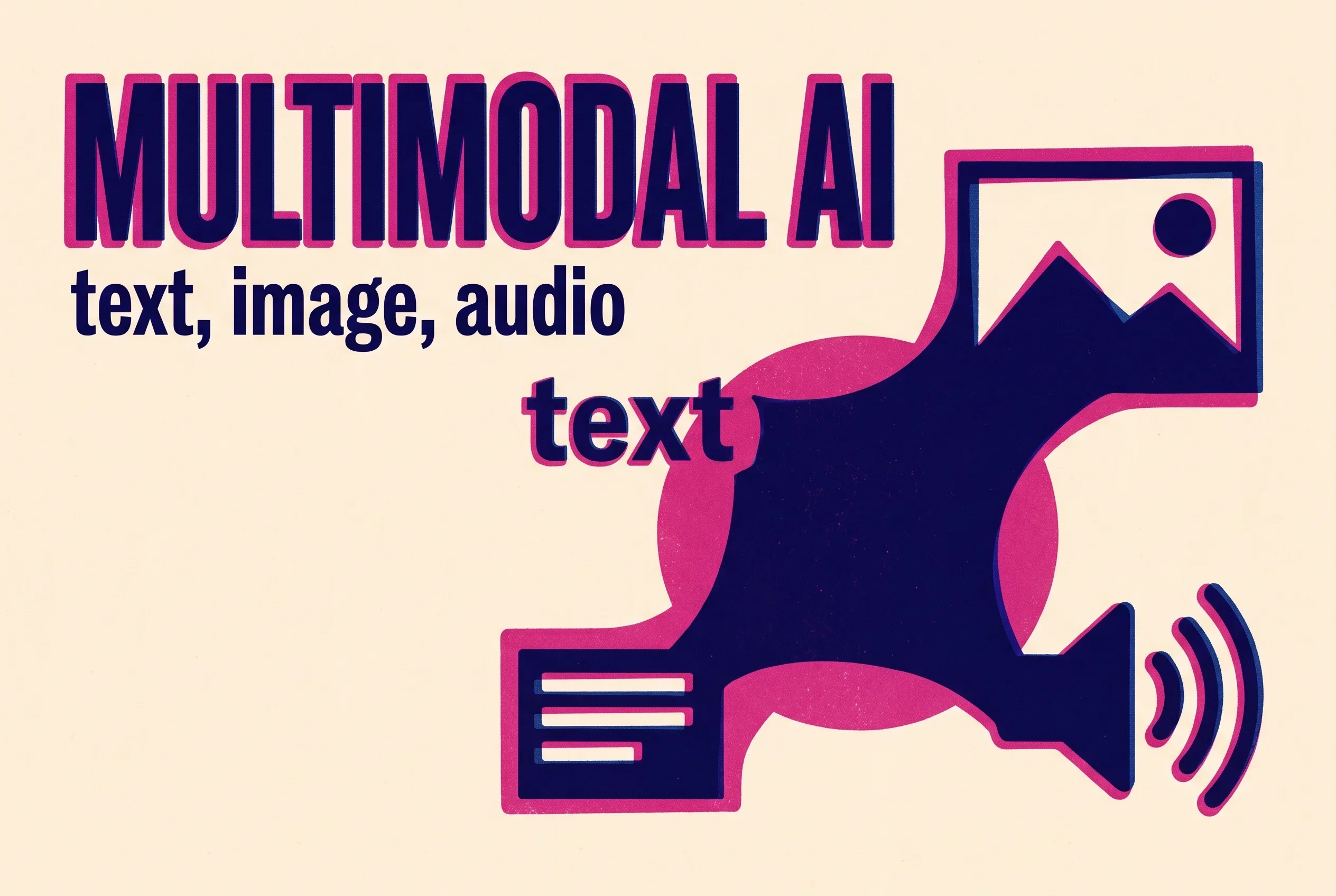
Showing an AI a photo on your phone and asking “what is this?”, or chatting by voice—generative AI is no longer limited to text-only exchanges. AI like this, which can handle images, audio, and video in addition to text, is called multimodal AI.
A “modality” is a kind or form of data. Text, images, audio, and video are each a separate “modality,” and AI that can handle several of these together is multimodal AI. This article explains what multimodal AI is, how it understands different kinds of data together, and what it’s used for—written for non-experts, based on official information. Reading it alongside the underlying mechanism of the LLM (large language model) will deepen your understanding.
What Is Multimodal AI: Handling Multiple Kinds of Data Together
Hitachi Solutions Create’s explanation defines multimodal AI as “AI that can learn by combining various kinds of data (modalities) such as text, images, audio, and sensors”3.
Its counterpart is “single-modal AI.” The same explanation states that “whereas single-modal AI is AI that processes only one kind of data, multimodal AI can learn from multiple kinds of data from different angles, enabling more complex understanding”3. For example, “an AI that only reads text” or “an AI that only classifies images” is single-modal, but multimodal AI can look at a photo and its caption at the same time and understand the two in connection.
In fact, this ability is built into the AI we use. Anthropic’s official documentation says of Claude that its “vision capabilities allow it to understand and analyze images, opening up exciting possibilities for multimodal interaction”1, and further that “multiple images can be included in a single request, which Claude will analyze jointly when formulating its response. This can be helpful for comparing or contrasting images”1. Google also positions Gemini as a “multimodal” model2, and a separate model line is shown handling text, images, video, audio, and PDFs in a unified way2.
How It Works: Putting Different Data on a “Common Footing”
How does AI understand data of different kinds all together? The key is “converting it into a common format first.”
Hitachi Solutions Create’s explanation describes the processing flow as “extracting the features of each piece of data in stages (encoding), giving the mapped results and the text features to the LLM, and converting (decoding) the processed information to generate output”3. Put simply, the flow is: convert images as images and audio as audio into “numbers representing their features” using dedicated mechanisms, then put those on a common footing and process them with the LLM.
This part—“converting different data into numbers and handling them in a common space”—is exactly the idea of embeddings, which we’ve covered on this site. Embeddings were originally a technique for vectorizing the meaning of text, but by extending the same idea to images and audio, different kinds of data can be linked by “closeness of meaning.” The word “dog” in text and an image showing a dog can be treated as close in meaning—this is the foundation of multimodal AI.
What It Can Do: Getting Closer to Real-World Problems
Being able to handle multiple modalities greatly expands AI’s range of application.
On a familiar level, as with Claude above, you can have it compare multiple images and explain them, or read through materials that include charts and tables1. Use in business is also advancing. Hitachi Solutions Create’s explanation lists medicine, retail, customer service, and education as fields where application is anticipated3. In medicine, for instance, if you could integrate separate data—images and a patient’s records—it seems possible to reach higher-accuracy judgments than from images alone or records alone.
Behind these strengths is a closeness to how humans take in information. We understand the world using sight, hearing, and language at the same time. By combining multiple kinds of data, multimodal AI is trying to get closer to an understanding that fits reality more than looking at a single kind of information would.
Representative models include OpenAI’s GPT-4o and Google DeepMind’s Gemini3. That these can handle both images and audio is less a special add-on feature than the result of generative AI evolving from a “text-only entity” into one with “multiple senses.” When you bring AI into your business, keep in mind that what it can handle isn’t only text—that premise broadens your thinking about how to put on-site data like photos, audio, and charts to use with AI.
Sources
- Vision - Anthropic official documentation (Claude’s image understanding and multimodal interaction)
- Gemini models - Google official documentation (Gemini’s multimodal support)
- What is multimodal AI? An explanation of its mechanism and use cases - Japanese explainer by Hitachi Solutions Create
Was this article helpful?
Thank you!
Received. Thank you!