What Is AI Hallucination? Why Models Make Things Up and How to Reduce It
Generative AI sometimes states falsehoods with full confidence — a phenomenon called hallucination. Drawing on an OpenAI research paper and Anthropic's official documentation, this guide explains why it happens, what users can do in their prompts, and how developers mitigate it with RAG.
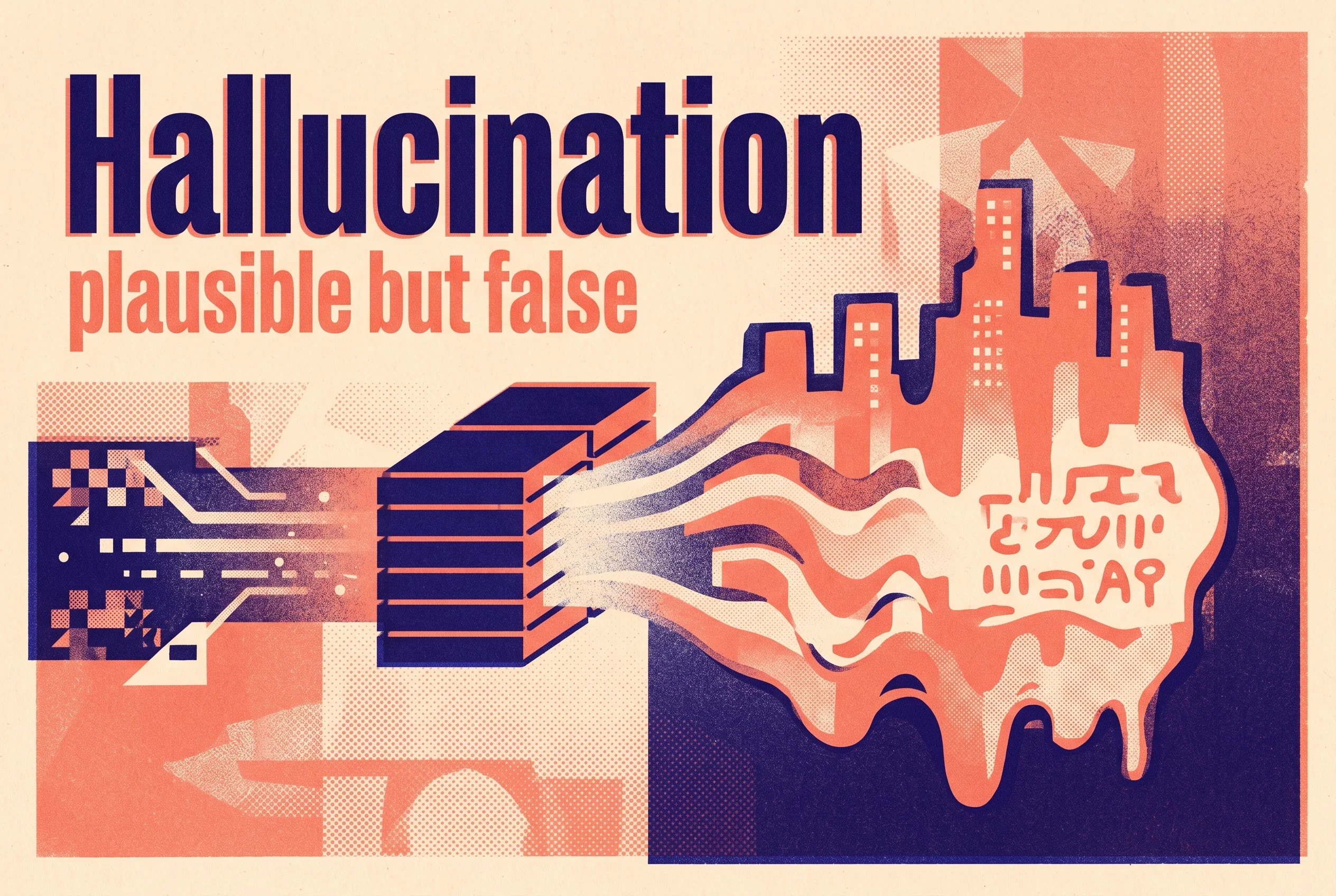
You ask ChatGPT or Claude a question and get a confident, polished answer. Then you check the facts — and the answer turns out to be wrong. If you have spent any time with generative AI, you have probably run into this. The phenomenon of an AI producing content that is factually incorrect yet sounds entirely plausible is called hallucination.
It is often cited as the biggest concern when bringing generative AI into business workflows. But once you understand why it happens, you can stop fearing it excessively and start working with it through the right safeguards. This article walks through the definition, causes, and countermeasures, based on Anthropic’s official documentation and a research paper co-authored by OpenAI researchers.
What is a hallucination?
A hallucination is when an AI generates information that is factually wrong while presenting it as if it were a correct answer3. Anthropic’s official documentation puts it this way: “Even the most advanced language models, like Claude, can sometimes generate text that is factually incorrect or inconsistent with the given context,” and notes that this phenomenon can undermine the reliability of AI-driven solutions1.
What makes hallucinations troublesome is that the incorrect content comes out as natural, well-formed text. It reads smoothly and the logic appears sound, so a reader without domain knowledge has no way to spot the error. In human terms, it resembles someone who, instead of saying “I don’t know,” improvises a plausible-sounding story.
A famous real-world example: in February 2023, a promotional video for Google Bard (now Gemini) showed the chatbot incorrectly answering that the James Webb Space Telescope (JWST) had taken the very first picture of an exoplanet3. An error in such a high-profile product launch became a catalyst that made the risk of hallucination widely known.
Why it happens: causes rooted in how LLMs work
Hallucination is not a bug or a malfunction — it stems from the operating principle of large language models (LLMs) themselves. An LLM does not understand meaning and verify facts; it generates text by “probabilistically predicting the next word”3. What comes out is the statistically plausible continuation of a text, not a verified fact.
Training data is another factor. LLMs learn from massive datasets collected from the internet, and if that data contains biases or misinformation, errors seep into the model’s output3. Other contributing factors include a lack of grounding — answers not being tied to any source of evidence — and ambiguous prompts that the AI fills in with guesses3.
OpenAI’s research: guessing pays off
A deeper explanation of the cause comes from “Why Language Models Hallucinate,” a paper published in September 2025 by researchers at OpenAI and Georgia Tech2. The paper opens with this line: “Like students facing hard exam questions, large language models sometimes guess when uncertain, producing plausible yet incorrect statements instead of admitting uncertainty.”2
The paper’s central claim is that hallucinations originate in how models are trained and evaluated. Most current benchmarks — the tests used to score AI performance — are graded in a way that rewards taking a guess over answering “I don’t know,” so models end up optimized to be good test-takers rather than honest ones2. The paper also explains that when incorrect statements cannot be distinguished from facts, hallucinations arise through natural statistical pressure rather than any exotic failure2. As a remedy, the authors propose changing how benchmarks are scored2.
One answer to the naive question “why can’t AI just say it doesn’t know?” turns out to be: because it was never trained to.
What users can do in their prompts
Since hallucination is rooted in the mechanism, users can reduce its frequency through how they prompt. Anthropic’s official documentation lists three basic techniques you can apply right away1.
First, explicitly give the model permission to say “I don’t know.” Simply adding an instruction like “if you are uncertain or lack enough information, say you don’t know” can drastically reduce false information1. Given the OpenAI paper’s point that models are trained in a world where guessing pays off, it makes sense that telling the model “you don’t have to guess” is effective.
Second, ground the answer in direct quotes from your documents. For tasks involving long documents (over 20,000 tokens), asking the model to first extract word-for-word quotes before performing its task grounds the response in the actual text and reduces hallucinations1. If terms like “tokens” or the limits on how much text you can pass at once are unfamiliar, see our explainer on context windows.
Third, make every claim verifiable with citations. Have the model cite a supporting quote and source for each of its claims, and retract any claim it cannot back up. This makes the response auditable after the fact1.
The documentation also covers advanced techniques: having the model explain its reasoning step by step before answering (chain-of-thought verification), running the same prompt multiple times and comparing outputs for inconsistencies, and restricting the model to the provided documents while forbidding answers from its general knowledge1.
What builders can do: RAG and systematic fact-checking
For teams building AI-powered systems, the flagship countermeasure is RAG (Retrieval-Augmented Generation)3. Before generating an answer, the system retrieves relevant material from a trusted knowledge base and hands it to the AI, which then answers based on those documents. This directly addresses the “lack of grounding” cause described above. We cover how it works in our explainer on RAG.
Other measures include adjusting model behavior through reinforcement learning from human feedback (RLHF), building fact-checking steps into business workflows, and structuring the context passed to the AI to reduce ambiguity3. In the world of AI agents — systems that autonomously carry out tasks — designing outputs to be grounded in primary information retrieved via search and tools has likewise become a foundation of reliability.
Living with the fact that it never fully goes away
The key thing to internalize is that even with every countermeasure applied, hallucinations do not disappear completely. Anthropic itself closes its guidance with this note: “while these techniques significantly reduce hallucinations, they don’t eliminate them entirely. Always validate critical information, especially for high-stakes decisions.”1
The practical stance for real work is to treat AI output as a capable assistant’s draft. It can be an excellent draft — but verifiable facts such as names, numbers, and dates should be checked against primary sources. Whether you can build that one extra step into your workflow is what separates successful generative AI adoption from failure. The prompt techniques introduced here — allowing “I don’t know,” requiring quotes — cost nothing to try today.
Sources
- Reduce hallucinations - Anthropic’s official documentation on hallucination-reduction techniques
- Why Language Models Hallucinate - Paper by researchers at OpenAI and Georgia Tech (submitted September 2025)
- ハルシネーションとは?AI が誤情報を生成する原因と対策 - Japanese-language explainer by Asana
Was this article helpful?
Thank you!
Received. Thank you!