What Is an AI Agent? How It Works and How It Differs from Generative AI
A plain-language guide to AI agents based on primary sources: how they differ from generative AI chat and workflow automation, the performance and cost of multi-agent systems, and principles for business adoption.
The term “AI agent” appears more and more often in news coverage and product announcements. How does it differ from a generative AI chat tool like ChatGPT, and what does it mean for your business? The phrase often travels faster than its meaning, and in fact the definition of an AI agent varies depending on which company or researcher you ask—there is no single settled definition today.
This article organizes the definition, mechanics, and practical uses of AI agents for non-specialists, drawing on reliable sources such as Anthropic’s technical guides and Fujitsu’s terminology reference.
What Is an AI Agent?
In its terminology guide, Fujitsu defines an AI agent as “autonomous or semi-autonomous software that works toward a goal by using AI technology to observe (understand) the situation, think (plan), judge (decide), and act, repeating an improvement loop in response to its environment to carry out tasks” 2.
The key phrase is “repeating a loop.” A generative AI chat tool like ChatGPT finishes its job once it generates an answer to your question. An AI agent, by contrast, takes a goal and autonomously repeats an observe-think-judge-act cycle, moving step by step toward that goal 2. Instead of a human issuing instructions one move at a time, you state the goal and the AI assembles the intermediate steps itself—this is the major difference between agents and conventional uses of generative AI.
Consider the goal “finish the expense report for next week’s business trip.” A chat-style AI can only explain the reimbursement procedure, whereas an agent-style AI is expected to carry out the sequence of work itself: checking receipt data, entering it into the expense system, and asking about missing information.
How It Works: Giving an LLM Tools and Memory
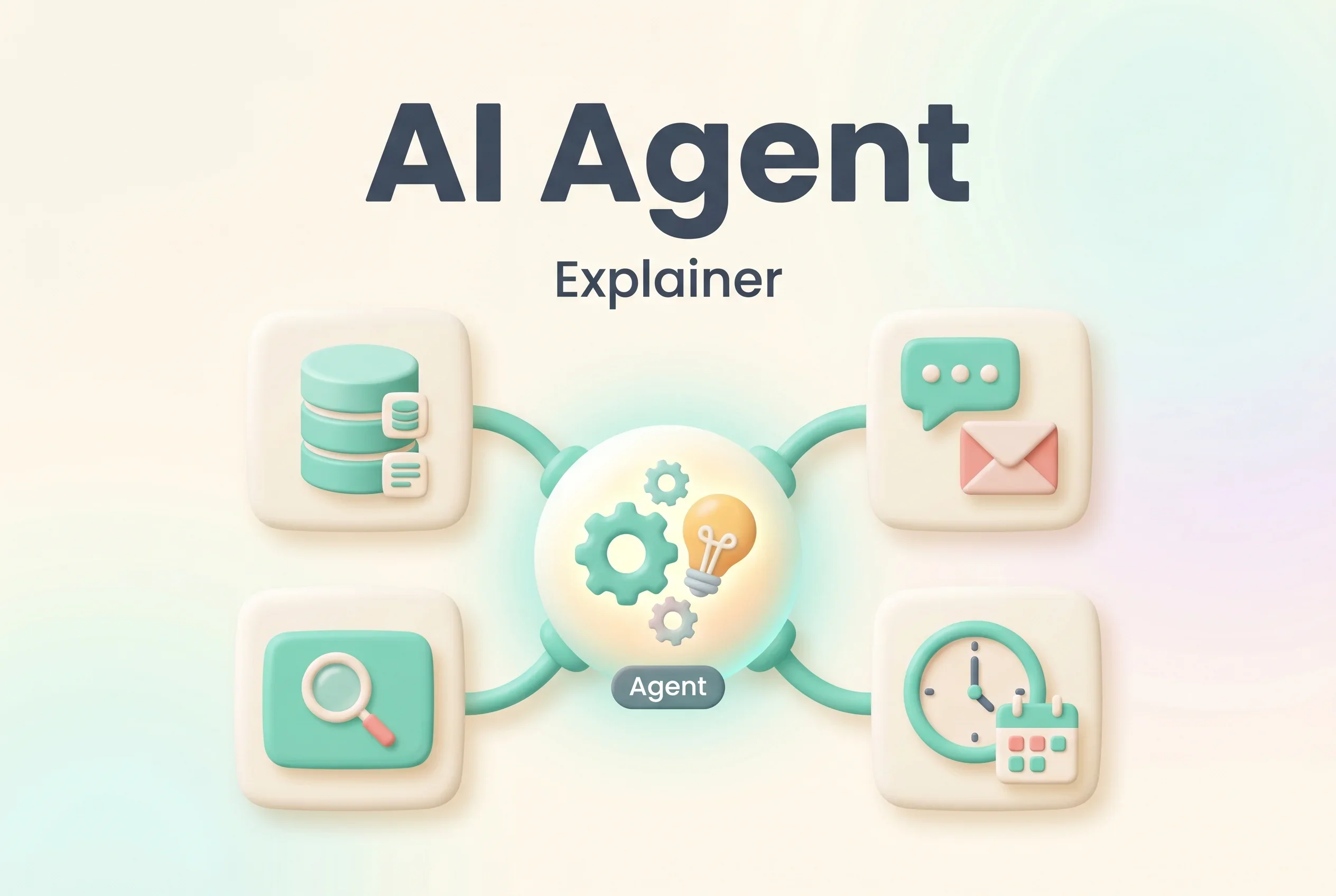
At the core of an AI agent is the same large language model (LLM) that powers ChatGPT and Claude. Anthropic describes the basic building block of agentic systems as “an LLM enhanced with augmentations such as retrieval, tools, and memory”—what it calls the augmented LLM 1.
Breaking down the three augmentations: retrieval is the ability to go fetch information outside the training data, such as internal documents and databases. Tools are the “hands and feet”—capabilities like running code, manipulating files, and calling external services—that let the AI do actual work rather than just return text. Memory is the ability to retain past interactions and intermediate progress on a task.
When an LLM runs the loop described above while using these augmentations, an “AI that only thinks” becomes an “AI that gets work done.”
How Agents Differ from Workflow Automation
A common point of confusion is the difference from conventional business automation (RPA and fixed-procedure AI processing). In its December 2024 technical guide “Building Effective Agents,” Anthropic divided agentic systems into “workflows” and “agents” 1.
By the company’s definitions, workflows are “systems where LLMs and tools are orchestrated through predefined code paths.” Agents, in contrast, are “systems where LLMs dynamically direct their own processes and tool usage” 1. In other words, in a workflow a human designs the flow of processing in advance, while an agent delegates the decision about the flow itself to the LLM.
The guide introduces five representative workflow patterns: prompt chaining, routing, parallelization, orchestrator-workers, and evaluator-optimizer 1. For routine tasks whose procedures can be determined in advance, a workflow is often sufficient without an agent—the right choice depends on the nature of the task.
Multi-Agent Systems: Multiple AIs Working Together
Agents can run not only solo but also in combination. Fujitsu’s guide presents a classification: the single type, where one agent executes tasks alone; hierarchical multi-agent systems, where a manager agent supervises multiple workers; and horizontal multi-agent systems, where peer agents cooperate as equals 2.
Drawing on its experience building its own research feature, Anthropic defines a multi-agent system as one consisting of “multiple agents (LLMs autonomously using tools in a loop) working together” 3. In the company’s internal evaluation, a multi-agent configuration with Claude Opus 4 as the lead agent and Claude Sonnet 4 subagents outperformed single-agent Claude Opus 4 by 90.2% 3.
The performance gain comes at a cost, however. According to the same report, agents typically use about 4 times more tokens (the unit of AI processing volume) than chat interactions, and multi-agent systems use about 15 times more tokens than chats 3. Configurations that put multiple AIs to work together are best suited to high-value tasks that justify the expense.
Where Agents Fit in Business, and Principles for Adoption
So which kinds of work suit agents? Anthropic cites two promising practical examples: coding agents that resolve tasks from SWE-bench (a benchmark of real software engineering problems), and customer support that combines the familiar chatbot interface with tool integrations 1. Coding assistance is already in practical use across many products such as Claude Code and Cursor, making it one of the most mature areas of agent adoption.
Anthropic offers three principles for adoption: first, “maintain simplicity in your agent’s design”; second, “prioritize transparency by explicitly showing the agent’s planning steps”; and third, “carefully craft your agent-computer interface (ACI) through thorough tool documentation and testing” 1.
What follows from these principles is a posture of not demanding a high degree of autonomy from the start. A realistic path is to begin small with fixed-procedure workflows or a single agent, keep the AI’s decision process visible to humans, and expand autonomy gradually in areas where the benefits have been confirmed.
If you want to see more real-world examples of AI agents, see our related coverage. The implementation and lessons of a multi-agent architecture are covered in our article on Anthropic’s multi-agent research system, safety research for an era of interacting agents in our article on the research funding from Google DeepMind and partners, and the internals of a coding agent in our Claude Code deep dive.
Sources
- Building Effective Agents - Anthropic official technical guide (published December 19, 2024)
- What is an AI agent: Terminology guide - Fujitsu official terminology reference
- How we built our multi-agent research system - Anthropic official engineering blog (published June 13, 2025)
Was this article helpful?
Thank you!
Received. Thank you!