Anthropic's Multi-Agent Research System: 90% Performance Improvement with Parallel AI Technology
Anthropic's multi-agent research system achieves over 90% performance improvement compared to single-agent systems through parallel operation of multiple AI agents. This innovative architecture streamlines complex research tasks and information gathering.
For complex tasks in AI research and development where single AI agents face processing limitations, Anthropic has unveiled an innovative approach. The company’s multi-agent research system achieves a remarkable 90.2% performance improvement by enabling multiple AI agents to operate in parallel, compared to traditional single-agent systems1. This technology is expected to find applications across a wide range of fields including corporate research and development, financial analysis, and legal research.
Design Philosophy and Basic Structure of Multi-Agent Systems
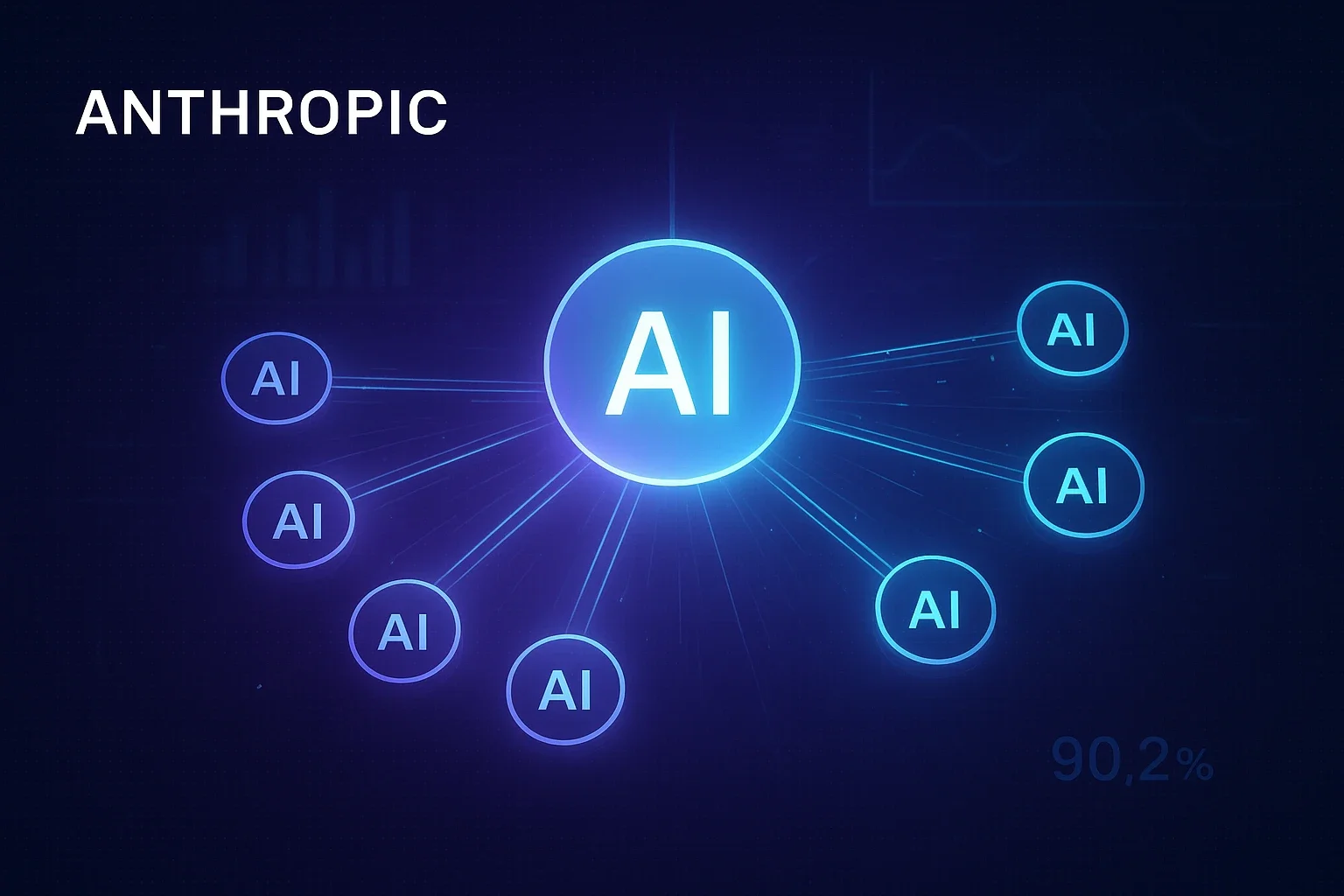
Anthropic’s multi-agent system is designed based on the philosophy that “the essence of search is compression.” In this system, a central AI called the lead agent develops overall strategy and assigns specific tasks to multiple sub-agents. Each sub-agent operates with independent context windows, conducting information gathering and analysis in parallel to work efficiently while avoiding redundancy.
The lead agent uses Claude Opus 4, while the sub-agents employ the more lightweight Claude Sonnet 4. This combination achieves a balanced system with sophisticated strategic planning capabilities and efficient execution abilities. Each agent has its own exploration trajectory, approaching problems from different angles to comprehensively collect information that might be overlooked by a single agent.
Notably, this architecture draws inspiration from models of human collective intelligence. Like human teams cooperating to solve problems, each agent has specialized domains and complements each other to achieve high overall performance.
Technical Implementation and Factors Behind Performance Improvements
In the technical implementation of the multi-agent system, Anthropic utilizes enhanced thinking mode to visualize agent thought processes, making system operations more understandable. Parallel tool calling functionality has successfully reduced search time by up to 90%.
According to Anthropic’s analysis of performance improvement factors, token usage emerged as the most important element, explaining 80% of performance differences1. Other important factors include the number of tool calls and model selection. This finding validates the architecture’s approach of distributing work across multiple agents, each with independent context windows, to add capacity for parallel reasoning.
While the system’s token usage reaches approximately 15 times that of normal chat interactions, this increase is justified by the performance gains. Multi-agent systems demonstrate overwhelming advantages particularly in breadth-first queries that require simultaneously pursuing multiple independent directions, such as identifying all directors in the information technology sector of S&P 500 companies.
Practical Applications and Implementation Effects
Multi-agent systems have diverse applications. In research and development, significant efficiency improvements have been realized in analyzing complex scientific papers and conducting market research for new technologies. In financial analysis, work that previously took considerable time to analyze multiple market data simultaneously and identify investment opportunities now completes in a fraction of the time.
In the legal field, multi-agent systems demonstrate their power in extracting relevant information from vast amounts of case law and regulations. Cases have been reported where research that traditionally took specialists several days now completes in just hours1.
Claude Code serves as a representative example of developer tools. Developers can interact directly with Claude from the terminal, delegating various tasks from code migration to bug fixes. Additionally, project management AI agents can reference tasks using MCP connectors with Asana, assign work, upload related reports via Files API, and analyze progress and risks with code execution tools.
Latest API Features and Developer Tools
Anthropic has announced four new API features that enable building more powerful AI agents. The code execution tool allows Claude to load datasets, generate exploratory charts, identify patterns, and iteratively improve outputs based on execution results, all within a single interaction1.
MCP connectors simplify integration with external services, while Files API streamlines file processing. Furthermore, the ability to cache prompts for up to one hour enables cost reduction for repetitive tasks.
These new features allow developers to build more complex and practical multi-agent systems. Particularly in real-time data processing and large-scale dataset analysis, previously impossible processing has become achievable.
Impact on Japanese Companies and Implementation Strategies
Multi-agent systems could represent an important opportunity for Japanese companies to strengthen their competitiveness. The manufacturing industry could particularly benefit from this technology in quality control data analysis and supply chain optimization, where multiple factors need simultaneous consideration.
In the financial industry, risk management and compliance checks require simultaneous monitoring of multiple regulations and market trends. Multi-agent systems can efficiently handle these complex tasks while reducing the risk of human error.
For implementation, starting with small pilot projects and gradually expanding after understanding system characteristics is recommended. Given that token usage reaches 15 times normal levels, careful cost-benefit evaluation is important, with priority given to high-value-added tasks.
Future Prospects and Technical Challenges
Anthropic aims to transition from the current synchronous execution model to asynchronous execution, where agents can create new sub-agents and work in parallel without waiting for all sub-agents to complete. While this transition promises greater flexibility and improved processing speed, it also introduces new challenges in coordination, state management, and error handling.
Implementing multi-agent systems involves challenges in coordination between agents, evaluation, and ensuring reliability. However, these challenges are often justified by the significant performance improvements the system delivers, particularly for complex research and analytical tasks where the investment offers commensurate value.
AI systems are evolving from single powerful models toward multiple specialized agents working in coordination. Anthropic’s multi-agent research system serves as a pioneer of this new paradigm, representing an important case study that points toward future AI development directions.
Sources
- How we built our multi-agent research system - Anthropic Official Blog (Detailed explanation of multi-agent research system)
Was this article helpful?
Thank you!
Received. Thank you!