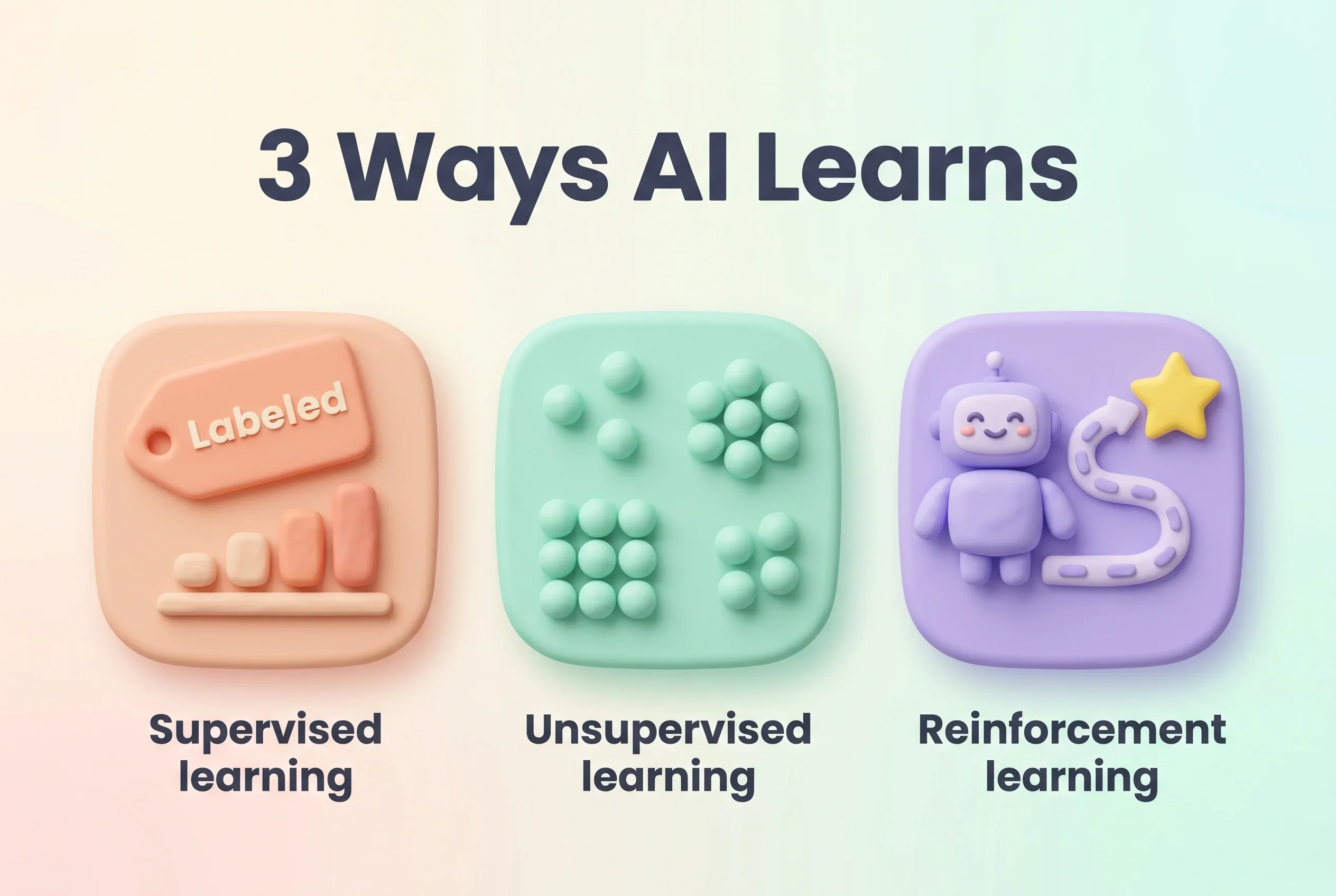
Supervised vs. Unsupervised vs. Reinforcement Learning: The 3 Ways Machines Learn
The three major paradigms of machine learning—supervised learning that's taught the answers, unsupervised learning that finds structure on its own, and reinforcement learning that learns from trial and reward—explained with concrete examples like classification, clustering, and AlphaGo, plus a comparison table.
“Machine learning” sounds like one thing, but there are broadly three ways to train an AI: supervised learning, unsupervised learning, and reinforcement learning. Spam detection, automatic customer segmentation, an AI that beat the world champion at Go—all of these are machine learning, yet their “ways of learning” are completely different.
Once you grasp the difference between these three, it becomes far easier to size up “how exactly did this AI learn?” and “which type fits our problem?” And in fact, large language models (LLMs) like ChatGPT are built by skillfully combining all three.
This article organizes the differences among the three major machine learning paradigms for non-experts, using concrete examples and comparison tables. It reframes the neural networks at the foundation of AI, and the difference between AI, machine learning, and deep learning, through a different lens: the “way of learning.”
Why Divide It into Three?
Machine learning is a method of learning patterns from data, instead of a human writing out rules one by one. But the approach changes greatly depending on “what data you provide and what clue you use to learn from it.” That difference in clue is the axis that divides the three paradigms.
Roughly speaking: learning by being taught the answers is supervised learning, finding structure in data on its own without answers is unsupervised learning, and learning by relying on the reward that results from an action is reinforcement learning. Let’s look at each in turn.
Supervised Learning: Learning from Answer-Keyed Examples
The most widely used is supervised learning. Wikipedia defines it as “a type of machine learning paradigm where an algorithm learns to map input data to a specific output based on example input-output pairs”1.
The key is using labeled data. Wikipedia explains that it “involves training a statistical model using labeled data, meaning each piece of input data is provided with the correct output”1. The name “supervised” comes from the fact that a teacher or supervisor provides the training data, guiding the algorithm toward correct predictions1. Picture showing it a large set of photos labeled “this image is a cat, this one is a dog,” so it can correctly call the answer on a new photo.
Supervised learning has two representative tasks. Wikipedia lists “classification (predicting a category, e.g., spam or not spam) and regression (predicting a continuous value, e.g., house prices)“1. The ultimate goal is “for the trained model to accurately predict the output for new, unseen data”1—that is, the ability to generalize to unseen data rather than memorize.
| Use | What it does | Everyday example |
|---|---|---|
| Classification | Sort data into categories | Spam detection, object recognition, disease diagnosis |
| Regression | Predict a continuous number | House price prediction, demand forecasting, temperature forecasting |
Its weakness is the cost of humans preparing correct labels. Attaching a “correct answer” to each of tens of thousands of images one by one takes effort and money. This labeling barrier is one reason the next approach, unsupervised learning, draws attention.
Unsupervised Learning: Finding Structure Without Answers
Unsupervised learning is a method of discovering patterns and structure from data without correct labels. Wikipedia defines it as “a framework in machine learning where, in contrast to supervised learning, algorithms learn patterns exclusively from unlabeled data”2. With no teacher to provide the answer, the AI searches on its own for the “similar groups” and “hidden axes” within the data itself.
The advantage is not needing labels. Wikipedia notes that the data is “harvested cheaply ‘in the wild’, such as massive text corpus obtained by web crawling”2. Because no human needs to attach correct answers, vast amounts of data can be used as-is.
A representative method is cluster analysis. Wikipedia explains that “cluster analysis is used in unsupervised learning to group, or segment, datasets with shared attributes”2. From purchasing data, for example, the AI automatically finds “customer segments that buy in similar ways” without us deciding the categories. Another is dimensionality reduction; Wikipedia cites clustering like k-means and “dimensionality reduction techniques like principal component analysis (PCA)“2 as representative examples. These compress many features into a small number of axes while preserving the essence.
| Use | What it does | Everyday example |
|---|---|---|
| Clustering | Automatically group similar data | Customer segments, automatic news categorization |
| Dimensionality reduction | Compress many features into few axes | Data visualization, noise removal, feature extraction |
Unsupervised learning suits “exploratory analysis where the answer isn’t predetermined.” On the other hand, humans must interpret what the resulting groups mean, and there’s the difficulty that accuracy is hard to measure by “agreement with a correct answer.”
Reinforcement Learning: Learning from Trial and Reward
The third, reinforcement learning, is quite different in character from the previous two. Rather than learning by surveying a dataset, it learns through trial and error, acting within an environment and relying on the reward obtained as a result. Wikipedia describes reinforcement learning as the field concerned with “how an intelligent agent should take actions in a dynamic environment in order to maximize a reward signal”3.
At its center is the interaction between an agent (the acting subject) and the environment. Wikipedia states that “an agent takes actions in an environment, which is interpreted into a reward and a state representation, which are fed back to the agent”3. The agent learns a policy that maximizes the accumulation of immediate rewards3, balancing between trying unknown actions (“exploration”) and taking the best known action (“exploitation”)3.
The decisive difference is that there are no correct labels. Wikipedia frames it this way: “while supervised learning and unsupervised learning algorithms respectively attempt to discover patterns in labeled and unlabeled data, reinforcement learning involves training an agent through interactions with its environment”3. Instead of being taught “the correct move,” it receives feedback in the form of “reward if you win, penalty if you lose,” and discovers good behavior on its own from millions of trials.
What demonstrated this power to the world was AlphaGo, the Go-playing AI developed by Google’s subsidiary DeepMind. According to the paper published in Nature in 2016, AlphaGo was trained “through a combination of supervised learning from human expert games and reinforcement learning from self-play games”4. Wikipedia further records that “it was trained further by being set to play large numbers of games against other instances of itself, using reinforcement learning to improve its play”5. And in March 2016, AlphaGo won a five-game match against top player Lee Sedol by four games to one5. What was groundbreaking was that humans did not teach it “the correct moves”; the AI devised strategies surpassing humans from the trial and error of self-play.
The Three Differences in One Table
Organizing the differences so far:
| Aspect | Supervised | Unsupervised | Reinforcement |
|---|---|---|---|
| Clue for learning | Labeled data1 | Unlabeled data2 | Reward for actions3 |
| What it learns | Input→output mapping1 | Structure/patterns in data2 | A policy of good actions3 |
| Representative task | Classification, regression1 | Clustering, dimensionality reduction2 | Games, control, optimization |
| Human’s role | Prepare the answers | Interpret the results | Design the reward |
| Representative example | Spam detection, image recognition | Customer segments | AlphaGo45 |
It’s not a matter of which is superior; the accurate view is that you choose among them based on the problem you want to solve and the nature of your data. If correct-answer data can be prepared, supervised; if you want to probe structure, unsupervised; if there’s an environment to try things out in, reinforcement.
How Generative AI and LLMs Combine the Three
With this in mind, you can also see how large language models (LLMs) like ChatGPT and Claude are built. An LLM isn’t a single paradigm; it’s built by layering multiple ways of learning in stages.
First, the foundational pretraining uses vast amounts of web text to have the model solve the task of “predicting the next word.” Rather than humans attaching correct labels, the data itself (the continuation of the text) provides the answer—an approach called self-supervised learning. Wikipedia defines it as a method where “a model is trained on a task using the data itself to generate supervisory signals, rather than relying on externally-provided labels”6, and notes it “is similar to unsupervised learning in that it does not require labels in the sample data”6. In short, it harnesses the “no labels needed” property close to unsupervised learning, feeding on the world’s text as-is.
On top of that, reinforcement learning appears at the stage of polishing the model into responses that are useful and natural for humans. The technique in which humans evaluate the quality of responses as a stand-in for reward, and the model is tuned to maximize that reward, is RLHF (reinforcement learning from human feedback). Just as AlphaGo grew strong on the reward of “win or lose,” a conversational AI acquires its naturalness on the reward of “human preference.” Fine-tuning, which adds adjustment for specific uses, is also largely an application of supervised learning that shows correct examples.
A Rule of Thumb for Choosing
The three paradigms aren’t opposed to one another; they are separate tools in a toolbox. When considering how to apply AI, simply asking “do we have correct-answer data?” and “is there an environment to explore in?” gives you a sense of which approach is realistic. If you’re rich in labeled data, supervised learning is the shortest path; if you want insight from data whose patterns are unclear, unsupervised learning; if the rules are clear and trial and error can be repeated, reinforcement learning shines.
And modern generative AI is constituted by skillfully linking these three together. If you want to learn more about the substance of each way of learning, reading on into RLHF, which polishes conversational AI with reward, or the neural networks that underlie everything, will bring the depth of the phrase “AI learns” into clearer, three-dimensional focus.
Sources
- Supervised learning - Wikipedia (definition of supervised learning, classification and regression)
- Unsupervised learning - Wikipedia (unsupervised learning, clustering, dimensionality reduction)
- Reinforcement learning - Wikipedia (reinforcement learning, agent, reward)
- Mastering the game of Go with deep neural networks and tree search - Silver et al., Nature 529:484-489 (2016). The AlphaGo paper
- AlphaGo - Wikipedia (AlphaGo and the Lee Sedol match)
- Self-supervised learning - Wikipedia (self-supervised learning)
Was this article helpful?
Thank you!
Received. Thank you!