AI vs. Machine Learning vs. Deep Learning: How the Three Relate
What's the difference between AI, machine learning, and deep learning? For non-specialists: the three form a nested 'AI ⊃ machine learning ⊃ deep learning' structure. This explainer covers what each means, the idea of 'features' that separates machine learning from deep learning, and where generative AI and LLMs fit—drawing on Nature's deep learning review.
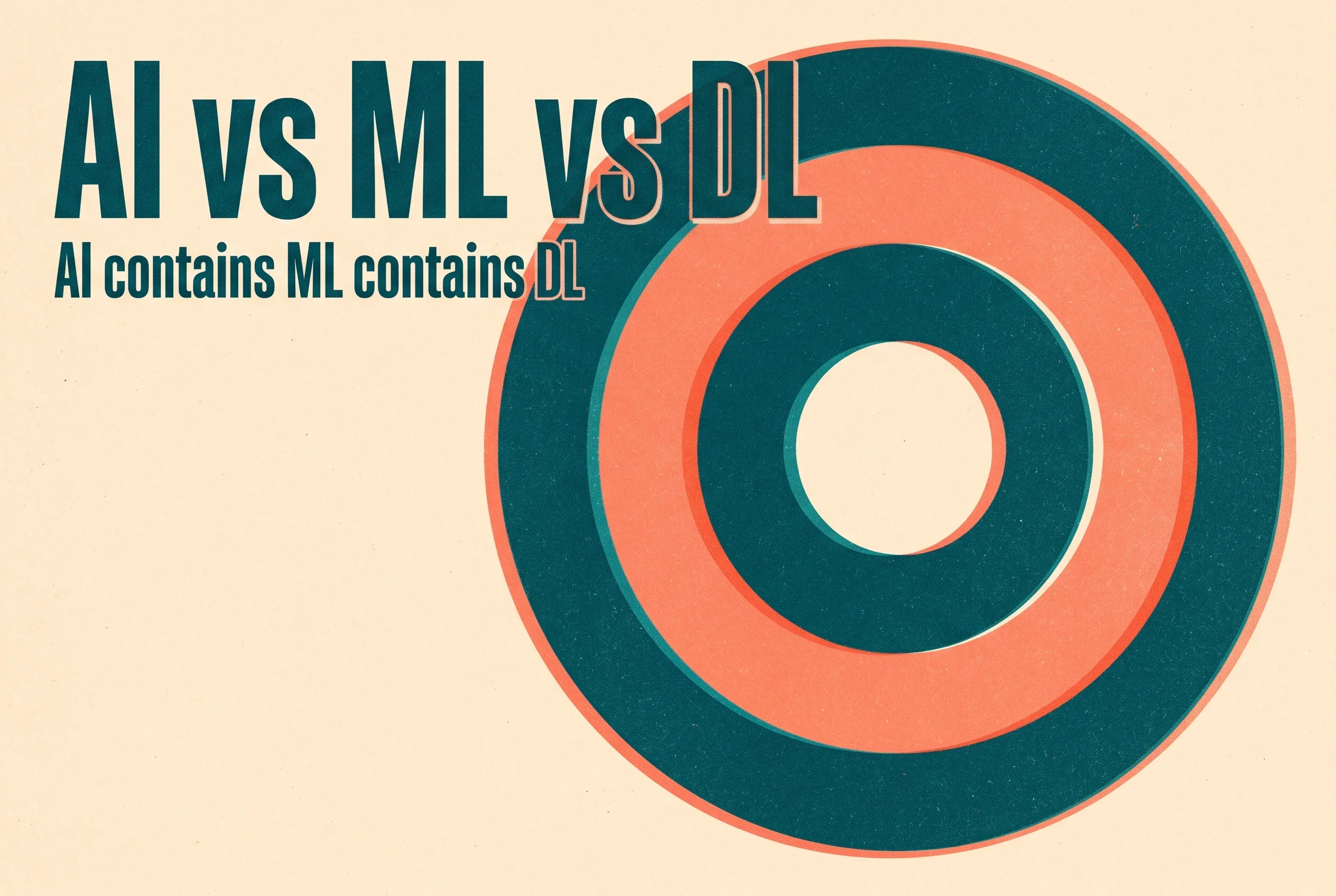
“AI,” “machine learning,” “deep learning”—three terms that fly around in the news and in meetings as if everyone knows them, yet when asked “what’s the difference?”, many people find themselves at a loss. In fact, these three are not rivals lined up side by side; they sit in a nested (containment) relationship, like smaller boxes inside a larger box.
To state the conclusion first: the broadest is AI (artificial intelligence), inside it is machine learning, and inside that is deep learning—a three-layer structure. This article organizes, for non-specialists, what the three terms refer to and where the lines are drawn, drawing on a review article on deep learning published in Nature.
The Big Picture: The Three Are Nested
First, let’s grasp the big picture. The three terms can be organized into the following containment relationship.
- AI (artificial intelligence): The whole endeavor of getting computers to realize human-like intelligent behavior. The broadest concept
- Machine learning: One means of realizing that AI—a method of learning patterns from data
- Deep learning: One technique within that machine learning
The explainer from Hitachi Solutions Create likewise positions deep learning as “a method developed from machine learning, and a part of machine learning” 2. In other words, deep learning is a kind of machine learning, and machine learning is one representative means of realizing AI. Keep this nesting in mind and you won’t get lost even when the three terms come up jumbled together.
What Is AI? The Broadest “Intelligent Behavior” of All
AI (artificial intelligence), the outermost layer, is the oldest term and the broadest concept. Both old-fashioned programs that humans hand-code in detail to run, and the latest systems that learn on their own from data, fall under AI in the broad sense as long as they are attempts to “make a computer perform human-like judgment and recognition.”
The point is that the word AI itself does not specify “how” it is realized. Realize it with hand-written rules, and it’s AI; realize it by learning from data, and it’s AI. The approach of “learning from data” is handled by the next layer: machine learning.
What Is Machine Learning? Learning Patterns from Data
Machine learning is a method where, instead of humans writing out every rule, you feed large amounts of data into a computer and have it automatically find the patterns lurking within 2. For example, if you want to judge “whether an email is spam,” it is hard for humans to enumerate every possible condition—but by training on large numbers of example emails, the machine acquires its own way of telling them apart. The basic flow is to apply the learned patterns to new data to predict and judge 2.
However, traditional machine learning still leaves human effort. “Where in the data to focus”—technically called features, the points of attention—had to be designed and specified by humans 2. For image recognition, humans would define the points to look at, such as “edges” or “color distribution,” and the machine would learn on that prepared footing. This division of labor—“who decides the features”—is the dividing line from the next layer, deep learning.
What Is Deep Learning? Finding Even the Features Automatically
Deep learning is a machine learning technique that stacks many deep layers of neural networks, which mimic the connections of neurons in the human brain. The name “deep” comes from this depth of layers.
The researchers who helped popularize deep learning (Yann LeCun, Yoshua Bengio, and Geoffrey Hinton), in a review article published in Nature in 2015, define deep learning as something that “allows computational models that are composed of multiple processing layers to learn representations of data with multiple levels of abstraction” 1. The image is of building up understanding in stages with each added layer, from simple features to more complex and abstract ones.
The biggest difference from traditional machine learning is that humans no longer need to design the features mentioned earlier 2. Deep learning automatically discovers, from large amounts of data, the very features of where to focus. This property made it possible to handle complex data—images, audio, language—where it is hard for humans to define features in words. The Nature paper also reports that such methods “have dramatically improved the state-of-the-art in speech recognition, visual object recognition, object detection and many other domains such as drug discovery and genomics” 1. Incidentally, these three authors went on to jointly receive the 2018 Turing Award, often called the Nobel Prize of computer science.
On the mechanism side, deep learning uses an algorithm called backpropagation. Based on the error in the output, it indicates how each layer should compute from the previous layer’s information and how its internal parameters should be adjusted 1. By repeating this adjustment over vast amounts of data, the network learns complex structure.
Where Do Generative AI and LLMs Fit?
Once you understand the nesting so far, the place of today’s hot technologies comes into view. Generative AI—such as large language models (LLMs) like ChatGPT and image-generation AI—is an application of deep learning. That is, it can be organized as “AI ⊃ machine learning ⊃ deep learning ⊃ generative AI/LLMs,” the newest, innermost development.
The Transformer at the core of LLMs is also a form of neural network, itself a type of deep learning. The numbers expressing model scale, like the “7B” and “70B” of parameter counts, ultimately refer to the abundance of adjustable values this neural network holds internally. In other words, the generative AI boom did not appear out of nowhere; it lies on the extension of the buildup from AI to machine learning to deep learning.
Where this distinction helps in practice is, for example, when “we want to adopt AI” comes up at your company. Whether rule-based automation is enough, whether you need machine learning that learns from data, or whether you must go as far as deep learning to handle images and text, greatly changes the data volume, the team, and the cost required. Having a firm grasp of how the three terms relate is the starting point for decision-making around AI.
If you want to understand the inside of AI one step further, read this alongside how LLMs work (the flagship of generative AI), the Transformer at their heart, and parameter counts that indicate model size, and you’ll see in clearer relief which technologies today’s AI stands on.
Sources
- Deep learning - Review article by LeCun, Bengio, and Hinton (Nature 521:436-444, May 2015; bibliographic record and abstract on PubMed)
- Key Differences Between Machine Learning and Deep Learning - Japanese explainer by Hitachi Solutions Create
Was this article helpful?
Thank you!
Received. Thank you!