Gemini Robotics 2: DeepMind's New Models Bring Whole-Body Humanoid Control and Multi-Robot Collaboration
DeepMind announced Gemini Robotics 2, ER 2, and On-Device 2 on July 30, extending control from the upper body to full-body motion. ER 2 is now open to developers via the Gemini API.
Google DeepMind announced the next generation of its robotics AI models on July 30, 2026: the Gemini Robotics 2 family1. It comes in three parts — Gemini Robotics 2, a vision-language-action (VLA) model that converts vision and language input into motor control; Gemini Robotics ER 2, an embodied reasoning model that orchestrates a robot’s tasks; and Gemini Robotics On-Device 2, which runs locally on the robot itself.
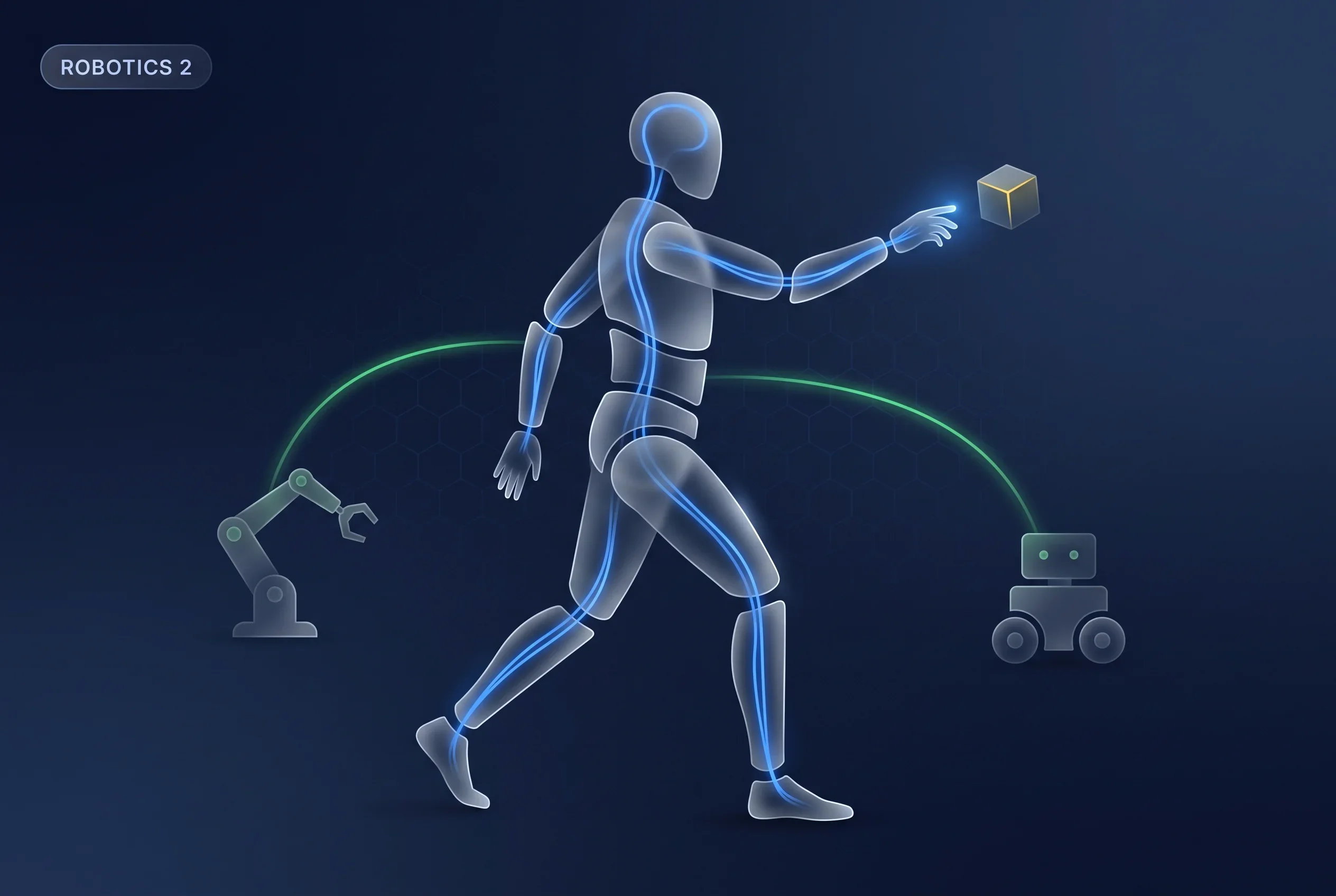
Where DeepMind’s previous models controlled only a humanoid’s upper body, Gemini Robotics 2 extends coverage to whole-body motion, including walking1. A humanoid can walk, crouch, reach, and manipulate objects to tidy up a cluttered room — a full sequence handled by a single model.
From Upper Body to Whole Body, From One Robot to a Team
Three things change with this release. The first is whole-body control. DeepMind cites the example of a humanoid combining walking, crouching, and object manipulation to clean up a cluttered room1. The success rates the company reports include 74.2% on general pick-and-place with a gripper robot, 78.9% on diverse tool kitting, and 89.6% on precise insertion tasks1. With a multi-fingered hand (SharpaWave), unscrewing a light bulb reaches 92%, while other tasks land in the 32-44% range — dexterity remains a work in progress1.
The second is multi-robot collaboration. Different types of robots can now communicate with each other and work together in shared spaces, splitting up complex workflows12. ER 2 underpins this: it tracks the robot’s own progress from a continuous video feed and self-corrects by reworking the plan when something goes wrong2. DeepMind positions ER 2 as a significant upgrade over ER 1.6, reporting 57.4% accuracy on progress classification, 91.3% accuracy on moment detection in video, and 4x the execution speed2.
The third is on-device operation. On-Device 2, described as the most efficient VLA in the family, runs on the robot without a network connection1. Adapting it to a new bi-arm robot reportedly takes a few hours and typically fewer than 200 examples1. If robots no longer need to be trained from scratch for each new body, the cost of bringing multimodal AI into the physical world keeps falling.
What Developers Can Try Today Is ER 2
Of the three models, only ER 2 is open to developers right now, via the Gemini API and Google AI Studio, with a private preview on the Gemini Enterprise Agent Platform for enterprises2. Gemini Robotics 2 itself and On-Device 2 remain limited to early-access partners1. The announcement names Apptronik, Boston Dynamics, and Agile Robots as partners1, making these partners the first proving ground.
The models were reportedly trained on human teleoperation data, video examples, and simulation3. No timeline was given for consumer robots, and DeepMind’s head of robotics Carolina Parada noted in press coverage that the safety question becomes even more pressing — deployment is still at an early stage3.
On safety, DeepMind takes a multi-layered approach combining traditional physical safety measures with AI safety frameworks, including the ability to detect when humans are nearby, trigger safety tool calls, and bring the robot to a safe stop, along with ASIMOV-Agentic, a new benchmark for agentic safety1.
Physical AI Is Now a Land Grab of Foundation Models and Hardware
The race to pair foundation models with robot hardware has accelerated sharply this year. In July, NVIDIA launched a full-scale physical AI push in Japan, building a coalition of more than 20 companies including Toyota, FANUC, and Sony around its 4B edge model Cosmos 3 Edge. On the hardware side, China’s Unitree Robotics has moved ahead of rivals in pushing low-cost humanoid and quadruped robots into volume production.
DeepMind’s move injects a foundation model that inherits Gemini’s multimodal capabilities into this landscape. The company just rounded out its agent-focused lineup this month with the low-cost Gemini 3.6 Flash series, making its strategy clear: Gemini as the common foundation for both digital agents and physical robots.
If you are weighing robot deployment at your company, what you can actually test today ends at the ER 2 API; the whole-body control will become visible through partner demos. But if On-Device 2’s numbers — adaptation in hours with fewer than 200 examples — hold up in production, the baseline cost of putting robots into factories and warehouses changes. Trying ER 2 just for the “let the robot plan the work” layer is an accessible way to get a feel for how fast this field is moving.
Sources
- Gemini Robotics 2 brings whole body intelligence to robots - Google DeepMind official blog
- Introducing Gemini Robotics ER 2 - Google official blog (The Keyword)
- Google’s new Gemini Robotics 2 platform allows for ‘intelligent whole-body control’ - Engadget
Was this article helpful?
Thank you!
Received. Thank you!