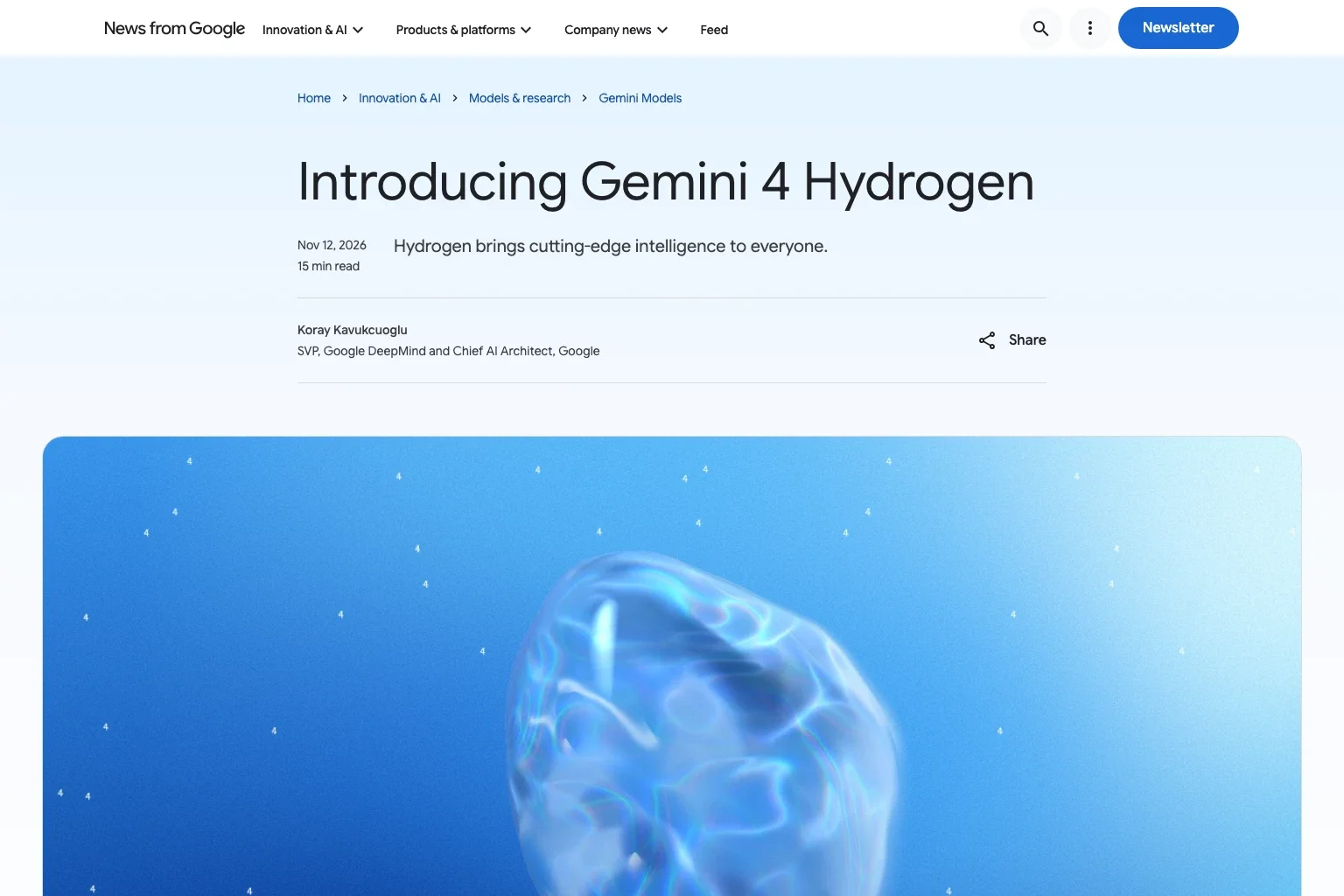
Gemini 4 Hydrogen Launches at $1.50 Input and $7.50 Output, Matching 3.8 Flash's 2027 Price, and Migration Needs Code Changes
On November 12, 2026, Google released Gemini 4 Hydrogen and made it available on both the free and paid tiers of the Gemini API. The paid rate of $1.50 input and $7.50 output equals what 3.8 Flash will cost from January 1, 2027. This article lays out what changes when moving from 3.8 Flash, including the lack of explicit caching and a new default thinking level.
Google has released Gemini 4 Hydrogen (model ID gemini-4-hydrogen)1. Google positions Gemini 4 Carbon and Argon as frontier models for deep, long-horizon reasoning, and Hydrogen as a model for fast execution across many kinds of agentic workflows.
For API users, the point is that Hydrogen is presented as the place to move from Gemini 3.8 Flash. The migration guide recommends it as the upgrade from 3.8 Flash and from older 3-series and 2.5-series models2. Paid-tier pricing is $1.50 for input and $7.50 for output per million tokens, with no change across the whole 1-million-token context. The free tier offers it too.
Twice 3.8 Flash’s Rate This Year, the Same Rate From January 1
Here are the paid-tier rates for Hydrogen and 3.8 Flash from the Gemini API pricing page (USD per million tokens)3.
| Model and tier | Input | Output (incl. thinking tokens) | Caching |
|---|---|---|---|
| Hydrogen Standard | $1.50 | $7.50 | $0.075 |
| Hydrogen Batch and Flex | $0.75 | $3.75 | $0.0375 |
| Hydrogen Priority | $2.70 | $13.50 | $0.135 |
| 3.8 Flash Standard (through December 31, 2026) | $0.75 | $3.75 | $0.075 |
| 3.8 Flash Standard (from January 1, 2027) | $1.50 | $7.50 | $0.15 |
3.8 Flash’s current rate is an introductory price that runs to the end of the year, and from January 1, 2027 it becomes the same $1.50 input and $7.50 output as Hydrogen. Put another way, on token rates alone Hydrogen costs twice as much as 3.8 Flash through December 31, and the gap disappears on January 1. On December 1, requests to gemini-2.5-pro start being rerouted to 3.8 Flash automatically, so a setup still on 2.5 Pro will see its billing basis change two months running: 3.8 Flash’s rate in December, then the raised rate in January.
Matching rates do not guarantee matching bills, though. Hydrogen’s default thinking level is high, one step above 3.8 Flash’s medium2, and thinking tokens are counted at the output rate. On the other side, Google says that in early partner testing on graph, SQL, and data-intensive business work, Hydrogen ran 2x to 2.8x faster than 3.8 Flash and used 12% to 23% fewer tokens1. The relevant passage of the announcement does not say which thinking levels were compared. Which way it goes for your own workloads can only be found by running them and counting.
What to Rewrite When Moving From 3.8 Flash
The migration guide lists changes that go beyond swapping the model ID2. These look like the ones with the most impact.
- No explicit context caching:
cachedContentsandcaches.createare not supported, and the guide asks you to dropcached_contentfrom requests. Instead, implicit caching is on by default once a prompt reaches 4,096 tokens, and input tokens served from the cache are billed 95% lower - Remove sampling parameters: temperature, top_p, and top_k are ignored when the value is in range and return a 400 error when it is out of range
- Thinking levels change: The default is now
high, a top level ofxhighhas been added, andminimalis rejected with an error - Context is counted differently: 3.8 Flash had separate budgets of 1 million input tokens and 64K output tokens, while Hydrogen puts input, thinking, and output into a single 1,048,576-token context window. Output per request defaults to and is capped at 65,536 tokens, and anything longer is produced with background execution or client-side continuation
Setups that kept long shared prompts cheap with explicit caching will likely lose the ability to decide for themselves what gets cached. Because in-range sampling values do not raise an error, carrying them over unchanged could make it easy to miss that they no longer have any effect. The guide also warns that prompting the model through system instructions to emit raw-text JSON tool calls without declared tools can return MALFORMED_FUNCTION_CALL, and asks you to declare tools through function calling or structured output.
On xhigh, the migration guide says to save it for difficult multi-step problems that high cannot handle, and warns that simple prompts can lead it to overthink2. Its suggested process is to evaluate every one of the four levels while giving max_output_tokens plenty of room, then settle on the lowest level that still clears your quality threshold. For migrations from 3.8 Flash, it says to compare medium and high on your evaluation set.
Splitting Work With Carbon and Argon
Google is promoting Hydrogen less as a standalone model than as a partner to its higher-end models. The announcement describes a setup where Carbon or Argon handle design work and untangling subtle bugs, and Hydrogen acts as the executor that writes code, runs tests, and checks changes1. Google has added Orchestrator to Google Antigravity, which switches between models such as Carbon and Hydrogen within one session, and says that on Terminal-Bench 4.0 it came close to Carbon’s task success rate while using 24% less quota and finishing 19% faster on average. These are figures from Google’s announcement.
On the API side, the guide says adding Hydrogen to a setup that already uses Carbon or Argon requires no change to the request shape2. Its example links a single multi-turn session with previous_interaction_id and sends planning turns to Carbon and execution turns to Hydrogen. The differences show up in the defaults. Carbon and Argon start at medium by default and stop at high, while Hydrogen defaults to high and goes up to xhigh. The cap on a single non-streaming response is also 65,536 tokens for Hydrogen, compared with 32,768 tokens for REST calls on Carbon and Argon.
The cost side of this split shows up in the rates. Following the schedule set out when Carbon became generally available, Carbon’s Standard rate rises to $4 input and $20 output on December 1, and it has no free tier3. Hydrogen’s rates are less than half of that. The more execution turns a setup runs, the more the choice of which model gets which turn is likely to drive the bill. The migration guide also says to stay with Gemini 3.5 Flash-Lite for classifying or routing large volumes and for jobs that need answers in under a second2.
Hydrogen has also become the default model behind the Antigravity agent offered through Gemini Managed Agents2. The underlying model can be set again with agent_config, so if you had settled the agent’s behavior or cost assumptions on another model, it is probably safest to specify that model explicitly.
Rollout Beyond Developers
The rollout is broad. According to Google, Hydrogen is coming to every tier of Google AI Studio, plus the Gemini API, Gemini for business, the Gemini app, and Google Search, while people on paid Google AI Pro or Ultra plans can use it in Google Antigravity1. On the business side, Google names the Gemini for business API and its model menu, Antigravity, and Gemini in Google Sheets on qualifying business plans. Free Gemini app users reach it through automatic model selection when a prompt calls for it.
There are two things API users can check first. One is to run the workloads now on 3.8 Flash, including what will be rerouted from 2.5 Pro after December 1, through Hydrogen at medium and high and compare quality and token counts. The other is to find the places in your code that depend on explicit caching and sampling parameters. Until December 31, while 3.8 Flash’s introductory price lasts, 3.8 Flash is cheaper on rates alone. When to move comes down to combining the January 1 rate change with what the token-count comparison shows on your own workloads.
Sources
- Introducing Gemini 4 Hydrogen - Google official blog (November 12, 2026)
- What’s new in Gemini 4 Hydrogen - Gemini API documentation (migration guide, checked November 14, 2026)
- Gemini Developer API pricing - Gemini API documentation (rates for Hydrogen, 3.8 Flash, and Carbon, checked November 14, 2026)
Was this article helpful?
Thank you!
Received. Thank you!