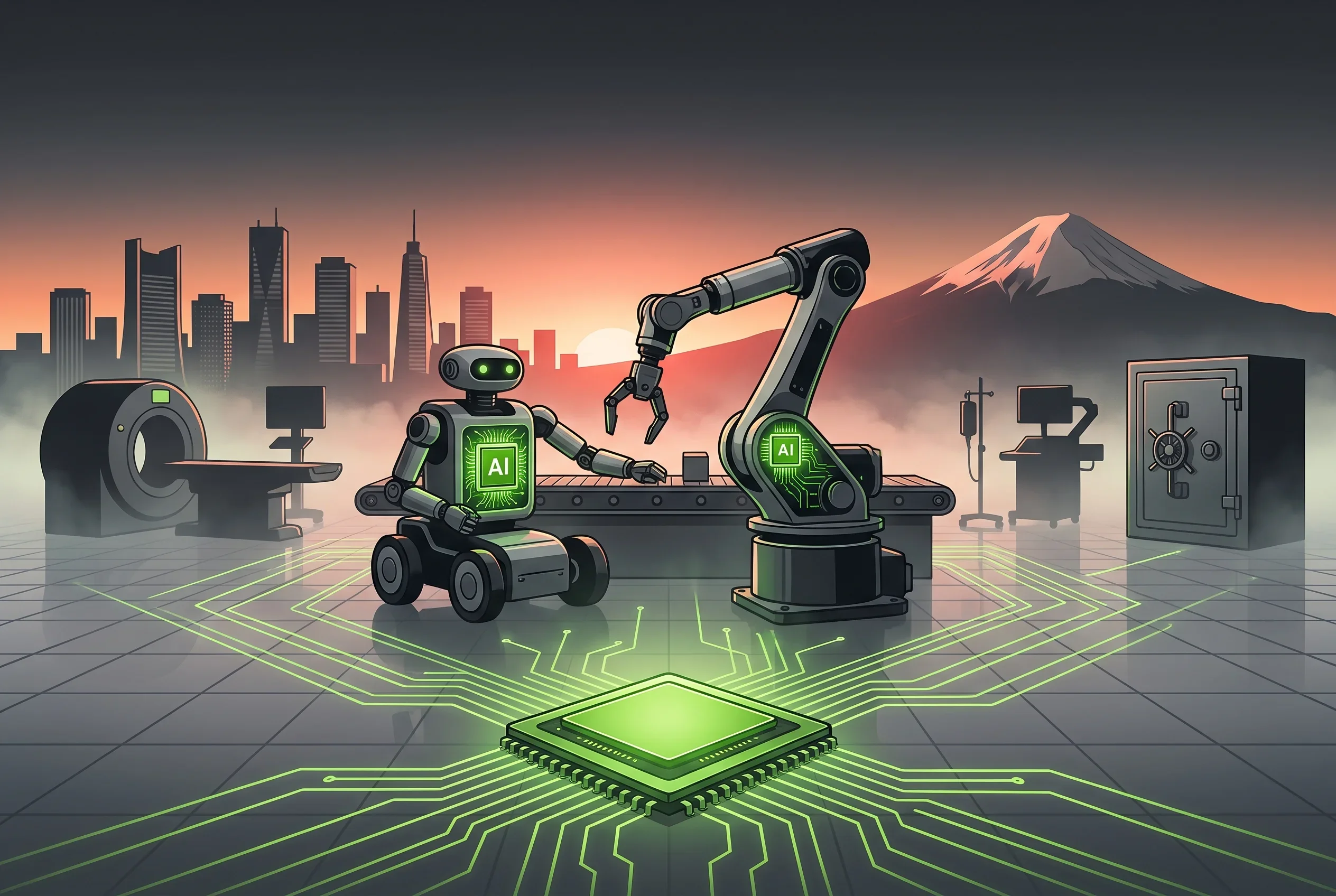
NVIDIA's Japan Physical AI Push: Cosmos 3 Edge and a 22-Company Coalition With Toyota, FANUC and Sony
NVIDIA unveiled Cosmos 3 Edge, a 4B-parameter robotics model, and Japan-wide physical AI partnerships on July 16, 2026: FANUC, Kawasaki, Mizuho, RIKEN, Toyota and more. What the rollout means for AI adoption.
NVIDIA CEO Jensen Huang traveled to Japan and announced a sweeping set of “physical AI” partnerships with Japanese industry on July 16, 2026 (July 15 US time)12. The announcement pairs a new robotics model, Cosmos 3 Edge, with more than 20 named Japanese companies — including FANUC, Fujitsu, Hitachi, Kawasaki Heavy Industries, Sony Group and Toyota. “The next frontier of AI is in the physical world, and this is a once-in-a-generation opportunity for Japan,” Huang said2.
Physical AI refers to AI that perceives and acts in the physical world — robots and autonomous vehicles — rather than chatbots that live on a screen. The Associated Press describes it as robots that make autonomous judgments instead of merely executing programmed instructions, designed to work safely alongside humans in factories, homes and hospitals3.
Cosmos 3 Edge: a 4B-Parameter Model That Runs on the Robot Itself
Cosmos 3 Edge is a 4-billion-parameter model built on NVIDIA Nemotron2. It helps robots and vision AI agents understand their surroundings, reason in real time and generate robot actions2.
What stands out is where it runs: not only on NVIDIA RTX GPUs and DGX systems, but also on Jetson edge devices, including the newly announced T2000 and T3000 modules2. Instead of querying a large cloud model for every decision, the robot can reason locally — which matters in factories and hospitals where latency and connectivity are real constraints. Running compact models on local hardware is the same trend we covered in our guide to hardware for local LLMs.
NVIDIA says developers can adapt the model for specific robots, vehicles, sensors and environments in about a day2. New Metropolis libraries also let developers use coding agents to build, train and operate video intelligence systems with Cosmos at least 6x faster, according to the company2.
Around this model, 22 Japanese organizations declared their intent to join the NVIDIA Cosmos Coalition, which co-develops open physical AI models: AIRoA, classmethod, Enactic, FANUC, Fujitsu, GROOVE X, Hitachi, Honda R&D, Kawasaki Heavy Industries, Kubota, Mitsui & Co., Mitsubishi Corp., Mujin, NEC, Preferred Networks, SoftBank Corp., Sony Group Corporation, Telexistence, TIER IV, TRON K.K., Turing and Yaskawa Electric2. It is an unusual lineup — industrial robot giants (FANUC, Yaskawa), startups (GROOVE X, Telexistence, Turing) and trading houses (Mitsui, Mitsubishi) all in one coalition.
Industry by Industry: Manufacturing, Healthcare, Finance and Research
NVIDIA’s blog lists concrete deployments across sectors1.
In robotics and manufacturing, Kawasaki Heavy Industries plans to deploy its FORRO, Nyokkey and NURABOT robots using NVIDIA Holoscan IGX and Isaac technologies1. Fujitsu, Hitachi, Asilla and AWL are building on the Metropolis video-analytics stack, while Shimizu Corporation is piloting video search and summarization (VSS) for construction-site safety1.
In healthcare and drug discovery, pharmaceutical company Eisai joined the Tokyo-1 drug discovery consortium alongside Astellas, Daiichi Sankyo and Ono Pharmaceuticals1. Canon launched Japan’s first NVIDIA-accelerated photon-counting CT system, and Fujifilm commercialized Japan’s first whole-body CT system powered by NVIDIA Blackwell1.
In finance, Mizuho plans to build the largest on-premises AI factory in Japan’s financial sector using DGX B200 systems1. Japan Research Institute (SMBC Group) and Rakuten Bank are deploying NVIDIA’s Nemotron models1. Banks favor on-premises infrastructure because it keeps customer data off external clouds — the same logic behind JPMorgan’s adoption of SambaNova’s on-prem inference.
In research, RIKEN is building two new supercomputers: RIKYU with 1,600 Blackwell GPUs and ROQUO with 540, the latter integrating quantum computing1. In automotive and entertainment, Toyota is developing Level 2++ autonomous vehicles on NVIDIA DRIVE AGX and using Omniverse/Isaac Sim for factory simulation1, while SEGA is bringing VIRTUA FIGHTER CROSSROADS to NVIDIA RTX Spark1.
The Backstory: From GPU Vendor to National AI Infrastructure
NVIDIA has grown from a gaming GPU maker into the backbone of AI infrastructure, and in recent years it has made “sovereign AI” — AI infrastructure that nations build and operate themselves — a pillar of its growth strategy. The Japan announcement fits that playbook: rather than selling products piecemeal, NVIDIA is importing an entire ecosystem of models, hardware and a corporate coalition.
The Cosmos family itself debuted its latest generation in June 2026 as Cosmos 3, an open frontier foundation model for physical AI; the new pieces here are the edge variant and the Japanese coalition. “Forty years ago was the beginning of the PC revolution. Now, forty years later, instead of a personal computer, you can now have your own personal AI,” Huang said, adding that “Japan has historically been very good at precision manufacturing and very large-scale manufacturing, but now we have AI”1.
Japan has its own reasons to lean in. According to the AP, the Japanese government plans to mobilize over 370 trillion yen (about $2.3 trillion) in combined public and private investment across technology sectors by 2040, including physical AI3. The driving concern is a labor shortage caused by rapid population aging; Huang framed the answer as “with AI and robotics, you can augment the workers you have and increase national productivity”13. It also sets up a contrast with China’s fast-moving robotics startups such as Unitree Robotics: Japan is betting on incumbents plus NVIDIA rather than on new entrants.
Why It Matters: AI Adoption Moves From the Office to the Factory Floor
Until now, most corporate AI adoption has centered on office work — documents, code, customer support. This announcement signals the battleground shifting to physical sites: factories, hospitals, construction sites and stores.
For readers in manufacturing, healthcare, finance or construction, the list of named early adopters in your industry just got much longer. The first phase of the collaboration is reported to begin in late 20263, so concrete deployment results should start appearing next year. Whether your suppliers or competitors are in this coalition is worth checking as an input to your own AI investment plans.
On the demand side of AI chips, projects like RIKEN’s supercomputers and Mizuho’s AI factory add large domestic orders in Japan — corroborating, from the buyer’s side, the AI semiconductor demand that SK Hynix’s record Nasdaq IPO signaled from the supplier’s side. Whether physical AI ramps up on schedule remains to be verified, but the announcement makes one thing concrete: Japan is now a priority market for NVIDIA, with named companies attached.
Sources
- NVIDIA and Japan Bring Full-Stack AI and Robotics to Every Industry - NVIDIA official blog
- Japan’s Robotics and Manufacturing Leaders Build on NVIDIA Cosmos to Advance Physical AI Frontier - NVIDIA official press release (GlobeNewswire)
- Fujitsu and leading Japanese robotics companies to use Nvidia technology in ‘physical AI’ - Associated Press (via KSAT)
Was this article helpful?
Thank you!
Received. Thank you!