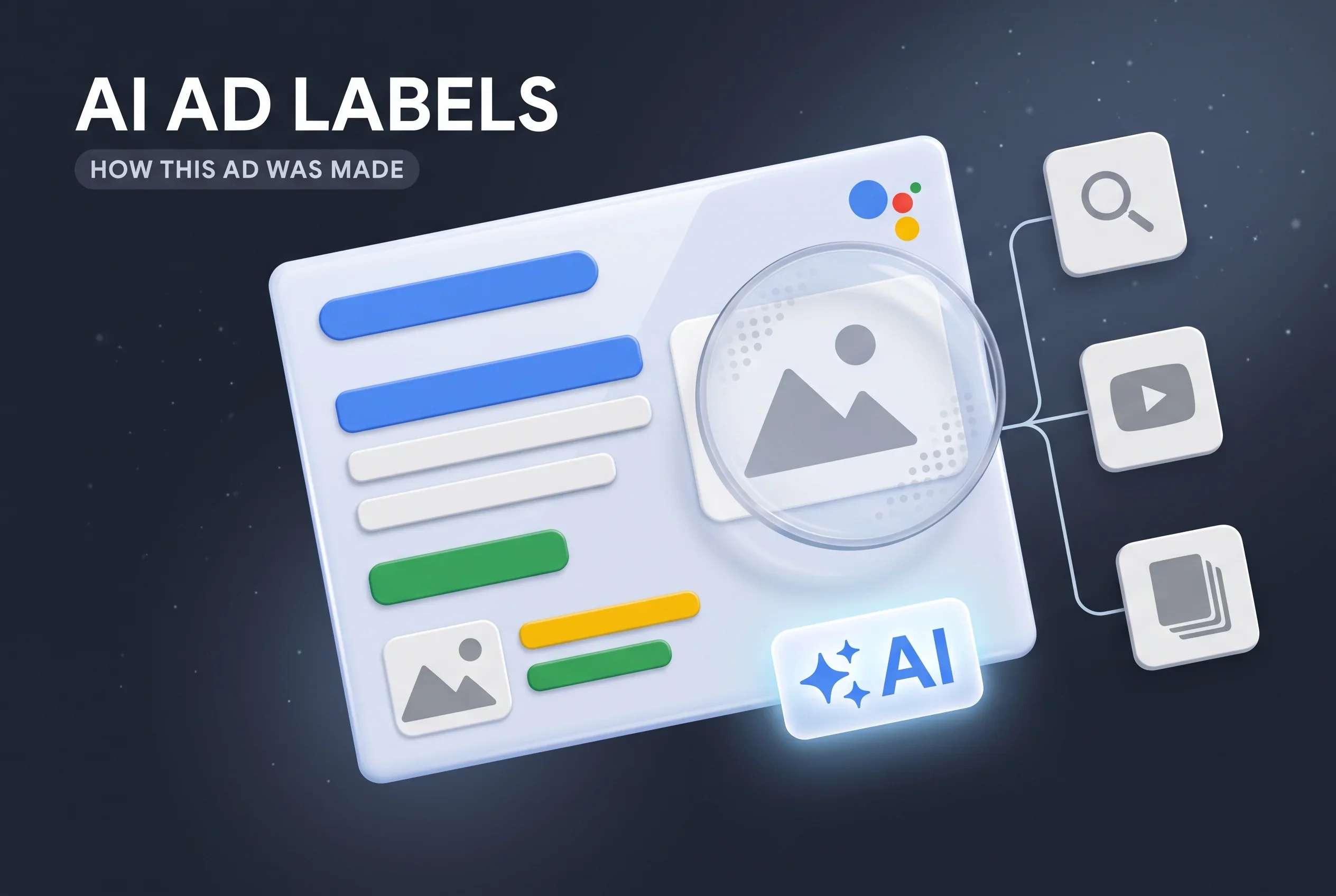
Google Will Now Disclose Which Ads Are Made With AI - 'How This Ad Was Made' Comes to My Ad Center
Google announced on July 9, 2026 that a 'How this ad was made' section in My Ad Center will disclose whether ads on Search, YouTube and Discover were created or edited with generative AI. Ads made with Google's own AI tools get automatic disclosures; ads made elsewhere rely on advertiser self-reporting, and labels may appear directly on ads where local rules require it.
Google announced on July 9, 2026 a transparency feature that lets people check whether an ad was created or edited with generative AI1. A “How this ad was made” section is being added to the My Ad Center panel, accessible globally via the three-dot menu or info icon on ads across Search, YouTube, and Discover1. The announcement came from Keerat Sharma, VP & General Manager of Ads Privacy and Safety1.
As generative AI becomes routine in ad production, this extends platform-level “AI-use visibility” to ads in general - and it creates practical to-dos for businesses that run ads.
How It Works - Automatic for Google’s Tools, Self-Reported for Others
Disclosures attach in one of two ways, depending on how the ad was made. When advertisers use Google’s generative AI advertising tools to create ads, Google automatically adds a disclosure to each ad’s My Ad Center panel1. For ads created with other tools, Google is introducing a control that lets advertisers easily indicate that they used generative AI1.
In addition, based on local legal requirements, a label may appear directly on the ad itself - not just inside the My Ad Center panel - either automatically or when an advertiser uses the reporting control1.
There is a caveat. As TechCrunch points out, Google will not independently verify whether ads made outside its own tools actually used AI; the system relies on advertiser self-disclosure2. Google maintains that misleading and deceptive ads are prohibited by policy regardless of how they were made2, but the disclosure coverage has real limits.
An Extension of SynthID and the Election-Ads Rule
Google frames the feature as building on its existing AI-content transparency work. Outputs from the company’s generative AI tools already carry imperceptible signals such as SynthID1, and in 2023 the company introduced a requirement to disclose synthetic or digitally altered content in election ads1. This release effectively widens that scope from election ads to advertising in general.
“We want to help people better understand the ads they see, while providing advertisers with straightforward tools to navigate evolving industry standards,” Sharma wrote in the announcement1.
What It Means for Advertisers and Marketers
For those running ads, the workload is fairly light. If you build creatives with Google Ads’ generative AI tools (such as automated asset generation), disclosures attach automatically with no extra work. If you upload assets produced with external image or video generation tools, you may need to use the new reporting control1.
The backdrop is a broadening set of rules around labeling AI-generated content. In the EU, a code of practice covering AI content labelling is taking shape, and the design choice of showing labels “directly on the ad based on local requirements” appears intended to accommodate such region-specific rules. With AI-generated ad creative becoming standard practice, building an “disclose that AI made this” step into the production workflow looks set to become a baseline for advertisers.
Sources
- Google introduces new AI labels for Ads - Google official blog (July 9, 2026)
- Google will now disclose which ads are made with AI - TechCrunch (July 9, 2026)
- Google expands AI ad disclosures across Search, YouTube, Discover - Search Engine Land (July 9, 2026)
Was this article helpful?
Thank you!
Received. Thank you!