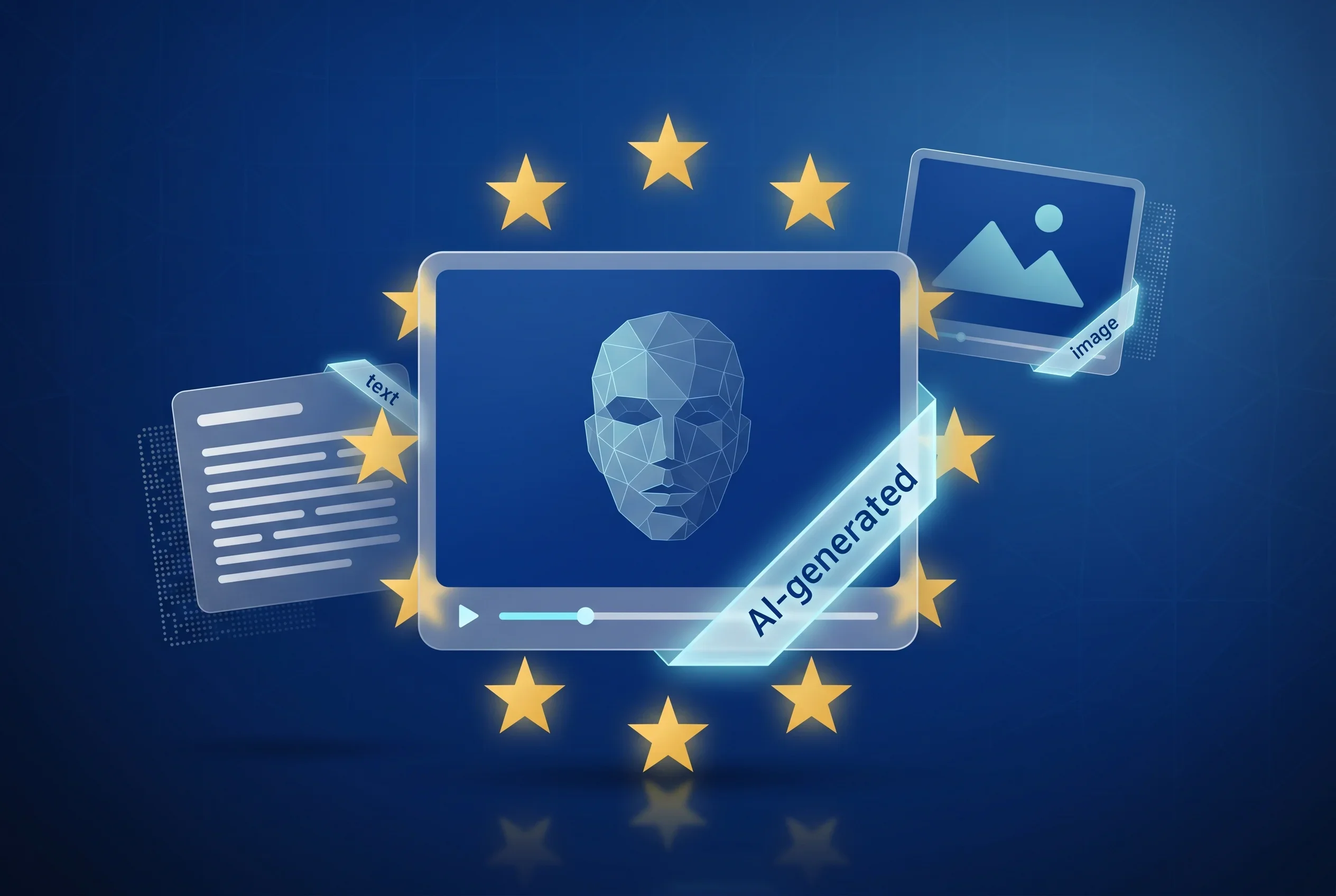
European Commission Publishes Code of Practice on Labelling AI-Generated Content Ahead of August AI Act Obligations
On June 10, 2026, the European Commission published the final Code of Practice on marking and labelling AI-generated content. We explain the voluntary framework supporting the AI Act's Article 50 transparency obligations that apply from August 2, including clear labelling of deepfakes.
On June 10, 2026, the European Commission published the final version of its Code of Practice on marking and labelling of AI-generated content1. The code is a voluntary framework setting out practical steps to help providers and deployers of generative AI systems comply with the EU AI Act’s transparency obligations, which apply from August 2, 20263.
With less than two months until the obligations take effect, the document serves as a concrete preparation guide for companies offering generative AI in the EU, as well as those creating and distributing AI-generated content there.
The Transparency Obligations Under Article 50 of the AI Act
The code addresses the transparency obligations that Article 50 of the AI Act imposes on providers and deployers of generative AI systems, targeting the risks of AI-driven deception and manipulation2.
The obligations differ by role. Providers are required to mark AI-generated content in a machine-readable way and enable its detection, while deployers must disclose deepfakes and AI-generated or manipulated text on matters of public interest2. Specifically, deepfakes must be clearly labelled, and AI-generated or manipulated text published on matters of public interest also requires clear labelling1. Users must additionally be informed when they are interacting with an interactive AI system, such as a chatbot1.
For AI-generated text, an exemption applies where a human exercises editorial responsibility over the content2.
How the Code Is Structured and Why Companies Might Sign
The code of practice consists of two sections. Section 1 is aimed at providers and sets out rules for marking and detection of AI-generated and manipulated content. Section 2 is aimed at deployers and covers rules for labelling deepfakes and AI-generated and manipulated text2.
While the code is voluntary, signatories will collaborate in Signatory Taskforces and, in return, gain predictability, legal certainty, and trust across all EU member states2. The Commission has also published a page explaining how to sign the code, along with “EU icons” that can be used to label AI-generated content1.
Drafted Through More Than Half a Year of Multi-Stakeholder Consultation
The code was drafted by independent experts in a multi-stakeholder process facilitated by the Commission’s AI Office. Participants included providers of generative AI systems, developers of marking and detection techniques, associations of deployers, and civil society organizations2.
The process began with a consultation in September 2025, followed by a kick-off plenary on November 5, 2025, leading to the publication of the final version on June 10, 20262.
What Companies Should Check Now
The August 2 start of the AI Act’s transparency obligations is not just an issue for companies based in the EU. Japanese and other non-EU companies that offer generative AI services to the EU, or distribute AI-created content there, may also be affected. A practical first step is to determine whether your organization qualifies as a “provider” or a “deployer,” and whether the content you handle includes deepfakes or AI-generated text on matters of public interest, then check it against the code’s rules.
The full text of the code (PDF) and signing instructions are available on the European Commission’s policy page2.
Sources
- Commission publishes Code of Practice on marking and labelling AI-generated content - European Commission (official news)
- Code of Practice on marking and labelling of AI-generated content - European Commission (official policy page)
- EU Commission publishes code of practice on labelling AI-generated content - Telecompaper (news report)
Was this article helpful?
Thank you!
Received. Thank you!