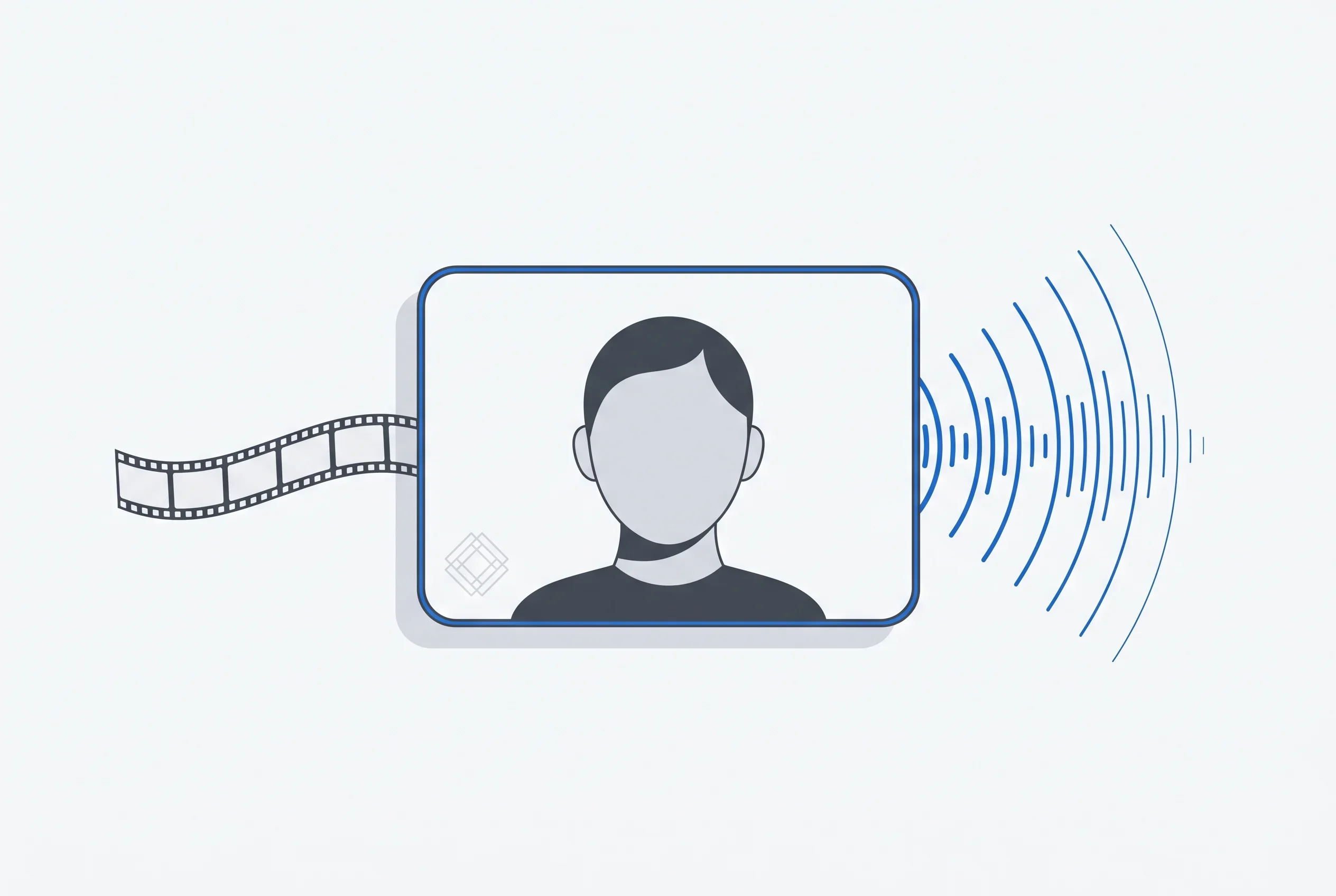
Google Adds Live Avatar, a Video Response Layer, to Gemini 3.8 Live for Gemini Enterprise
On September 24, 2026, Google announced Live Avatar, pairing Gemini 3.8 Live with low-latency video generation. It ships in Gemini Enterprise, and the Google Cloud blog says it is GA on US and EU endpoints. Building a custom avatar requires allowlisting.
On September 24, 2026, Google announced a configuration that joins its voice dialogue model Gemini 3.8 Live with Live Avatar, a layer that answers in video. It ties live dialogue natively to low-latency streaming video, described as an offering aimed at enterprises and the people they serve 1. It ships inside Gemini Enterprise, and the Google Cloud blog states that it has reached general availability on US and EU endpoints, accompanied by provisioned throughput, enterprise compliance and data governance 2.
The announcement carries the names of a researcher and an engineer from the Gemini Audio team, and is framed as following on from the previous week’s release of Gemini 3.8 Live 1. This site covered Gemini 3.8 Live and its reasoning variant, announced on September 15; the automatic switching across 97 languages and the asynchronous mechanism that lets tool calls run in the background while the conversation carries on, both reported then, appear again here as capabilities of the model itself. What is added this time is the video.
The claim: switching languages does not break the lip-sync
For Live Avatar, Google points to lip movement synced exactly to the speech, expressions that read as natural, and turns that pass smoothly between speakers, saying the feature lets enterprises extend their virtual offerings more interactively 1. Change language mid-conversation and the lip movements and expressions are said to follow, holding across 97 languages without the video losing fidelity or drifting out of alignment.
The Google Cloud blog is specific about where this runs — web, mobile and interactive kiosks — and lists as characteristics that an interruption can be recovered from without losing conversational context or backend transactions, and that camera feeds and screen shares can be processed alongside audio at the same time 2.
On the technical side, the Live API runs over a stateful WebSocket connection. Input covers 16kHz PCM audio, images and video at JPEG 1FPS, and text; output is 24kHz PCM audio and text, plus mp4 video in the avatar case. The model ID is gemini-3.8-live, and Live avatar appears in its list of supported features 3.
Custom avatars are allowlisted, and the output carries SynthID
A library of varied preset avatars is provided, and organizations can also have one of their own. Starting from one reference image of sufficient quality, the mechanism produces an animated avatar that responds, keeping the resemblance to that image along with a brand’s styling or a character’s identity intact; per the description of a Google Cloud demo, the steps involve system instructions plus a single reference photo and an audio sample 2.
Creating a custom avatar, however, is limited for now to organizations that have cleared enterprise allowlisting 1. The Google Cloud blog explains this as a measure to guard identity and prevent misuse, placing the capability behind a strict allowlisting and verification process. Provisioned throughput and custom avatar approval are activated by contacting a Google Cloud sales representative 2.
The audio and video that come out both carry an imperceptible SynthID watermark, described as a way to keep AI-generated content detectable and to reduce misinformation and misattribution 1. In August, when Google announced a setting that turns off Gemini’s visible watermark, it likewise said the invisible SynthID stays embedded. For a feature that generates footage resembling a human face, the fact that the watermark is a given rather than an option is what matters once the output gets reused elsewhere.
For now, the way in runs through Gemini Enterprise
What this announcement establishes is that Live Avatar runs in Gemini Enterprise and that there are US and EU endpoints. None of the three documents puts a price on it. Nor is there a count of how many preset avatars exist. This is not something an individual developer picks up and tries the same afternoon; getting it involves going through sales.
The Google Cloud blog says Gemini 3.8 Live Extended Thinking remains in private preview 2. The Gemini API release notes that this site reported on September 16 had both models reaching GA on the same date, so the stated availability differs depending on the platform. Anyone designing around Extended Thinking would want to settle which route they intend to use first.
As examples of adoption, the Google Cloud blog carries comments from several companies. Akhilesh Damaraju, CEO of Equal AI, says the company’s AI handles more than a million live calls a day across nine Indian languages, and credits Gemini 3.8 Live with gains in how interruptions are handled, in conversations that span languages, and in how reliably tool calls land 2. These are each company’s own assessment, not third-party measurement.
With video generation accumulating alongside agentic video understanding and the rollout of the Gemini 3.8 Flash line, the option of putting a face on a voice agent has now opened up on the enterprise side. For anyone building a front desk that talks while watching a camera feed, the first fork in the road is whether their organization sits inside Gemini Enterprise.
Sources
- Introducing Gemini 3.8 Live with Live Avatar - Google official blog (September 24, 2026)
- Power your agents: Gemini 3.8 Live with Live Avatar is now generally available - Google Cloud official blog
- Live API overview - Gemini Enterprise Agent Platform official documentation (accessed September 25, 2026)
Was this article helpful?
Thank you!
Received. Thank you!