Apple's Reference Image Signs a Photo at the Sensor - SynthID Support Due Later This Year
The iPhone 18 Pro, announced by Apple on September 9, 2026, turns signed sensor data into a reference image through Private Cloud Compute. It is opt-in, unavailable in China at launch, and capture is not offered in the EU at launch. SynthID support is due in a software update later this year.
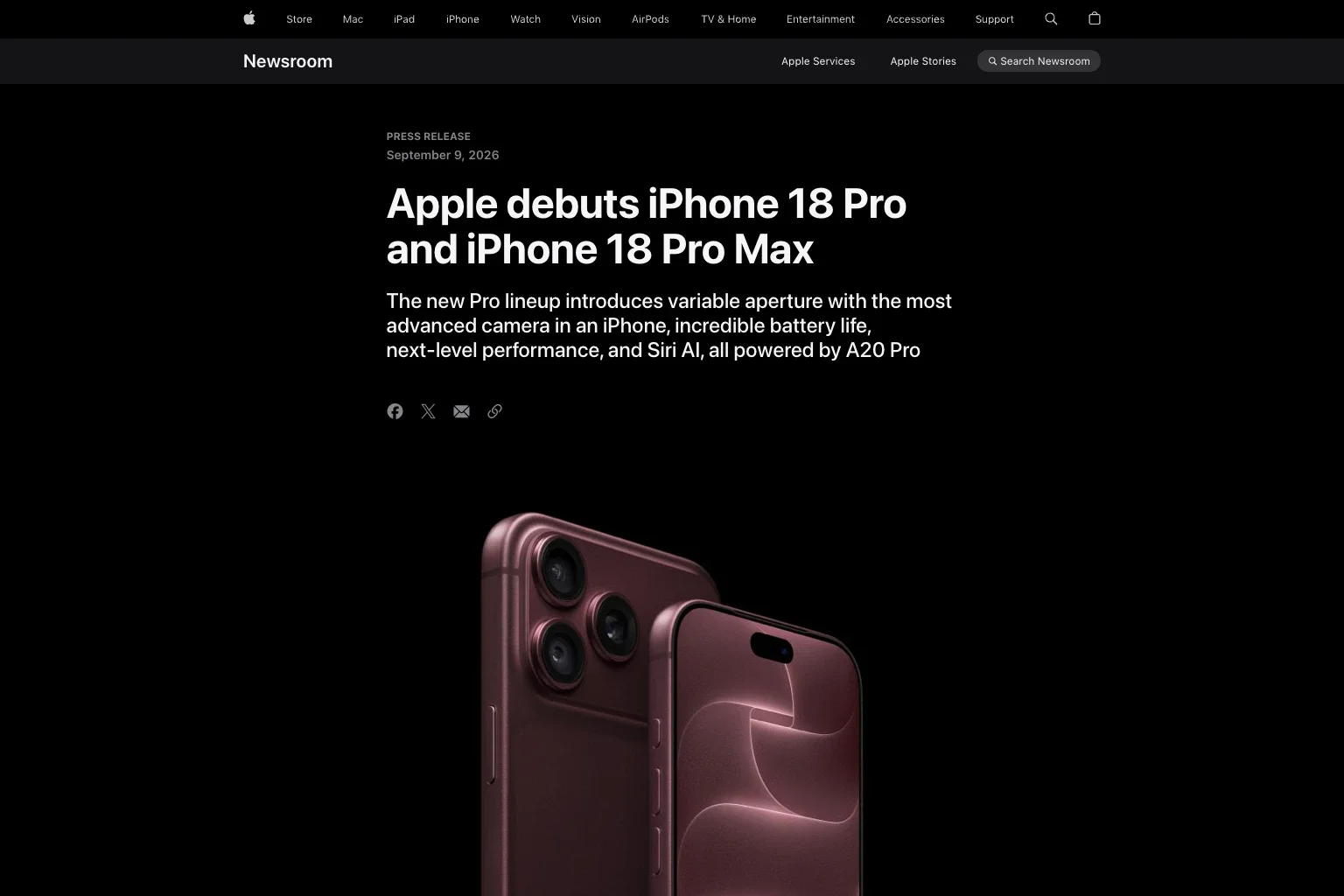
Apple announced the iPhone 18 Pro and iPhone 18 Pro Max on September 9, 2026. Among the camera features, the one that bears directly on the spread of generative imagery is Apple Reference Image. According to the company, a new sensor in the Main camera can “sign every pixel it sees,” and Private Cloud Compute turns that signed sensor data into a reference image the company describes as unalterable1.
The reference image can be opened in the Photos app next to the original, and Apple compares the pairing to a digital negative: put the two side by side and it becomes visible whether edits were made. APIs in iOS 27, iPadOS 27 and macOS 27 let third-party apps display these reference images as well1. Apple frames the whole set as a many-sided approach to image authenticity, and calls it important for photojournalists, photographers and everyday viewers.
Three qualifications worth checking before relying on it
The footnotes to the press release carry the conditions that decide whether this is usable in practice.
First, Apple Reference Image is opt-in1. Buying the phone does not attach a reference image to every photo taken on it; the shot has to be made in the dedicated Reference mode.
Second, availability differs by region. In China the feature is not offered at launch, which Apple attributes to regulatory requirements. In the EU, capture is not available at launch on iPhone 18 Pro models, and what remains for users of iOS 27, iPadOS 27 and macOS 27 is the ability to develop and view reference images1. For work where the place of shooting and the place of publication sit in different jurisdictions, that gap shows up in day-to-day operations.
Third, the part that touches AI-generated material is not present at launch. Apple says image metadata, plus forthcoming support for what it calls the SynthID standard, will help identify images made or altered with AI. A footnote places that support in a software update later this year, applying to most edited images depending on which edits were made1.
Marking the output, versus keeping a signed original of the capture
This site has followed provenance work as a running thread. In August, Google announced that the visible watermark in Gemini could be switched off, while stating that the invisible SynthID mark and C2PA metadata stay in place. The same week brought an open-source C++ library for verifying C2PA Content Credentials. Anthropic set out a policy of watermarking Claude’s generated text in line with the EU AI Act’s transparency obligations.
All of those work in one direction: whoever generates the content marks its own output. An image carrying no such mark is not thereby shown to be genuine, so that direction alone fills in only one side of the question. Apple Reference Image covers the other side, keeping a signed original of the moment of capture on the device so that later versions can be compared against it.
The press release does not mention C2PA. Nothing states how the reference image relates to C2PA Content Credentials, so whether existing C2PA tooling can handle it is not something that can be answered now. On SynthID, Apple writes of “the SynthID standard,” while Google DeepMind presents SynthID as its own tool3. What that difference in wording implies for licensing or implementation has not been published.
Settled at launch, and not
TechCrunch reports that Apple introduced the feature at its Surprise and Shine event on September 9, and that reference images will at first be viewable only inside the Photos app, with APIs offered to developers2.
Pricing starts at $1,199 for iPhone 18 Pro and $1,299 for iPhone 18 Pro Max in the U.S. Pre-orders open at 5 a.m. Pacific on September 12, with the phones going on sale September 181.
Seen from a workplace where the authenticity of source material is a requirement rather than a preference, what is settled is that a route now exists for producing a signed original on the device at the moment of capture. How the AI-detection half arrives with SynthID, and how any of it meshes with the existing provenance stack including C2PA, both remain to be confirmed.
Sources
- Apple debuts iPhone 18 Pro and iPhone 18 Pro Max - Apple Newsroom (September 9, 2026)
- Apple has a new way prove your iPhone photos aren’t AI slop - TechCrunch, Tim De Chant (September 9, 2026)
- SynthID - Google DeepMind (accessed September 10, 2026)
Was this article helpful?
Thank you!
Received. Thank you!