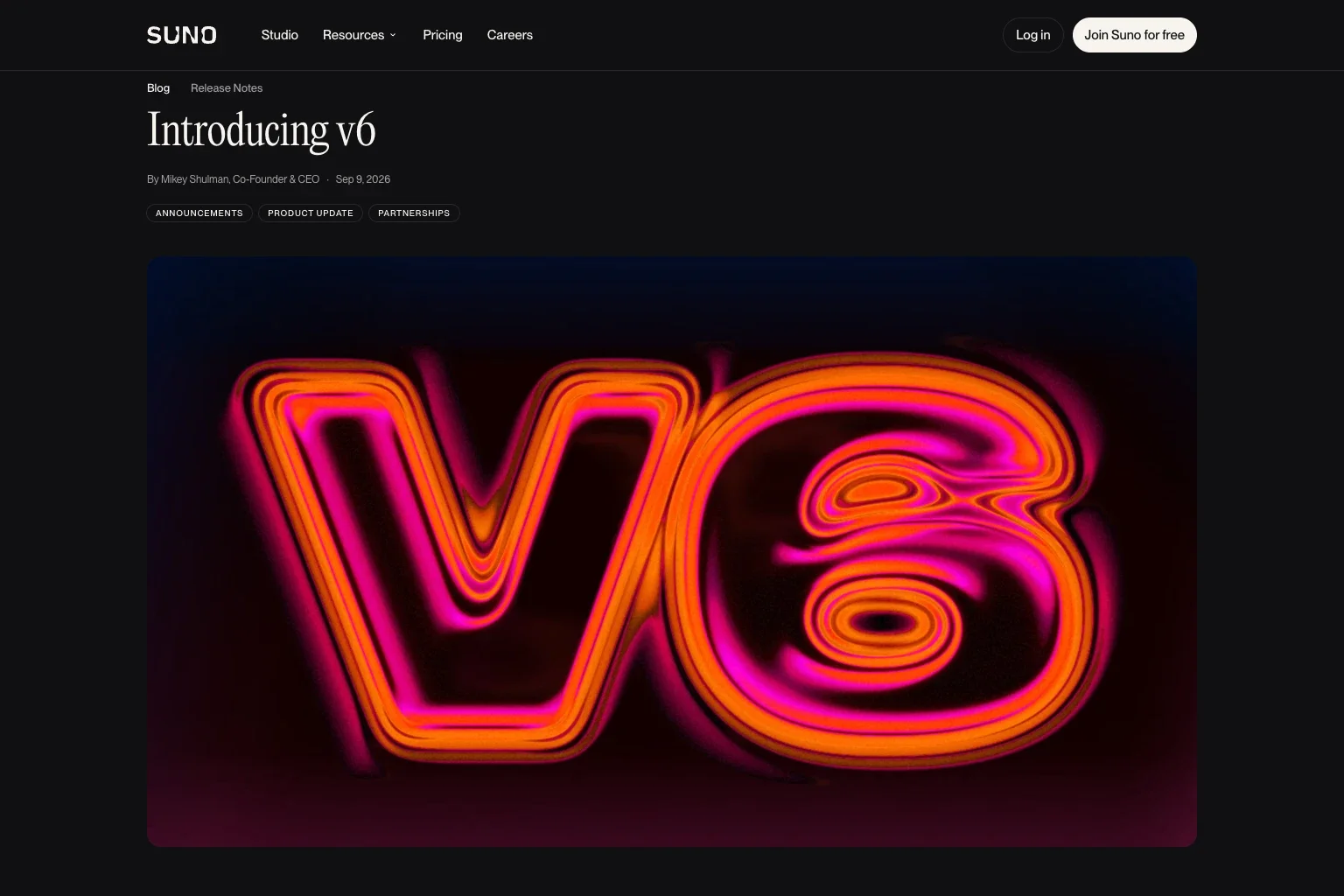
Suno Releases Its v6 Music Models, Built With Industry Partners, and Will Phase Out the Older Ones
On September 9, 2026, Suno released its v6 generation of music models, saying they were developed with Warner Music Group, BMG and Believe. Earlier models will be withdrawn as v6 rolls out, and the watermarking and download limits described as planned in August are now in place.
Suno, the AI music generation company, released a new generation of music models called v6 on September 9, 2026. In a post signed by co-founder and CEO Mikey Shulman, the company said the models were built together with industry partners, naming Warner Music Group, BMG and Believe1. Suno calls the result its best work to date and claims gains in speed, expressiveness and quality, though no third-party measurement accompanies those claims.
For anyone already using the service, the more consequential part is not the performance framing but the migration. The same post states that the earlier models will be retired as v6 rolls out, with the whole service moving to the new generation1. If a production workflow depends on the sound of one particular model, that assumption is being replaced.
Three models, and more ways to steer them
The lineup has three members. The flagship v6, for Pro and Premier subscribers, is aimed at producing a result the user already has in mind. Also limited to Pro and Premier, v6-wild returns less predictable and more varied output and is framed as a source of ideas rather than of finished tracks. The third, v6-mini, is described as a faster version open to everyone1.
On the editing side, the company lists replacing one part of an existing track through an instruction written in ordinary language, assembling a mashup out of elements taken from several songs, and sampling a specific moment, isolating an instrument and building a beat from it — each expressible in a single request. Inputs are not limited to text: audio, images and video can serve as the starting point. Changing a single word in the lyrics while leaving the rest untouched is listed as well1.
All of this comes from Suno’s own description, and there is no published benchmark against which to check the accuracy. Still, whether a section can be corrected without regenerating the whole track is what determines how much rework a generative tool adds to a production pipeline.
What was described as planned in August is now described as shipped
This site covered Suno’s transparency tooling on August 7. At that point the only item already underway was a tool for identifying Suno-made tracks on other services; audio watermarking, fingerprinting and a download policy meant to curb bulk distribution were all still described as upcoming.
In the September 8 post, one day before v6, the company writes about those items as things it has recently put in place. Two are named: watermarking and fingerprinting of the audio, so that a Suno track can be recognised once it leaves the service and so that fraud and abuse can be acted on; and a ceiling on downloads, aimed at stopping large volumes from being pushed onto streaming services2. Where that ceiling sits, and how it differs by plan, is not stated.
So a set of measures announced a month earlier moved to the implementation side at the same moment as the model generation changed. Anyone generating in volume and pushing the results outward will want to check what the limit is on their own plan.
A distribution route that had been closed is now open
The September 8 post announced a partnership, global in scope, with Believe and with TuneCore, the platform Believe runs for artists who put out their own releases. A track made with the new industry-partner model qualifies for distribution through either of them2.
As the company itself notes, earlier in the year both had said they would refuse to carry music produced by models that fell short of their standards, and Suno’s models of that period were covered by the refusal2. Reading the announcement in that order — the party that refused now becoming the outlet — makes its nature easier to see.
Rights holders are not moving in one direction on this. Stability AI’s Series B in August brought in Sony Music Group, Universal Music Group and Warner Music Group as new investors. At the same time, music publishers have sued Anthropic, so investment and litigation are running in parallel.
The lawsuits continue and the payout terms are not public
On training data, the official post says only that the models were developed with industry partners; it does not say they were trained on licensed music alone. The statement that the data behind earlier versions was not used for v6 comes from the company by way of TechCrunch3.
The litigation is not over either. That outlet’s September 9 report says Suno settled with Warner Music Group the previous year and reached an agreement with BMG the month before, while claims from Sony and Universal Music Group, from the artist Jason Isbell, and from users remain outstanding3. Chief product officer Jack Brody told the outlet that creating additional revenue for rights holders and artists is a large part of what this release is for. No rate, no scope and no payment timing has been disclosed.
As the next step, Suno points to products organised around a single artist who chooses whether to take part, and who is paid if they do. When v4.5 arrived in May 2025, the update was centred on model-side capability such as track length and genre blending. This time what stands in front is the relationship with rights holders and the question of where a finished track can go. For a team using the service at work, the only item that can be put on a schedule today is the removal of the older models.
Sources
- Introducing v6 - Suno official blog, Mikey Shulman (September 9, 2026)
- A New Partnership with Believe and TuneCore - Suno official blog, Mikey Shulman (September 8, 2026)
- Suno replaces its AI models with a new one trained on licensed music as copyright suits pile up - TechCrunch, Ivan Mehta (September 9, 2026)
Was this article helpful?
Thank you!
Received. Thank you!