Music Publishers Sue Anthropic and Two Co-Founders Over Lyrics
Music publishers including Sony Music Publishing (US) LLC and Warner Chappell Music, Inc. filed a complaint on August 28, 2026 against Anthropic PBC, Dario Amodei and Benjamin Mann in the Northern District of California. Alongside damages, they ask for an accounting of training data and destruction of infringing copies.
Music publishers including Sony Music Publishing (US) LLC and Warner Chappell Music, Inc. filed a complaint on August 28, 2026 against Anthropic PBC and the company’s co-founders Dario Amodei and Benjamin Mann, in the United States District Court for the Northern District of California1. The complaint demands a jury trial1. Alongside those two, the caption lists a large number of additional music publishers1.
Everything below is the plaintiffs’ allegation, not a finding by the court. The filing is only days old, and we have not been able to confirm any response from Anthropic. TechCrunch writes that the company could not be reached for comment prior to publication2.
The four counts
The complaint divides its claims into four counts1.
The first treats the acquisition of books over BitTorrent as direct infringement in itself, and is brought against all three defendants1. The plaintiffs allege that in June 2021 Mann, at Amodei’s direction, torrented at least five million copies from LibGen, and that in July 2022 at least another two million copies were torrented from PiLiMi, and that these books contained the lyrics and sheet music to compositions they own1. Because BitTorrent uploads as it downloads, the plaintiffs argue, the distribution right was violated alongside the reproduction right1.
The second count holds Amodei and Mann liable for contributory infringement over that same conduct1. In the prayer for relief, the plaintiffs ask the court to find that the two infringed both directly and contributorily1.
The third count is direct infringement against Anthropic, listing scraping from authorized lyric-display sites such as MusixMatch and LyricFind, downloading from third-party datasets (the complaint names Common Crawl, The Pile and Books3), “destructively scanning” second-hand books, training, verbatim reproduction in outputs, and generating derivatives “in the style of” the songwriters they represent1.
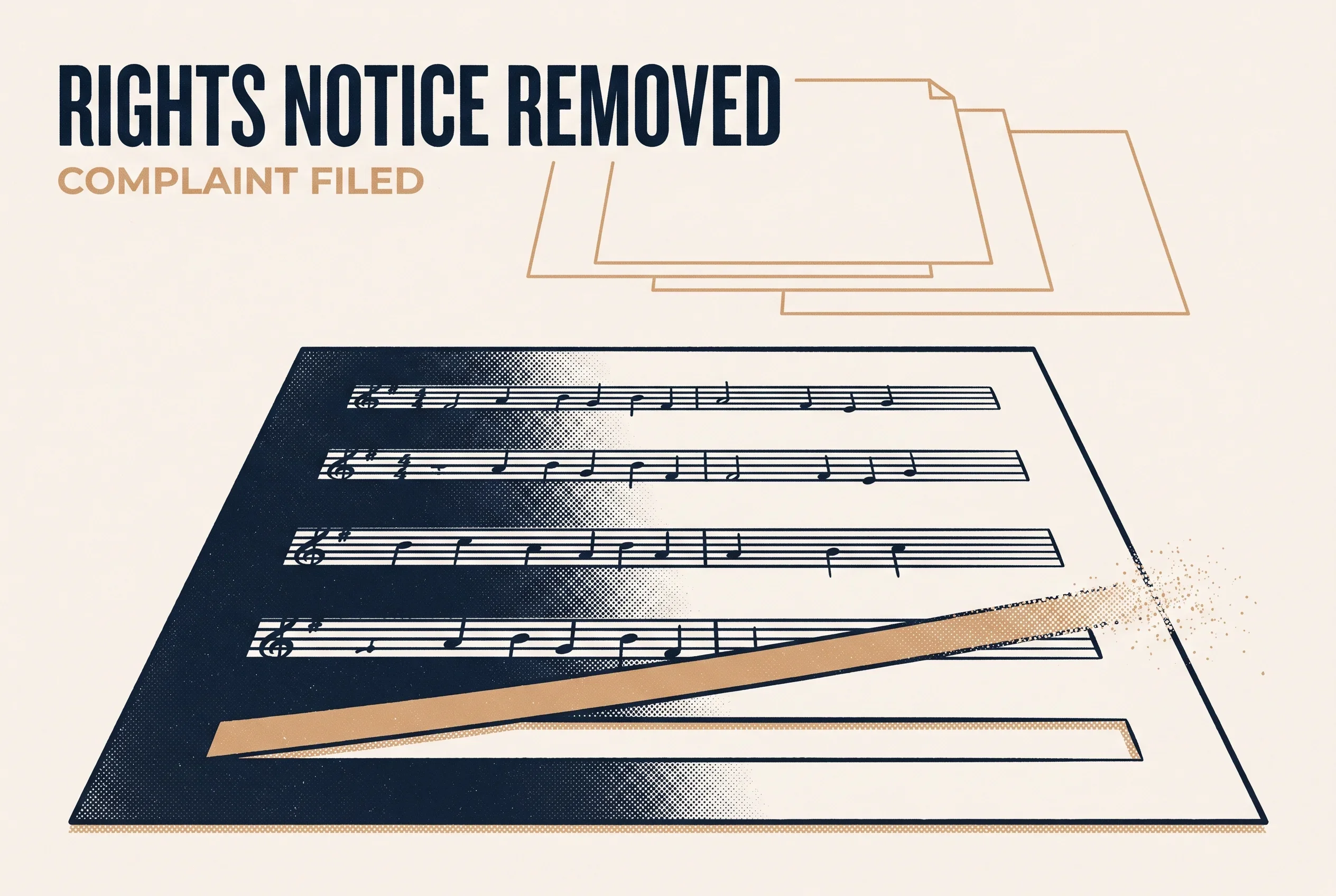
The fourth count concerns removal of copyright management information (CMI)1.
What the “cleaning” step removes
On the fourth count, the complaint argues that when Anthropic “cleans” its training text of unwanted material, what gets removed is not the lyrics but the rights information attached to them1. The framing is that lyrics are kept because the expressive content is valuable, while CMI is stripped because it has no value to Anthropic and constitutes direct evidence of infringement1.
The example the complaint gives is the choice of a text-extraction tool. The plaintiffs say that in June 2021 Mann and Jared Kaplan decided against jusText because it left behind too much “useless junk,” including the copyright notices in webpage footers1. This is not new to this filing: the complaint cites documents from the earlier Concord litigation (case number 5:24-cv-03811-EKL) as its source1.
Discussion of AI and copyright often centres on whether generated output can be copyrighted. What this complaint targets sits earlier in the chain: how the training corpus was assembled. The plaintiffs build the CMI removal into a separate fourth count under 17 U.S.C. § 1202(b)(1) and (b)(3), apart from the infringement claims1.
The relief sought is not only money
For relief, the complaint asks for statutory damages of up to $150,000 per work infringed for copyright infringement, up to $25,000 per violation for CMI, a permanent injunction, and attorneys’ fees1. No total figure appears in the prayer for relief.
Two of the requests matter as much as the money. One is an accounting of the training data, training methods and known capabilities of Anthropic’s models, requiring the company to identify which works it trained on and disclose how it collected, copied, processed and encoded that data1. The other is destruction of infringing copies under the court’s supervision, followed by a sworn report on how that was carried out1.
The complaint also draws on earlier cases, quoting a court in the same district describing Anthropic’s conduct as “straightforward piracy but at massive scale,” and noting that the company settled that class action for $1.5 billion1. The plaintiffs’ position is that this sum is not enough to deter the conduct1. The complaint cites two Concord case numbers, 5:24-cv-03811-EKL and 5:26-cv-00880-EKL1; this action is separate from both.
Rightsholders are not moving in one direction
The plaintiffs state in the complaint that they are not opposed to AI as such, and that they have entered licences permitting authorized use of their compositions in connection with AI1.
Other recent moves show the same mixed picture. The Stability AI Series B announced on August 25 listed Sony Music Group and Warner Music Group among its new investors. And as with Suno starting work on tools to identify AI-generated tracks, some companies on the other side are building out the rights plumbing. Licensing with one counterparty while suing another looks closer to how this actually works.
For Anthropic, the timing is notable: a federal court vacated the Department of Defense’s supply-chain risk designation on August 27. In the same week, the company was on the side that got to hold its usage policy against a government customer, and on the side being asked how it acquired its data.
If you use Claude, nothing stops immediately because of this filing. But two of the requested remedies — the accounting of training data and destruction of infringing copies — are the kind that, if granted, could reach into how a product is rebuilt. How training data was acquired is worth carrying as one axis when you evaluate models internally.
Sources
- Complaint and Demand for Jury Trial, Sony Music Publishing (US) LLC v. Anthropic PBC, No. 5:26-cv-09217 (N.D. Cal. Aug. 28, 2026) - The complaint as filed, via CourtListener/RECAP
- Sony Music, Warner sue Anthropic, alleging a “brazen campaign” of intellectual property theft - TechCrunch (August 29, 2026)
Was this article helpful?
Thank you!
Received. Thank you!