Anthropic Opens 10,000 Claude Seats to Scientists, Standard Seats Free for a Year
On August 27, 2026, Anthropic announced an expansion of its support for scientists. A new Claude team plan for scientists opens 10,000 seats with standard seats free for a year and premium seats at $15 per month, while AI for Science widens beyond biology with up to $50,000 in credits per project.
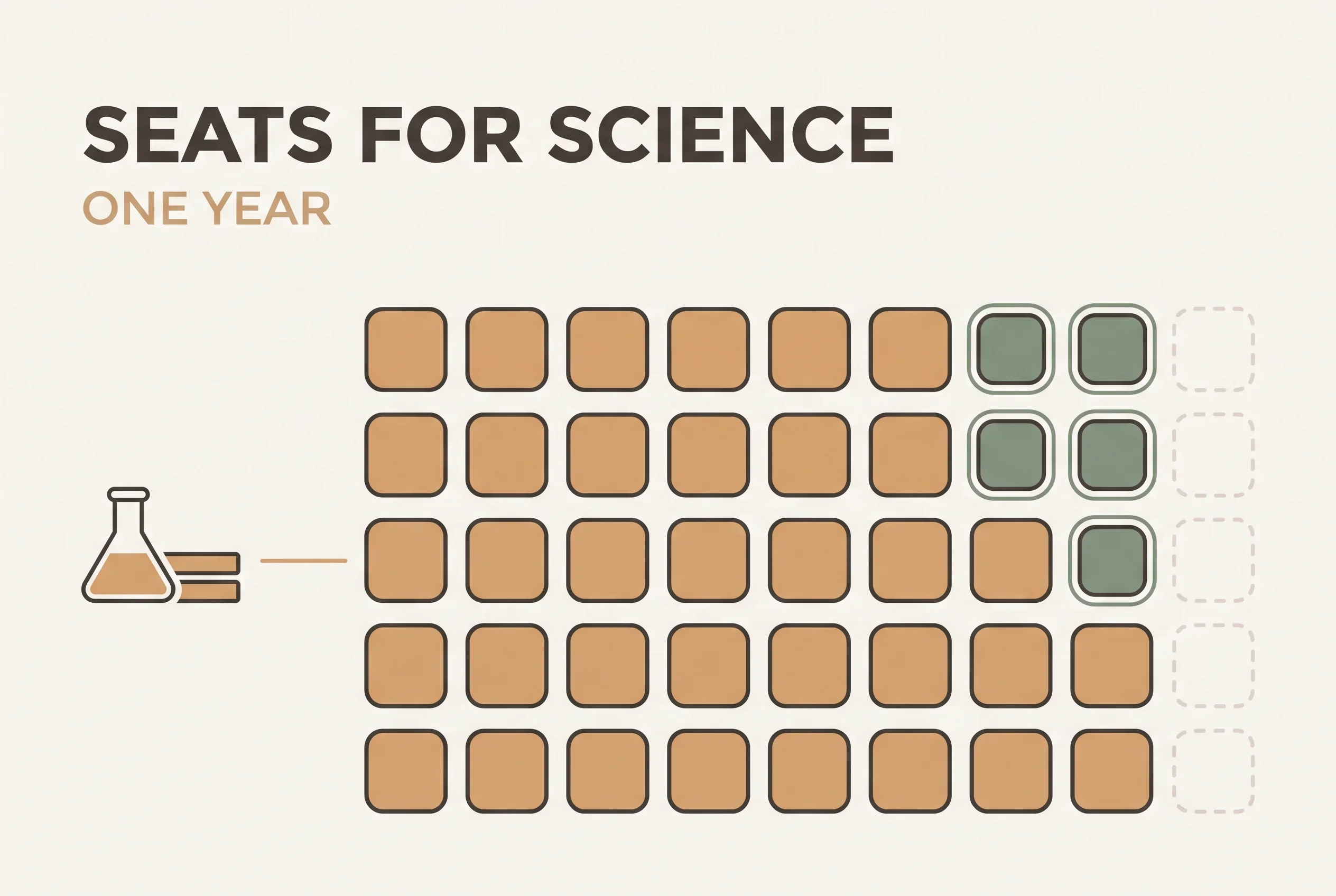
On August 27, 2026, Anthropic announced that it is widening what it offers to scientific researchers1. A new “Claude team plan for scientists” opens 10,000 seats to researchers around the world, with standard seats free for one year and premium seats carrying 5x usage limits at $15 per month1. Alongside that, the AI for Science program — until now focused largely on the biological sciences — is being extended to other fields, with up to $50,000 in credits per project1.
The same day, Anthropic also published a research preview of the Model Hardware Standard, a shared specification for AI agents to operate laboratory instruments. A move to standardize the interface on the equipment side and a move to hand out model access on the researcher side landed together.
Seats, Price, and Term
The announcement describes the plan as opening 10,000 seats “for scientists around the world to access Claude subscriptions for free and at discounted rates for one year”1. Standard seats are free; premium seats, which carry 5x usage limits, cost $15 per month1. Anthropic says it intends “to extend this program well beyond the initial 10,000 seats” over the coming months — a statement of intent, with no scale or timing given1.
There is a condition on who can register. Eligibility requires being “a principal investigator or equivalent at an academic or nonprofit research institution,” and once verified, that person can add the researchers in their lab to the plan1. It is distributed by lab, not by individual sign-up.
If a lab uses up its allotment and needs more than the standard or premium plans provide, it can apply to the AI for Science program for up to $50,000 in credits per project1. That path is open more broadly: “Any researcher is eligible to apply”1.
The announcement is also specific about the widening of scope. Anthropic says it has so far largely supported scientists using Claude for the biological sciences, and is now looking to offer credits to researchers in other scientific fields, including those doing ambitious, compute-heavy research “of the kind that resulted in progress on the Riemann zeta function and Claude’s work on protein design”1. Those are cited as examples of the kind of work the program can support; the announcement does not describe the results themselves or the extent of Claude’s contribution.
Constraints Remain in Biology and Chemistry
While broadening distribution, Anthropic keeps limits on the higher-risk areas. The announcement states that “for now, researchers working in biology and chemistry will still be limited to our Opus-class models,” and that Claude Fable models “will continue to block professional biology and drug development queries because of their potential dual-use risks”1.
That line is easier to read alongside what came just before it. On August 7, Anthropic retuned Fable 5’s biology safeguards, reducing fallbacks on everyday health and education questions such as interpreting test results while continuing to route virology, toxicology, and molecular design to Opus 5. This announcement carries that same boundary straight into the terms of the researcher program.
For the higher Mythos class, Anthropic says it is working in partnership with the US government to establish an access program for life sciences professionals to use those models for research and development1. It has “now enrolled our first participants,” with more to share and wider access expected later — not general availability1.
The “Verified Audience, Free for a Year” Pattern
The design follows a distribution pattern Anthropic has used before. In July 2026 the company announced Claude for Teachers, giving verified U.S. K-12 teachers free premium features for one year. Gating on verification and capping the term at a year are the same here. What differs is that a principal investigator distributes seats across a lab rather than each person signing up individually, that a $15-per-month premium seat sits above the free standard seat, and that a second channel — credits — sits behind the subscription.
The announcement also refers back to Claude Science, launched in June, described as a product that integrates the tools researchers most commonly use, produces auditable artifacts, and provides flexible access to computing resources1. Anthropic frames this expansion as an effort to help scientists access and increase their usage of Claude through subscriptions, credits, and products like Claude Science, with the aim of “radically accelerat[ing] scientific discovery”1. That framing of the goal is the company’s own.
For anyone weighing budget or policy for AI use at a research institution, the points to check are concrete. The free term is one year. Standard and premium seats differ by a factor of five in usage limits. Anything beyond that becomes a per-project credit application. And in biology and chemistry, the usable models are limited to the Opus class. All four are stated in the announcement, and any evaluation starts by confirming them.
Sources
- Expanding our support for scientists - Anthropic official announcement (August 27, 2026)
Was this article helpful?
Thank you!
Received. Thank you!