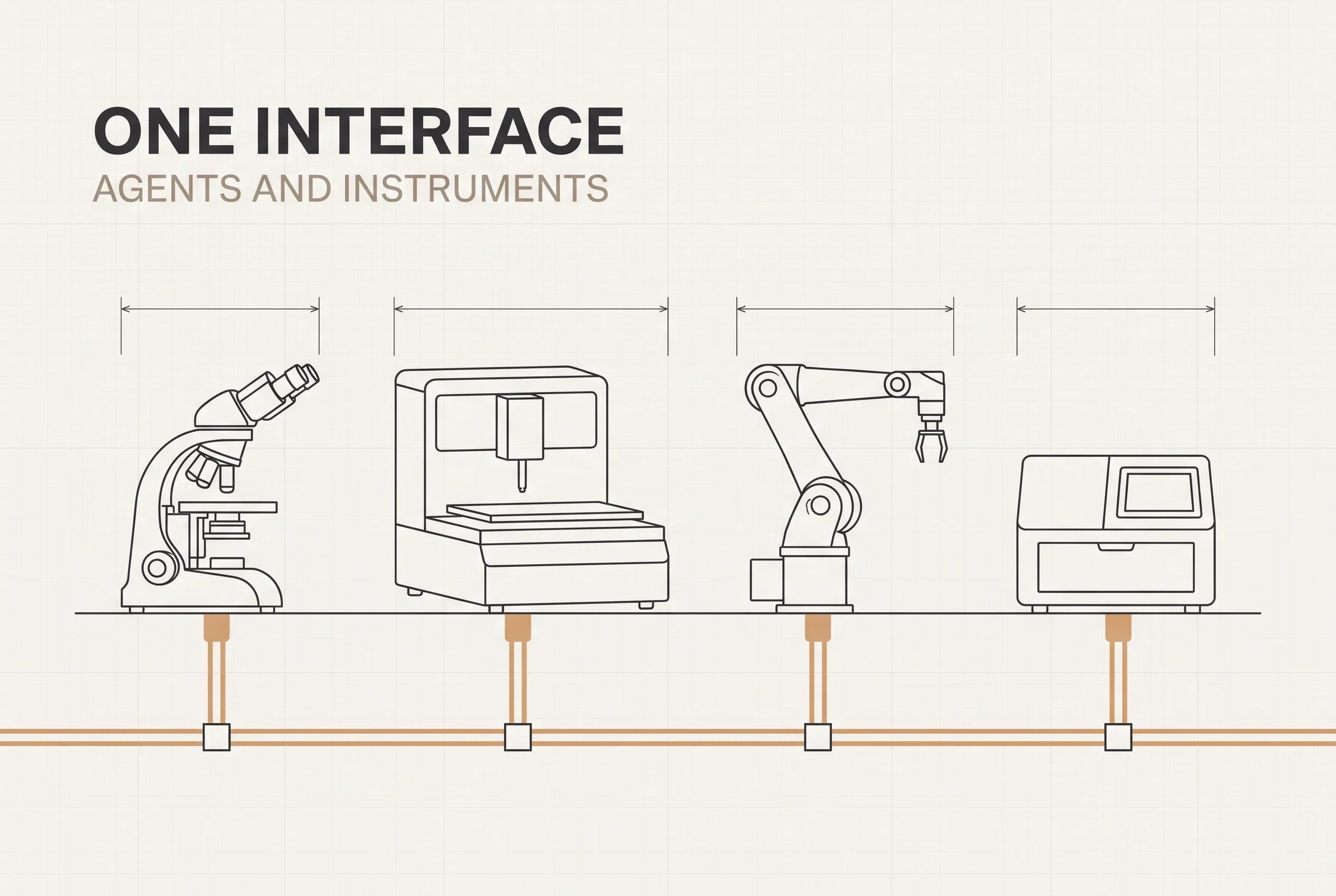
Anthropic Previews Model Hardware Standard: One Interface for AI Agents to Run Lab Instruments
Anthropic opened a research preview of MHS, a shared spec letting agents drive microscopes, liquid handlers and robotic arms. Field reports from six organizations, including Genentech and QuEra, cover the failures too.
AI agents have so far stayed on the software and data side of the world. The Model Hardware Standard (MHS) that Anthropic published on August 27, 2026 is a shared specification for adding physical devices to that scope — microscopes, liquid handlers, robotic arms 1. The company opened it as a research preview to a first group of scientific research labs and advanced manufacturers 1.
Anthropic describes MHS as a spec that lets agents operate multiple lab and manufacturing instruments in parallel, handling work that ranges from routine drug discovery experiments to laser calibration on a quantum computer 1. Development began as a collaboration between Anthropic and HHMI Janelia Research Campus 1.
Replacing Bespoke Integrations With a Standard Driver
The starting problem Anthropic names is that instruments do not talk to each other. Each device tends to have its own programming interface, with no standardized way to integrate them. Even once connected, there is no common way for them to share data with an agent, nor to let the agent operate them safely 1. Setting up and integrating hardware at a lab or manufacturing facility typically takes weeks or months, the company says, and MHS reduces that work to hours or minutes 1.
At the center sits a standardized driver — software that translates between a computer’s operating system and a hardware device, built on a simple set of primitives such as “read” (get temperature) and “write” (set temperature) 1. It also makes each device discoverable in a standard format, so devices and agents can find each other without a bespoke translator program in between 1.
The more interesting piece is how it handles what code cannot express. The weight of a robot arm matters for manipulating it safely, yet that kind of detail has lived in paper manuals, on someone’s computer, or as tacit knowledge 1. The MHS driver carries tags that let a user write this information directly in natural language — either by hand, or by chatting with an agent that interviews them about their hardware setup 1. From those tags, the driver automatically produces a reference file describing what the device can measure, what can be adjusted, and what safety limits will be enforced 1.
Agents reach the hardware through three mechanisms: MCP, the command line interface, and code files (APIs) 1. MCP spread as a common port between AI and software or data; MHS extends that idea to physical equipment. It works with any device that has a programmable interface, is model-agnostic, and can be reached by any agent harness over standard protocols 1.
The Field Reports Include What Did Not Work
The announcement page carries reports from six organizations that used MHS — Genentech, the University of Washington’s Baker and Pinglay labs, Carnegie Mellon University, HHMI Janelia Research Campus, QuEra Computing and Tetsuwan Scientific. Each is written by that organization, not measured by Anthropic 1.
Genentech implemented the automation of the BCA protein assay — a standard procedure for measuring total protein concentration in a sample — as a proof of concept 1. The work requires coordinating a liquid handler, a robotic arm, and a plate reader 1. Setting up such automated systems is currently a manual, time-consuming process that can take weeks or even months, the company says 1.
The results were mixed. In the first test, Claude executed the protocol steps but selected generic liquid handling parameters, using the same flow rate for both aqueous and viscous solutions. That caused bubbles to form in the viscous solution and produced inaccurate liquid transfers 1. In the autonomous optimization that followed, Claude arrived at roughly 140 µL/s for water (0.016 RMSE) and 10 µL/s for BSA (0.181 RMSE), values the company’s automation experts confirmed were reasonable for their setup 1. Ordinarily that optimization requires a specialist to write custom programming logic for every parameter set and iterate on the data 1.
What Genentech writes next is the candid part. During the experiment Claude hit several unexpected errors, including tip pickup failures and fluid detection errors, and recovered on its own — a capability the company notes current scientific instruments mostly lack. But the same experiments highlighted the limits of today’s models: strong at general-purpose reasoning, still struggling with physical, chemical and biological constraints, particularly when troubleshooting calls for real-world physical intuition 1.
Bubbles were the example. Facing runtime errors caused by bubbles during mixing, Claude’s default instinct was to retry in the same plate well with different parameters — which only agitated the fluid further and created more bubbles. Because Claude did not yet understand the physics behind the failure, the team had to guide it toward gentler parameters 1. Once told that the error code came from physical bubbles and that it needed to move to a clean well and reduce mixing cycles, Claude held that context for the rest of the run 1. The team then codified those lessons into reusable liquid handling skills so Claude could pick sensible defaults for liquids of differing physical properties, reducing errors 1. Genentech frames the study as a highly promising proof of concept 1.
At the University of Washington’s Baker and Pinglay labs, a PhD student used MHS to build a dashboard for remotely monitoring instruments, an agent-supervised qPCR that watches amplification curves and halts the procedure at the right moment, and an integration between a robotic arm and a liquid handler for collision-free plate handoffs 1. The integration time is the number worth noting: connecting six instruments took under a week, including the time spent writing their drivers 1. Wiring instruments from different vendors — each with its own software, data format and driver — has been an integration problem taking months to years and costing anywhere from thousands to millions 1. In the plate handoff demo, the agent picked up the liquid handler’s completion signal and triggered the arm about 10 seconds later; across repeated tests the two instruments never collided 1.
Carnegie Mellon University reports running serial dilution dose-response experiments about three times faster than before, with an agent orchestrating a liquid handler, a plate reader, a robotic arm and monitoring cameras spread across three computers with fundamentally incompatible interfaces 1. Done by hand, setting up and running such experiments can take weeks; even with an automated lab available, developing the procedure can take weeks of automation engineering 1.
The other three span different fields. At HHMI Janelia Research Campus, a scientist in the Ahrens lab studying how sleep helps the body recover from stress reports using MHS to unify and orchestrate a microscopy rig that previously involved seven different vendor programs with no shared interface 1. QuEra Computing, which builds quantum computers using neutral atoms, gave an agent control over parts of the laser system inside its machines; the agent developed a controller that recovers the laser’s “lock” — the ultra-precise frequency the lasers must hold to interact with the atoms — 99.3% of the time without human intervention 1. Tetsuwan Scientific integrated MHS with ResearchOS, its automated biology lab platform, using it to orchestrate a qPCR workflow for citizen science characterizing pollution in California’s San Pedro Creek 1.
What the Preview Does and Does Not Establish
Several limits are worth carrying forward. MHS is a research preview, open to a first group of partners 1. On open sourcing, Anthropic says it is sharing an early version with partners to build safety evaluations and best practices “ahead of making the standard open source,” without naming a date 1. The claimed compression from weeks and months to hours and minutes is Anthropic’s own, not a third-party measurement.
The reports also state their own stage. The UW account says these demonstrations are still just proofs of concept, that more complicated protocols will need significant optimization to run reliably along with broader and more complex physical manipulations, and that the compute cost of running an agent continuously over long monitoring windows has to be weighed against the researcher time saved 1.
Others are approaching the same territory from the robot side. Skild AI’s S1 robot foundation model claims a machine can perform an untrained task after being shown a single video — raising the generality of the machine itself. Google DeepMind’s Gemini Robotics 2 covers whole-body control of humanoids and multi-robot coordination. MHS comes at it from the opposite direction: keep the existing instruments and standardize the connection layer instead.
For anyone weighing whether to let an agent touch their own equipment, the most useful detail here may not be the optimized flow rates but Genentech’s account of the bubbles. Reading an error code and retrying is a reasonable strategy in software; against a physical process it made things worse. A spec for operating instruments safely and an agent that understands real-world causation are separate achievements, and for now the first arriving does not remove the need for a human to supply the second.
Sources
- Previewing the Model Hardware Standard - Anthropic announcement (August 27, 2026), including contributed reports from Genentech, the University of Washington Baker and Pinglay labs, Carnegie Mellon University, HHMI Janelia Research Campus, QuEra Computing and Tetsuwan Scientific
Was this article helpful?
Thank you!
Received. Thank you!