Anthropic Analyzes Its Own Workforce - Junior Share of Technical Hires Drops From 27% to 9%, Human Attention Becomes the Bottleneck
On October 16, 2026, Anthropic published a report using internal data to analyze how employment and work have changed at the company. The junior share of technical hires fell from 27% to 9%, and agents run by employees logged six times the hours of their human users in August. The report says human attention to agent output has become a bottleneck, and that interviewers increasingly weigh autonomy and judgment.
On October 16, 2026, Anthropic released “How employment is changing at Anthropic,” a report on how AI has altered hiring and day-to-day work inside the company1. Anthropic presents itself as an organization that has rebuilt its workflows around AI, and therefore as a possible early signal of how work, hiring and labor demand may shift more broadly.
The analysis combines internal HR records, AI usage logs, output metrics by function, employee surveys, communication patterns, calendars and hiring decision records, supplemented by interviews with 17 employees. All of it is Anthropic’s own analysis of its own data. TechCrunch covered the report with a focus on the falling junior share and the rise in meeting time2.
A smaller junior share in technical teams
According to Anthropic’s analysis, juniors made up 21% of employees in technical departments in early 2025 and 14% now, while their share of technical hires dropped from 27% to 9%1. Junior job postings fell especially fast after December 2025.
Talk of weaker demand for junior technical staff began inside the company in January 2026, when the teams leaning hardest on Claude found they could hand off more of their code writing and bug finding to it. In April, engineering and research groups were putting less weight on hiring for lower-level technical roles. In a survey that month, most managers said AI had changed the skills they hire for; roughly one in three ML managers and one in five SWE managers said they were hiring less because of AI.
The mix of departments has shifted too. Technical departments went from 61% to 56% of total headcount over the past year. Technical hiring still grew in absolute numbers, but sales, finance and recruiting added staff even faster. The report attributes this partly to normal growth of business functions and partly to coding tools that let non-technical staff build software on their own. Among non-technical employees who had not committed code at the start of the period, coding-oriented agent sessions numbered two a month in August 2025 and 90 a month by May 2026.
Inside technical teams, the proportion of people with no commits in the previous 30 days was nearly cut in half over the year to April 2026. Managers’ commit counts doubled, and engineers now outnumber product managers by about 17 to 1. For employees with at least a year of tenure, the monthly probability of moving to another department was 50% higher in 2026 than in 2025.
Comparing companies at the five-year mark, Anthropic says its revenue per employee is two to four times what Meta and Google had at the same age1. The comparison uses Anthropic’s internal records for the 12 months through April 2026 and the 10-K filings of Meta and Google at five years old, all converted to 2025 dollars.
Agent hours overtake human hours
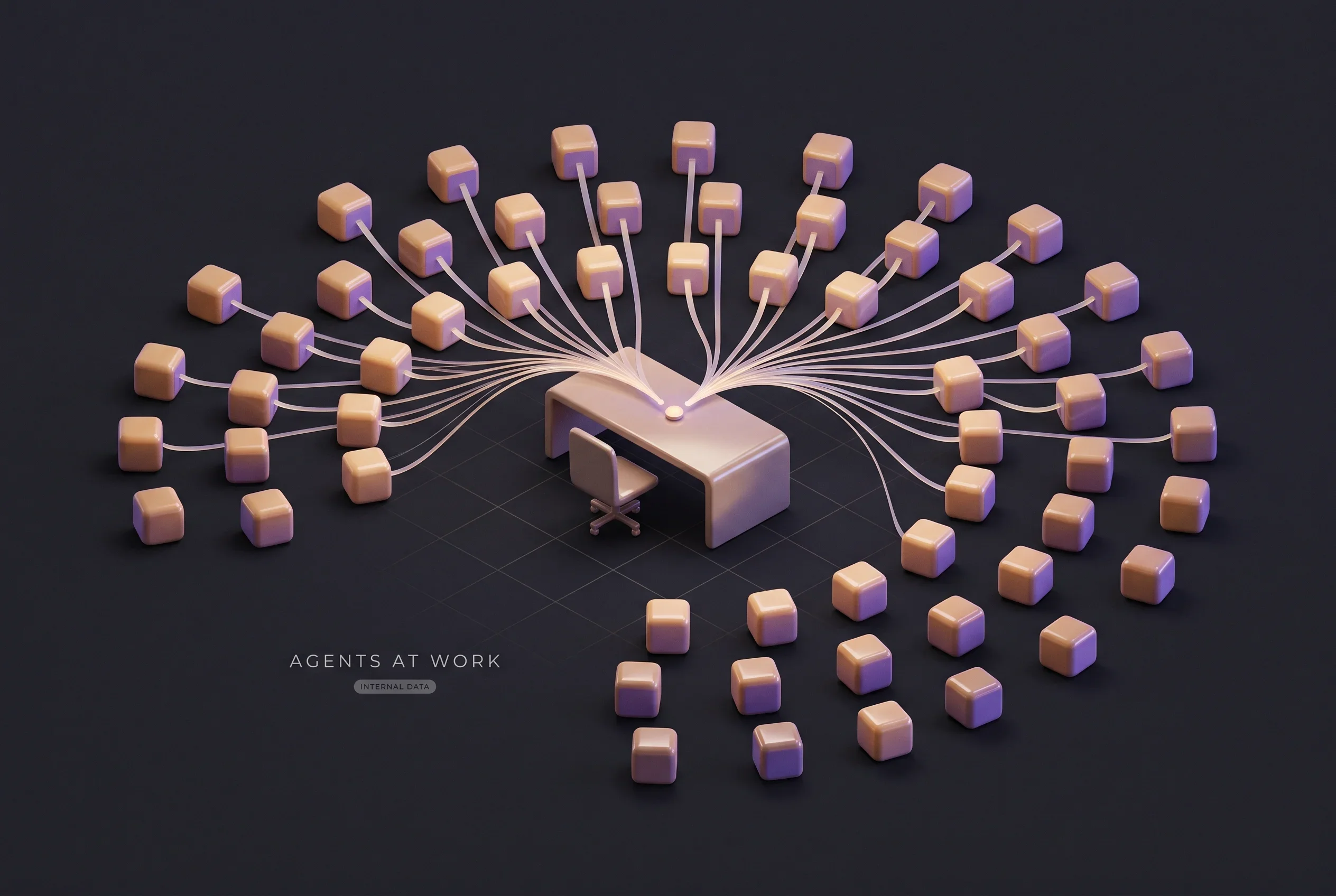
Total agent runtime across the company, counting both autonomous and interactive work, exceeded human working hours for the first time in March 20261. Looking only at interactive agents run by individual employees, by August the agents logged six times the hours of the people using them. That comparison pools subagents, counts inference and tool use as agent runtime, drops any idle stretch longer than 30 minutes, and treats human time as headcount multiplied by 40 hours a week.
On output, commits per engineer grew fastest, reaching five times the pace of six months earlier1. Output also rose in non-technical work such as contract handling in legal, invoice processing in accounts payable and closed deals in sales.
The same period, however, saw rapid growth in Anthropic’s business, and the report acknowledges this. To isolate the effect of AI, it compares 192 engineers who adopted coding agents with 74 who did not, in the same months, and reports a sharp increase in the amount of code added in the months after adoption1. It also states that adoption was not random, which could bias the estimates, and that more code is not the same as better code or more business value. On quality, it compares lines written by agents and lines written directly by the same engineer in the same month and directory, and finds no difference in how often those lines were later deleted or reverted. The report adds that code quality has many dimensions and that AI mistakes may be harder to spot than human ones.
Human attention as the bottleneck
A recurring theme is that people cannot keep up with what the agents produce. In interactive sessions, about 80% of the time is spent waiting on a human1. Even for non-technical groups, reading everything their interactive sessions produce would take more than half of a work week (at an assumed 0.75 words a token and a reading speed of 250 words a minute). In open-ended responses to a survey in April 2026, 27% cited higher productivity thanks to Claude tools, while 20% said their role had moved from doing the work to managing Claude.
The response has been growth in what the report calls “meta-work”: building skills for agents, drafting plans for other agents and reviewing their work, building dashboards and monitors to watch agent pipelines, and writing down how tasks are carried out. For the average employee, meta-work accounted for 10% of interactive sessions in fall 2025, and by spring 2026 the figure was 22%, based on an automated classification of 2,000 session summaries. By July 2026, agents had 8,500 standing instructions written for them, up from a few hundred a year before.
Meetings have not shrunk. Calendar data show the median employee’s meeting time up 20% year over year, and up 16% for technical individual contributors. The report notes that company growth and a shift toward meeting-heavy non-technical roles explain part of this, while employees in interviews described in-person coordination as essential. Agents appeared in close to half of the active public Slack channels, adding to human conversation rather than replacing it. Because decisions made in unrecorded meetings or direct messages are invisible to agents, the report describes pressure to move human work and decisions into places agents can read.
On the product side, Anthropic in September 2026 rebuilt Projects in Claude Code so that a coordinator directs parallel threads.
What interviewers look for
Anthropic ran an automated classifier over the scorecards interviewers filled out for thousands of people hired since 2024. Mentions of a candidate’s track record with AI tools appeared in about 5% of technical assessments and 7% of non-technical ones in 2024; by 2026 those rates were three times higher for technical roles and four times higher for non-technical ones1. For technical candidates, comments on autonomy and judgment grew the most, while domain expertise took up a smaller share of assessments. In non-technical interviews, remarks about customer focus and commitment to the mission increased, and remarks about execution skills declined.
Redeployment first, with limits on how far it applies
In response, Anthropic says it is building an early warning system that reads role-level demand and productivity metrics against AI capabilities and usage, and that it has prioritized moving affected employees into other roles internally1. The report also points to broad employee stock ownership, while conceding that this is easy for a company whose valuation has risen sharply. It notes a trade-off as well: promising to redeploy current staff could make a company more hesitant to hire new people.
The report is explicit about its limits. Much of how Anthropic handles employment cannot be copied across the economy, and none of the measures it lists directly addresses the slowdown in junior hiring. Protecting current employees does not help people who were never hired, and the report argues that employer action needs to be paired with public policy on retraining and income support.
What it means for organizations adopting agents
Anthropic has shared internal AI metrics before. Its June 2026 report said Claude writes more than 80% of the code merged into the company’s codebase. OpenAI published data in September showing 3.1 agent workdays per human workday in its research organization. The measurements differ, so the numbers are not directly comparable, but this report goes beyond code volume and agent usage to cover the human side: hiring mix, time in meetings and the criteria used in interviews.
For organizations rolling out agents, the more useful takeaways for operational planning may be less about the productivity figures and more about the growing work of reading output, writing instructions and monitoring agents, and the need to record decisions where agents can see them. At the same time, this is internal data from a single fast-growing company whose employees widely hold stock, and the report itself says much of it would not carry over to other firms. Those differences should be kept in mind before applying the findings to hiring plans or evaluation systems.
Sources
- How employment is changing at Anthropic - Anthropic (October 16, 2026)
- Anthropic says its workforce has become less junior and is spending more time in meetings - TechCrunch (October 17, 2026)
Was this article helpful?
Thank you!
Received. Thank you!