Anthropic Releases Claude Sonnet 5.5 - List Prices Unchanged, Cyber Work Drops Back to Sonnet 5
Anthropic released Claude Sonnet 5.5 on September 28, 2026. Per-million-token prices stay at Sonnet 5's $2 input and $10 output, while cost per task is down as much as 30% by the company's own testing. It is the first Sonnet model shipped with cyber safeguards.
Anthropic released Claude Sonnet 5.5 on September 28, 2026. It arrives as the Claude 5.5 family’s second entry, and the company positions it as a clear step up from Sonnet 5: more than 30% faster to generate, and on most work as much as 30% cheaper1. Haiku 5.5, aimed at high-volume and cost-sensitive use, is said to follow in a few weeks.
What matters for a purchasing decision is that the price tag reads in the opposite direction from Opus 5.5 six days earlier. Opus 5.5 cut its unit prices outright. Sonnet 5.5 leaves them exactly where they were.
The unit price holds; the token count drops
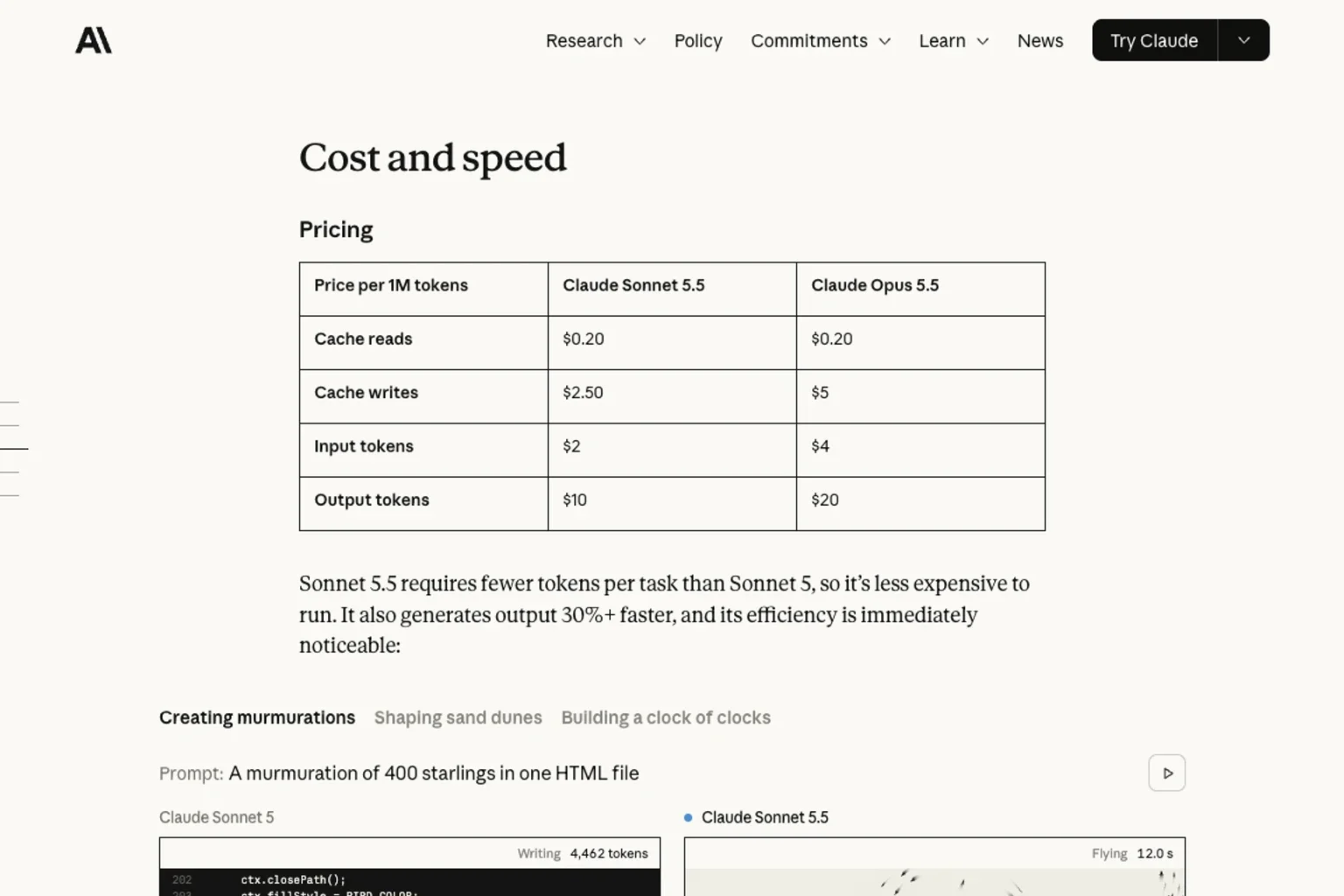
Per million tokens, the rates are $2 for input, $10 for output and $0.20 for cache reads — all identical to Sonnet 51. Cache writes are $2.50. That places the model at precisely half of Opus 5.5’s $4 and $20.
The “up to 30% less” line therefore rests on a different claim: that fewer tokens are needed to finish the same job. Anthropic reports that in its own testing, cost per task came in as much as 30% below the previous generation. That this is the vendor’s own measurement rather than an independent one is worth noting before it goes into a budget. Early testers also observed heavier batching of tool calls than they saw from Sonnet 5, which trimmed the number of steps and the cost along with them.
None of this is visible from a rate card. When the unit price holds steady and per-task consumption falls, the same invoice buys more work — and any budget or unit-cost model built on the rate alone quietly drifts out of alignment.
There is a second cost lever. The default effort level is Medium in Claude Code and the Claude apps, but High on the Claude Platform. Lower settings answer faster on fewer tokens; higher ones reason longer and check their own work more. The same model name can bill differently depending on where you call it from.
Benchmarks close on Opus 5.5, with footnotes attached
In the figures Anthropic published, the agentic coding test Terminal-Bench 4.0 comes in at 70.6% against Sonnet 5’s 10.3%, and GDPval-AA v2.1, which covers real-world tasks across occupations, reaches 1844 against Opus 5.5’s 18461. CursorBench 4.0 is 55.5% to Opus 5.5’s 57.8%, and Chartography is 61.6% where Sonnet 5 scored 15.6%.
The company attaches its own caveat. Run at Max effort, it says, the model draws level with Opus 5.5 on a number of these tests — but a benchmark result reflects one facet of a model and no more, and for complex, open-ended work demanding sustained judgment Opus 5.5 is still plainly ahead.
The table needs care in other places too. For Terminal-Bench 4.0 and CursorBench 4.0, no public GPT-6 Sol figures exist, so those cells are left empty in the table, and it is the cost-versus-accuracy charts that plot GPT-5.6 Sol in its place. And on FrontierCode, Max effort (46.2%) lands below the Xhigh result — not from any capability gap, but because Max invoked Claude Code’s code-review skill more frequently; in two instances Cognition looked at, that ended in a timeout or in edits reaching past the task’s scope.
Cyber work drops back to Sonnet 5
The change with the most operational bite is on the safeguards side. Anthropic judges Sonnet 5.5’s cyber capability to be on par with Opus 5’s, and has shipped it as the first Sonnet model carrying the kind of cyber safeguards and fallbacks built for its most capable models1. Finding and fixing bugs as part of ordinary software development still works, but higher-risk cybersecurity tasks visibly drop back to Sonnet 5. For defenders, the company says it plans to widen the Cyber Verification Program across Sonnet 5.5, Opus 5.5 and the Claude Mythos models with tiered access.
Biology safeguards, by contrast, are unchanged from Sonnet 5. Research, teaching and clinical work are largely untouched, though the company notes that certain requests in microbiology and virology can be flagged by mistake. Broader work goes through the Life Sciences Verification Program, which opened for applications on September 17.
Distillation defenses are also a first for the Sonnet line. Safety classifiers that block reasoning extraction are now in place, and preserved thinking has been extended so that Claude’s thinking cannot be separated from the account that produced it. Most developers will see no difference, but any workflow that carries a conversation from one account to another — a mid-session account switch in Claude Code included — now behaves differently. What extraction at scale through networks of fake accounts actually looked like is covered in September’s threat report.
On alignment, Anthropic explains that because Sonnet 5.5 does not push the capability frontier, its assessment concentrated on risks that apply at any capability level. Across an automated behavioral audit of roughly 1,850 scenarios, the model matches or improves on Sonnet 5 on most measures; it comes close to Opus 5.5 in how seldom it attempts to leave its sandbox, and probes the limits of its containers less than any of the company’s other models. The same text adds that no evaluation suite dependably surfaces every failure mode, and that undiscovered tendencies may remain.
One thing that will catch you during migration
Sonnet 5.5 is offered across all platforms including Amazon Web Services, Google Cloud and Microsoft Azure, and the Claude Platform identifier is claude-sonnet-5-5. Zero data retention is available, as it is for Opus 5.5 and Sonnet 5.
The step most likely to stall a migration concerns thinking. Anyone running Sonnet with thinking disabled has to adopt the new between_tools setting first, before moving over to Sonnet 5.51. Swapping an existing integration over without that change can produce behavior you did not plan for, so a model-name find-and-replace is not enough.
In GitHub Copilot the model reached general availability the same day, covering Pro, Pro+, Max, Business and Enterprise, selectable from the model picker in VS Code, Visual Studio, Copilot CLI, the coding agent, JetBrains IDEs, Xcode and Eclipse2. Billing is usage-based at provider list pricing. The detail administrators tend to miss is the default: unless the global default has been turned off or the model is explicitly disabled, new models are enabled automatically. The rollout is described as gradual.
One absence is worth recording. Nothing in this announcement corresponds to the five-hour usage-limit increase that accompanied Opus 5.5. Whether subscription-side conditions changed cannot be read from it.
Sources
- Claude Sonnet 5.5 - Anthropic official announcement (September 28, 2026)
- Claude Sonnet 5.5 in GitHub Copilot - GitHub Changelog (September 28, 2026)
Was this article helpful?
Thank you!
Received. Thank you!