Anthropic Ships Claude Fable 5.1 and Mythos 5.1 — Same Per-Token Price, Cache Reads Cut 75%
Anthropic released Claude Fable 5.1 and Mythos 5.1 on September 1. Input and output stay at $10 and $50 per million tokens, but cache reads drop 75% to $0.25 per million, which the company estimates cuts typical workloads by about 25% and highly agentic ones by up to about 45%.
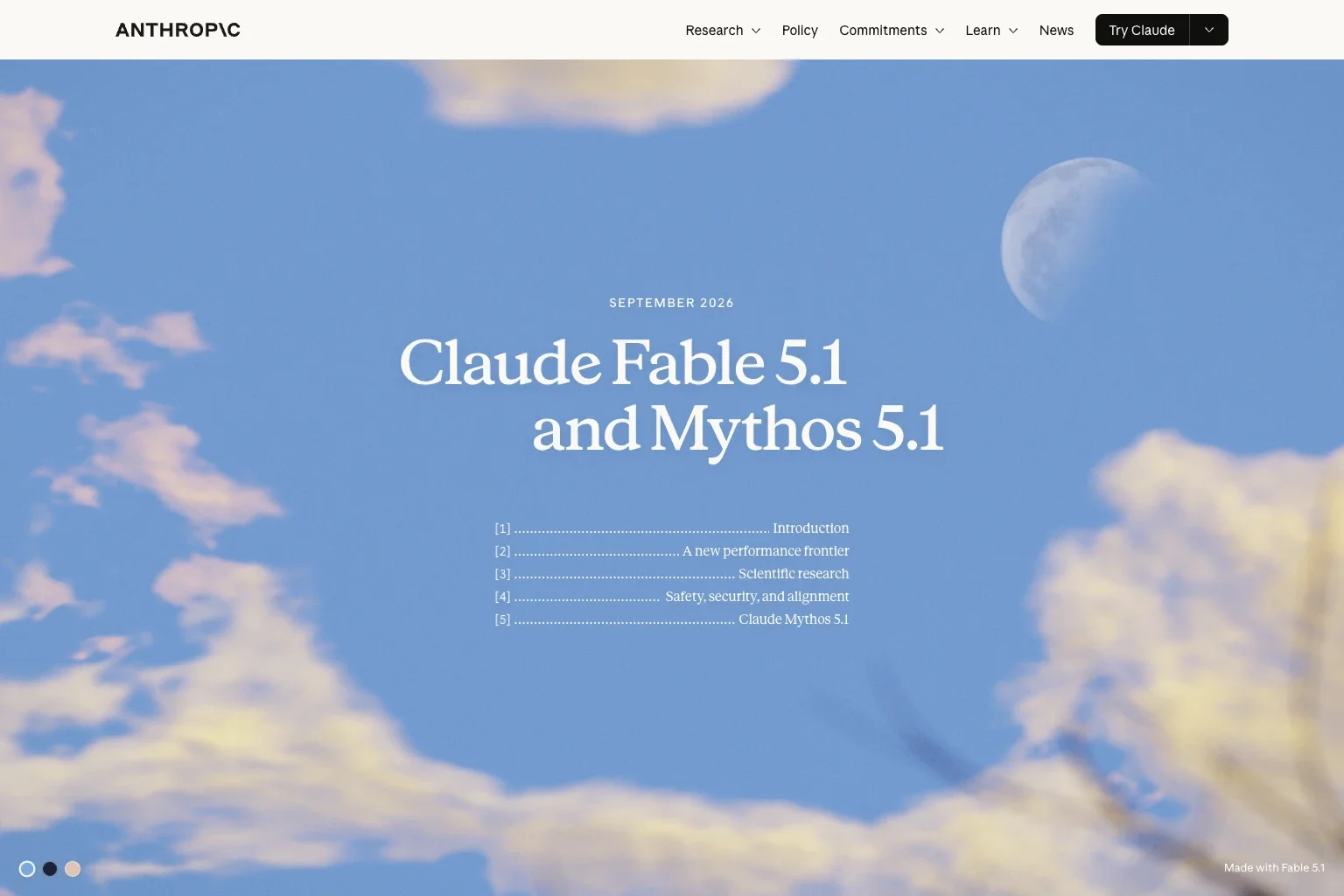
Anthropic released Claude Fable 5.1 and Claude Mythos 5.1 on September 1, 2026 12. The company describes the two as “the same model, but with different levels of safeguards.” Fable 5.1 is generally available; Mythos 5.1 is limited to vetted organizations doing cybersecurity and life sciences work 1.
The shape of the pricing is what stands out. Per-token rates are unchanged from Fable 5: $10 per million input tokens and $50 per million output tokens 1. What moved is the cache read rate, now $0.25 per million tokens — 75% less than Fable 5 1. On the strength of that single change, Anthropic estimates costs drop by around 25% for typical workloads and by up to around 45% for highly agentic ones 1.
One model, two safeguard levels
The relationship between Fable 5.1 and Mythos 5.1 carries over the framing introduced with the Fable 5 / Mythos 5 announcement in June. Anthropic again says the two are the same model with different levels of safeguards, and that Mythos 5.1’s safeguards are “specifically designed to support work in cybersecurity and the life sciences,” with access only through its trusted access programs 1.
There are two doors into Mythos 5.1. The Cyber Verification Program (CVP) currently provides access to certain Opus- and Sonnet-class models with reduced cyber safeguards for defensive security work, and will include Mythos-class models in the near future 1. The Life Sciences Verification Program (LSVP) is designed so life sciences professionals can use Mythos 5.1 with safeguards built for professional research and development; Anthropic says it has enrolled its first participants in partnership with the US government and plans to widen access later 1. For now, Mythos 5.1 is available only to a set of US organizations, with expansion to more domestic and international partners being coordinated with the US government 1.
Claude Security — Anthropic’s product that scans codebases for vulnerabilities and proposes patches for human review — is now powered by Mythos 5.1 1.
Lowering the bill through cache, not list price
The pricing needs care in how it is described. Fable 5.1’s rates are $10 per million input tokens and $50 per million output tokens, the same as Fable 5 1, so summarizing this as “Fable 5.1 got cheaper” misses what actually changed.
What changed is the cache read rate — the price of the model re-reading inputs it has already processed and stored 1. That fell to $0.25 per million tokens, a 75% cut 1. Anthropic’s figures are a roughly 25% reduction for typical workloads and up to around 45% for complex coding and highly agentic tasks 1.
Those are estimates with stated conditions. They index the same workloads run on Fable 5 and Fable 5.1 at usage-based pricing, measured at default effort over four weeks of actual usage in August 2026. “Typical workload” covers Fable usage across Claude Enterprise, Claude Code, and the API; “highly agentic workload” covers context-heavy, tool-heavy work where cache reads make up most of the cost 1. Where cache reads are a small share of spend, the savings will be correspondingly smaller.
The pattern of a list price that misleads on its own also showed up when the Claude Sonnet 5 increase scheduled for September 1 was withdrawn. A change in published rates and a change in the actual invoice are worth checking separately.
Default effort levels also affect the bill. Anthropic notes that Fable 5.1 defaults to High effort in Claude Code and to Medium in Claude Cowork and on Claude.ai 1. Set to Low or Medium, the company says, Fable 5.1 achieves results similar to or better than Fable 5’s at a much lower cost 1.
The benchmarks, and how to read them
The announcement includes a table comparing Fable 5.1, Fable 5, Claude Opus 5, and GPT-5.6 Sol 1.
- Terminal-Bench-Science 0.1 (agentic scientific research): 52.6% (Fable 5: 24.7%, Opus 5: 29.0%, GPT-5.6 Sol: 22.4%) 1
- Terminal-Bench 4.0 (agentic coding): 55.8% for Fable 5.1 and 60.9% for Mythos 5.1 (Fable 5: 42.0%, Opus 5: 52.3%, GPT-5.6 Sol: 37.3%) 1
- CursorBench 3.2.0: 73.4% (Fable 5: 70.5%, Opus 5: 70.0%, GPT-5.6 Sol: 67.2%) 1
- GDPval-AA v2 (knowledge work): 1853 (Fable 5: 1723, Opus 5: 1824, GPT-5.6 Sol: 1711) 1
- Humanity’s Last Exam: 60.9% without tools and 65.0% with tools (Fable 5: 57.8% and 63.8%) 1
The numbers come with caveats. For Terminal-Bench-Science 0.1, Anthropic records a standard error of ±3.5–4.5 points per model 1. The Terminal-Bench 4.0 gap between Fable 5.1 and Mythos 5.1 reflects, in the company’s account, the tasks on which its earlier and less precise cyber safeguards intervened; with the safeguard improvements shipping alongside this release, Anthropic expects the difference between the two to shrink considerably 1. Benchmarks were run with production safeguards enabled: on tasks where those safeguards intervened, Fable 5.1 and Fable 5 scored zero on OSWorld 2.0, and Fable 5 scored zero on AutomationBench 1.
What the safeguards now allow, and what they still don’t
Anthropic has moved to cut false positives. In cybersecurity, it says its newest safeguards block 60% fewer false positives than before 1. One reason it gives is that Fable 5.1 can now be used to discover software vulnerabilities — though not to develop exploits for them 1. For Claude Code users, that works out to an average of around 60% fewer cyber-safeguard interventions per session compared with the previous safeguards on Fable 5 1.
The limits are spelled out too. Dual-use cybersecurity tasks — penetration testing, exploit generation, and binary-based vulnerability scanning — are still redirected to Anthropic’s Opus models 1.
In biology, the release carries forward the biology safeguard retuning from August. Biology safeguards on Fable 5.1 and Fable 5 now fire 85% less often for benign requests about elementary biology and medical questions, relative to those that launched with Fable 5 1. Queries about life sciences research and development are still directed to Opus models 1; the LSVP is the route by which professionals get at those capabilities.
Rebuilding zero data retention for regulated industries
On the same day, Anthropic announced Enterprise Frontier Safeguards (EFS) 3. It pairs the privacy of zero data retention (ZDR) with safeguards for detecting misuse, by storing data in cloud infrastructure the customer controls rather than Anthropic’s 3.
The company explains the background. Thirty-day data retention was introduced starting with Fable 5 because detecting sophisticated misuse spread across many sessions and accounts requires holding data long enough to correlate it. Anthropic states it “has never trained on enterprise data without explicit permission, and never will” 3. Even so, enterprises — especially in regulated industries — found models with data retention difficult to adopt 3.
Under EFS, activity data used for monitoring can live in the customer’s own cloud account, such as Amazon S3, Azure Blob Storage, or Google Cloud Storage 3. Automated safety monitoring runs, with no human review by Anthropic employees required 3. The company says it developed EFS with more than 100 customers and with its cloud partners at Amazon Web Services, Google Cloud, and Microsoft Azure 3. Supported surfaces include Claude Code, Claude Enterprise, the Claude Platform, Amazon Bedrock, Claude Platform on AWS, Google’s Agent Platform, and Microsoft Foundry 3.
Rollout happens in phases starting later this fall; until EFS is ready, eligible customers get ZDR on Fable 5 and Fable 5.1 3. It is not something anyone can turn on today.
Anti-distillation, and an EU AI Act detection API
Two changes are likely to be felt in day-to-day operations before the rest.
The first is anti-distillation. On Fable 5.1, new API accounts created from September 1, 2026 onwards can no longer manually edit Claude’s prior context in a multi-turn conversation while preserving the transcript of Claude’s prior thinking 1. Anthropic describes this as closing off a common, publicly documented distillation technique. Existing accounts are not currently affected, but the change will apply to all users with future model releases, and a small number of custom integrations will be affected 1.
The second concerns the EU AI Act. In July 2026, Anthropic — along with 190 other signatories — signed the Act’s Code of Practice on Transparency of AI-Generated Content, which required adding a watermark to the outputs of models released after August 2, 2026 1. The company is now rolling out a detection API in private preview, currently available to eligible organizations such as regulators, law enforcement, media, fact-checkers, independent researchers, educational organizations, and EU civil society groups, as required under EU law 1.
How it reaches your setup
Tooling picked it up the same day. Claude Code 2.1.257 added claude-fable-5-1 and made it the default Fable model, with the release notes listing 1M context and $10/$50 per million tokens alongside $0.25 per million for cache reads 5.
Availability is broad. Fable 5.1 is available on all platforms including Amazon Web Services, Google Cloud, and Microsoft Azure, and developers can call claude-fable-5-1 on the Claude API 1. For individuals and organizations, it is available on the Pro, Max, Team, and Enterprise plans 2.
Early-access customers were quoted in the announcement. Walden Yan, Co-founder and CPO of Cognition, said the company is “moving our Opus 5 traffic in Devin to Claude Fable 5.1 on launch day,” and that “with the new cache read pricing a Fable-class model is finally economical for the workloads we’d kept on Opus” 1. Josh Boyer, Distinguished Engineer at Red Hat, said that using Claude Code, it “correctly identified the root cause of every broken build we tested, across all the effort levels” 1. These are results each company reports from its own evaluations, not third-party verification.
On safety testing, Anthropic assesses that Mythos 5.1’s capabilities exceed those of Mythos 5 but still fall short of the next risk tier defined in its Responsible Scaling Policy, so it ships with the same safeguards applied to Mythos 5 1. On cyber, the company says the model “demonstrates the strongest cyber capabilities of any model we’ve released” while remaining in the lower risk category of its Frontier Compliance Framework 1. Its automated behavioral audit found Mythos 5.1 better aligned than Mythos 5 across most metrics, though its own testing found the model can still sometimes bypass approvals and auto-mode classifiers 1.
For a cost decision, the quickest check is what share of your current bill comes from cache reads. Agentic use that re-reads long contexts repeatedly gets the most out of this change; short one-off requests barely move. Read alongside the Model Hardware Standard for driving lab equipment and the seats opened to researchers in late August, the science-oriented thread in Anthropic’s product line continues.
Sources
- Introducing Claude Fable 5.1 and Claude Mythos 5.1 - Anthropic official announcement (September 1, 2026)
- Claude Fable - Anthropic official product page (pricing and plan availability)
- Developing Enterprise Frontier Safeguards with our customers - Anthropic official announcement (September 1, 2026)
- Anthropic’s new Fable release is cheaper, less restrictive - TechCrunch (September 1, 2026)
- Claude Code v2.1.257 release notes - GitHub official release notes (September 1, 2026)
Was this article helpful?
Thank you!
Received. Thank you!