Claude Sonnet 5: The September 1 Price Increase Is Not Happening
Claude Sonnet 5's API pricing was announced as $2/$10 per million tokens through August 31, 2026, rising to $3/$15 on September 1. Anthropic withdrew that increase in an August 10 edit. But the tokenizer changed too, so comparing per-token rates against Sonnet 4.6 does not give you a cost comparison.
August 31, 2026 is a date on the calendar for anyone budgeting around Claude Sonnet 5’s API pricing, because Anthropic announced at launch that the introductory rate ran through August 31, 2026 2.
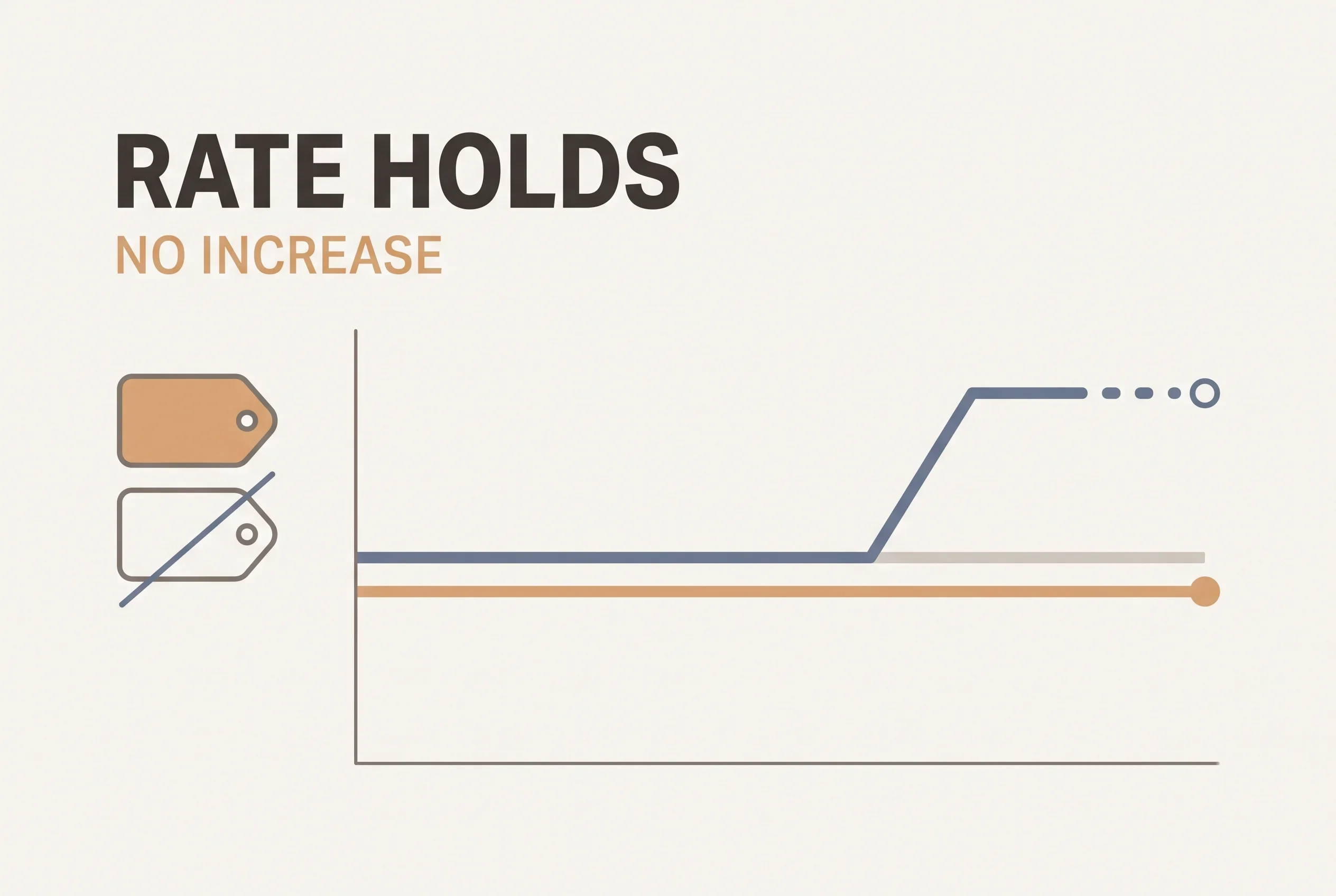
The short version: there will be no price increase tomorrow. Anthropic made the introductory pricing permanent in an edit dated August 10, 2026, and the official documentation states plainly that the increase to $3/$15 per million input/output tokens scheduled for September 1 will not occur 12.
Worth being precise about one thing: this is not a price cut. Sonnet 5 has cost $2 per million input tokens and $10 per million output tokens since it shipped on June 30 1. What changed is the assumption that it would go up.
What was decided, and when
Sonnet 5 was announced on June 30, 2026 1. Pricing was set at $2 per million input tokens and $10 per million output tokens, described as introductory pricing through August 31, 2026, after which standard pricing of $3 input / $15 output would take effect 2. This site wrote up those terms when the model launched.
The plan was withdrawn not at the end of August but on August 10. The Changelog on the announcement page carries an edit dated that day, saying the introductory pricing is now permanent and that the $3/$15 standard pricing previously set for September 1 no longer applies 1. The pricing documentation carries a matching note: $2/$10 is now the standard price, and the September 1 increase will not occur 2.
So nothing new happens today. A question settled three weeks ago simply reaches its stated deadline. It is still worth writing about, because material written between late June and early August still carries the “it rises to $3/$15 in September” assumption — this site’s own back catalogue included. From today, any estimate built on that wording is wrong.
Current pricing
Here are the headline rates as of August 31, 2026, in US dollars per million tokens 2.
| Model | Input | Cache hit | Output |
|---|---|---|---|
| Claude Opus 5 | $5 | $0.50 | $25 |
| Claude Sonnet 5 | $2 | $0.20 | $10 |
| Claude Sonnet 4.6 | $3 | $0.30 | $15 |
| Claude Haiku 4.5 | $1 | $0.10 | $5 |
Sonnet 5’s rate stays fixed at two thirds of its predecessor Sonnet 4.6. Prompt caching prices are multipliers on the base input rate: a 5-minute cache write is 1.25x, a 1-hour cache write is 2x, and a cache hit is 0.1x 2. Because the base rate anchors those, the withdrawn increase affects more than the two headline rows.
The Batch API takes 50% off both input and output, putting Sonnet 5 at $1 input and $5 output 2. And on Claude 4.6 and later models, the full 1M-token context window is billed at standard pricing — the documentation notes that “a 900k-token request is billed at the same per-token rate as a 9k-token request” 2. There is no cliff when you send long context.
A two-thirds rate does not mean a two-thirds bill
This is where reading the price sheet alone will mislead you.
Sonnet 5 succeeds Sonnet 4.6, but the tokenizer changed. A footnote on the announcement page explains that this is the same kind of change introduced with Claude Opus 4.7, made to improve performance by altering how the model processes text, and states the tradeoff directly: the same input can map to more tokens, roughly 1.0–1.35× depending on the content type 1.
The documentation describes the same thing differently. The newer tokenizer used by Claude 4.7 and later models “produces approximately 30% more tokens for the same text,” though “the exact increase depends on the content and workload shape.” Claude Sonnet 4.6 and earlier use the previous tokenizer 2.
The two figures are framed differently, but both carry the same caveat: it varies with the content. What follows from that:
- The per-token rate is $2 for Sonnet 5 against $3 for Sonnet 4.6, a ratio of two thirds 2
- But the same text maps to a different number of tokens on each model, so that ratio does not carry over to the invoice 12
- Since the increase is content-dependent, no single “you save X%” figure exists as a general claim 12
Tokens are the unit an LLM counts text in, and both billing and limits run on that unit. The same passage of text counts differently once the model changes. Obvious in principle, and the most commonly forgotten premise when estimating the cost of switching models.
The practical conclusion is straightforward: measure your own representative prompts on both models, down to the token count. That is the only reliable method. Anthropic raised rate limits across Chat, Cowork, Claude Code, and the Claude Platform alongside the Sonnet 5 release, citing the higher token usage of higher effort levels 1 — the assumption that token consumption shifts is built into the product side as well, not just the pricing.
Reading it into a September budget
As spending data showing top-tier models hold a small share of enterprise dollars suggests, model selection is not settled by capability alone; the price level itself drives adoption. This withdrawal confirms the decision to keep Sonnet 5 positioned as the standard option one tier below the flagships. With Opus 5 at $5 input and $25 output, that leaves a 2.5x gap on input and on output alike.
Three things to check as you revise September estimates. Any budget line carrying the increase can come out. If you are modelling a move from Sonnet 4.6, put a measured token-count delta into the calculation. And if you rely on caching or the Batch API, those amounts stay put too, since they track the base rate. None of the three falls out of staring at the two numbers on the price sheet.
This site has updated the relevant passages in its Sonnet 5 launch coverage and its AI coding tool pricing comparison accordingly.
Sources
- Introducing Claude Sonnet 5 - Anthropic official announcement (published June 30, 2026; edited August 10, 2026)
- Pricing - Anthropic official documentation (accessed August 31, 2026)
Was this article helpful?
Thank you!
Received. Thank you!