Businesses Aren't Paying for the Top Model: What Ramp's Spend Data Shows About the Price Ceiling
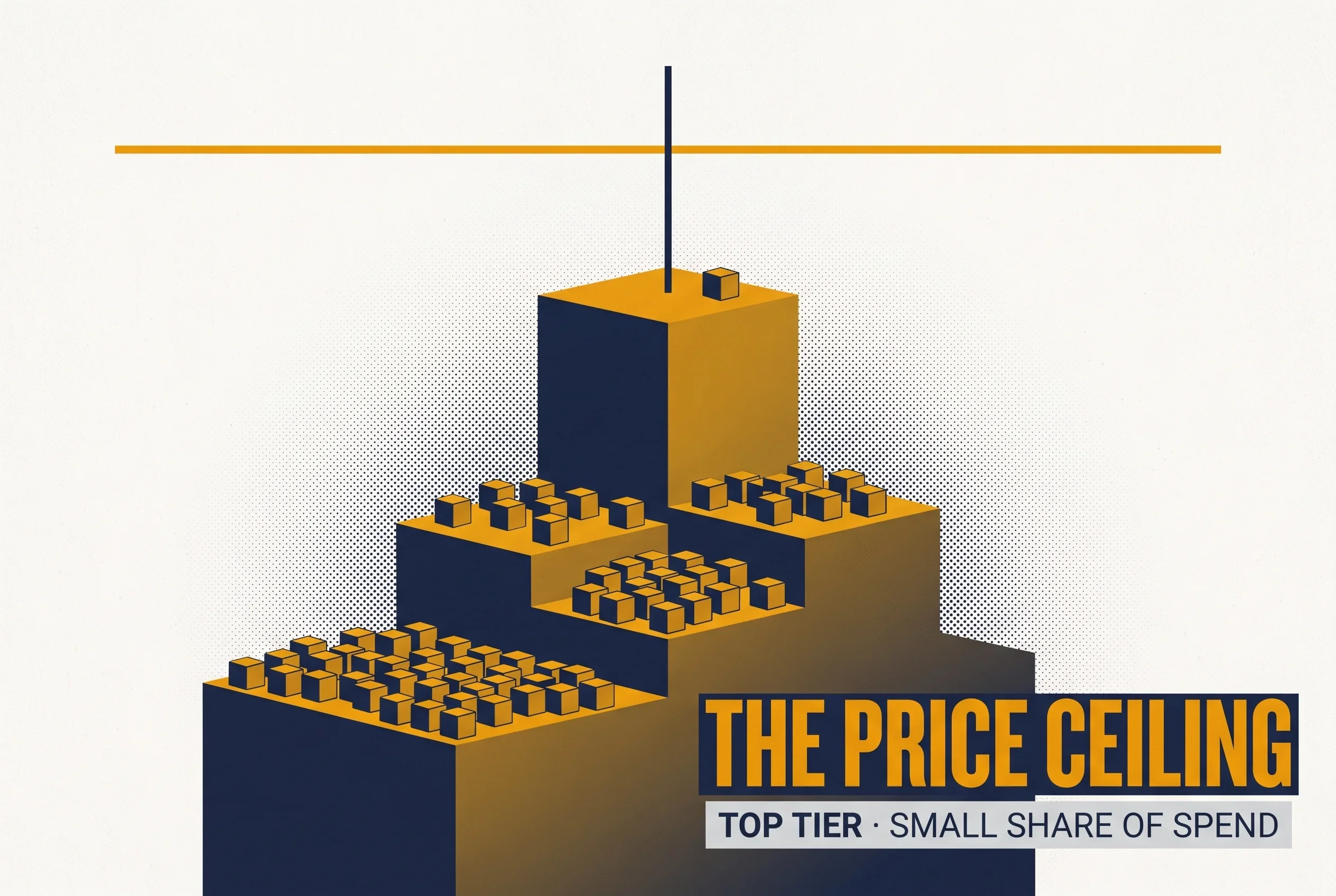
Ramp's August 2026 AI Index shows Anthropic's flagship Fable 5 accounts for 6% of tokens purchased from Anthropic and 11.4% of dollars spent. Ramp's lead economist argues that at this price point the added performance is not worth the cost, and that a ceiling on business AI spending has come into view.
Picking a model for internal use often proceeds from the assumption that standardizing on the highest-performing option is the safe choice. The monthly Ramp AI Index, published by corporate card and spend management company Ramp on August 12, 2026, shows that actual payment data does not support that assumption1.
The figures: over the past month, Anthropic’s flagship Fable 5 made up 6% of tokens businesses purchased from Anthropic, and 11.4% of dollars spent1. Despite being by far the most expensive model in the lineup, its share of spending sits just above one tenth.
OpenAI’s flagship as the comparison
The report places OpenAI’s numbers alongside. GPT-5.6 Sol accounts for 25% of OpenAI tokens and 23% of spend1. The position each flagship occupies within its own vendor’s mix looks entirely different.
Looking at July’s model-attributed spending, Fable 5 came to roughly 75% of GPT-5.6 Sol’s total1. Anthropic’s top-tier model is being used less by businesses than OpenAI’s.
Ara Kharazian, Ramp’s lead economist and the report’s author, characterizes Fable 5 as both the most performant model on the market and the most expensive — roughly $10 per million tokens, twice the price of the still highly capable GPT-5.6 Sol1. At that price point, he argues, the additional performance is not worth what it costs, and Fable 5 has revealed a new upper bound on what businesses will pay for AI1.
That “twice the price” comparison reflects conditions when the report was published on August 12, 2026. OpenAI cut GPT-5.6 Sol to $4.00 input and $20.00 output on August 212, so the current gap differs from the level the report assumed. We covered the details of that cut separately.
The scope this data covers
Before taking the numbers at face value, it is worth establishing how far they reach.
The Ramp AI Index tracks AI usage among American businesses using Ramp’s own spend data1. The population is therefore US businesses that use Ramp, not the global AI market.
For the Fable 5 chart the range is narrower still. Ramp notes that this data comes from its token spend management product and that the sample skews slightly more tech-heavy than its typical AI Index sample1. On that basis, the company adds that actual Fable adoption is likely even lower than its estimate here1. The data is anonymized and aggregated so that no individual business is identifiable1.
The assessment of performance is likewise Kharazian’s own; the report presents no independent benchmark to support it1. The numbers and the judgments are best read separately.
The other side of the same report
Reading this data as evidence that Anthropic is losing ground runs into other figures in the very same report.
As of July, 43.5% of US businesses paid Anthropic for subscriptions or tokens, up 1.1 percentage points month over month and extending its lead in business adoption1. OpenAI rose 0.23 points to 39.7%, underperforming overall AI adoption1. xAI rose 0.94 points to 4%, its fastest growth since July 20251.
Businesses using model serving platforms, which provide access to open source and some Chinese-developed models, account for 6.1% of AI-using firms, up 0.2 points1. Kharazian is explicit that new AI spenders are not shifting to open source or Chinese models — first-time buyers still go to the American model companies1. His concern runs through a different channel: adoption growth at OpenAI, and to a lesser extent Anthropic, has slowed in recent months, meaning more of their growth must come from existing AI spenders, particularly the heaviest ones, and those businesses are increasingly spending on open source1. We summarized where open-weight models stood over the summer.
Spending itself keeps climbing. In July, the top 1% of businesses spent a median $7,400 per employee on AI, the top 10% spent $650, and the median firm spent $11.951. The spread approaches three orders of magnitude.
Seen from the desk that picks the default model
Where this data bites is the decision about which model to make the internal default.
What Ramp’s numbers show is not that the top tier goes unused, but that the occasions for using it are limited. A 6% share of tokens is consistent with companies reserving the top tier for the calls that need it and running the rest on cheaper models. Ramp releasing the LLM router it had been using internally was a move to automate exactly that split; we covered how the mechanism works.
Kharazian also writes that encouraging business adoption of the newest models would require labs to demonstrate performance beyond even Fable 5 while ensuring competitors cannot come reasonably close — something that looks increasingly out of reach now that open source has caught up to within a few months1. Whether or not that forecast holds, the reading that more companies are building model selection around per-task unit cost and required quality, rather than a performance ranking, is not contradicted by the spend data.
Sources
- Cracks in the AI Thesis - Ramp AI Index, August 2026 - Ramp Economics Lab, Ara Kharazian (August 12, 2026)
- Changelog - OpenAI API - OpenAI official API documentation (entry for August 21, 2026)
Was this article helpful?
Thank you!
Received. Thank you!