OpenRouter: The Unified Interface for AI Era - Next-Gen LLM Platform by Former OpenSea CTO
OpenRouter by OpenSea co-founder Alex Atallah provides unified access to 400+ AI models. Why is it experiencing rapid growth? An analysis of its trajectory and features.
Update, August 19, 2026: This article is an analysis as of June 2025. In August 2026 it was reported that Stripe had reached a deal to acquire OpenRouter for more than $7 billion (neither company has confirmed it); see our separate article. The fee, funding and biography sections were checked against primary sources and corrected on August 19, 2026.
From NFT Success to AI Platform: The Man Behind OpenSea’s Next Venture
Alex Atallah, who built OpenSea into the world’s largest NFT marketplace, left his CTO position in 2022 to pursue his next challenge: “OpenRouter”1.
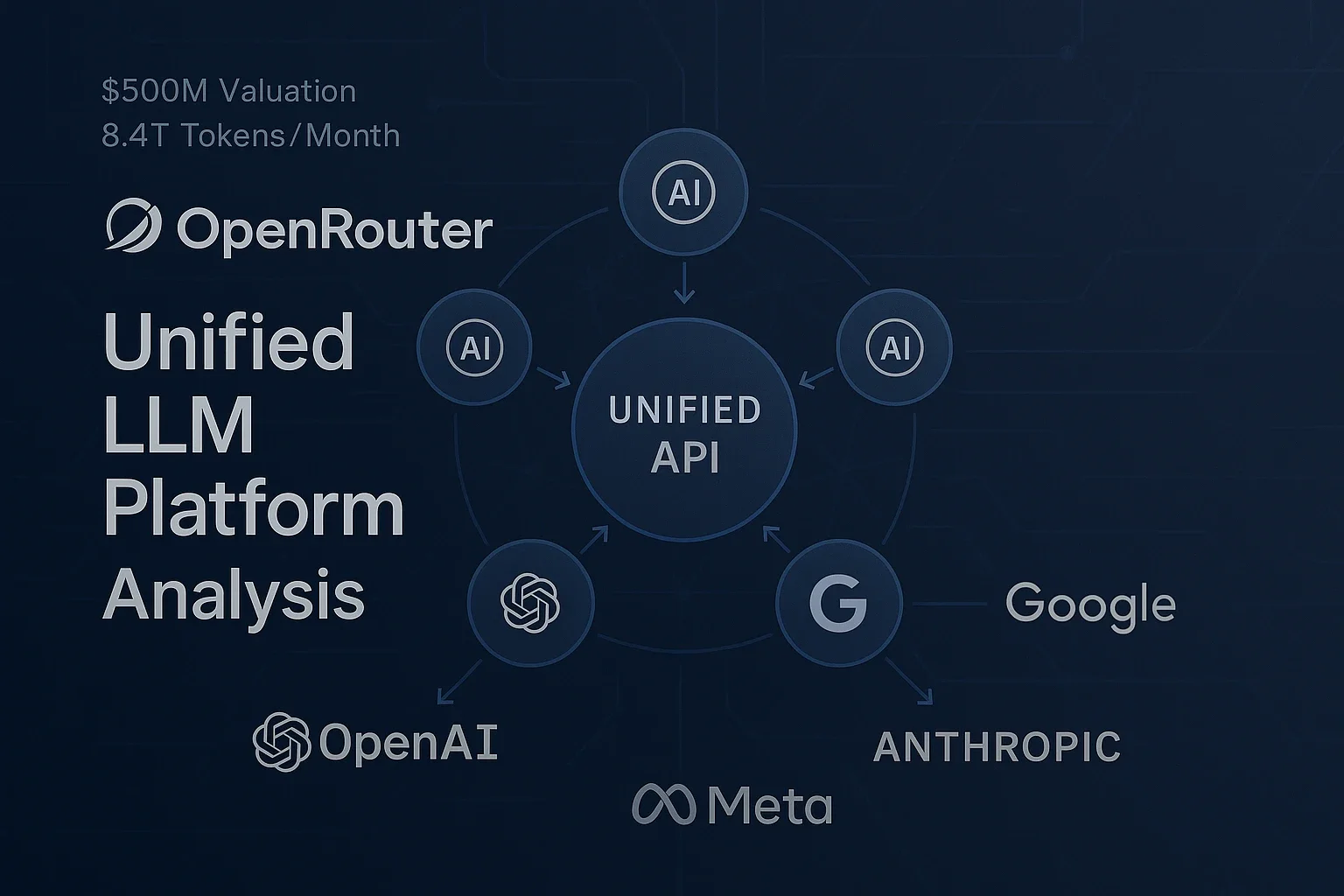
OpenRouter has reached a $500 million valuation in less than two years as a unified platform providing single API access to over 400 AI models. With 2.5 million developers and 8.4 trillion token processing capacity monthly, why has the company achieved such rapid growth? Let’s analyze its trajectory and features in detail.
Background of OpenRouter’s Founding
Insights from OpenSea Experience
Alex Atallah co-founded OpenSea with Devin Finzer, serving as CTO and building the company’s technical foundation. OpenSea experienced explosive growth during the NFT boom, reaching peak monthly trading volumes exceeding $3 billion.
However, in July 2022, Atallah left OpenSea to “build something from zero to one.” This decision was driven by his strong interest in the next wave of technological innovation beyond Web3.
Commitment to Enter the AI Field
Through his OpenSea experience, Atallah deeply understood the value of decentralized technology ecosystems. He believed that diversity and choice, rather than dependence on specific companies, would be crucial in the AI field, leading him to begin developing OpenRouter in early 20231.
Particularly after witnessing Stanford’s Alpaca model achieve competitive AI performance with minimal resources, he became convinced that an era where small teams could create innovative AI models had arrived.
Technical Features of OpenRouter
Unified API for Multiple Model Access
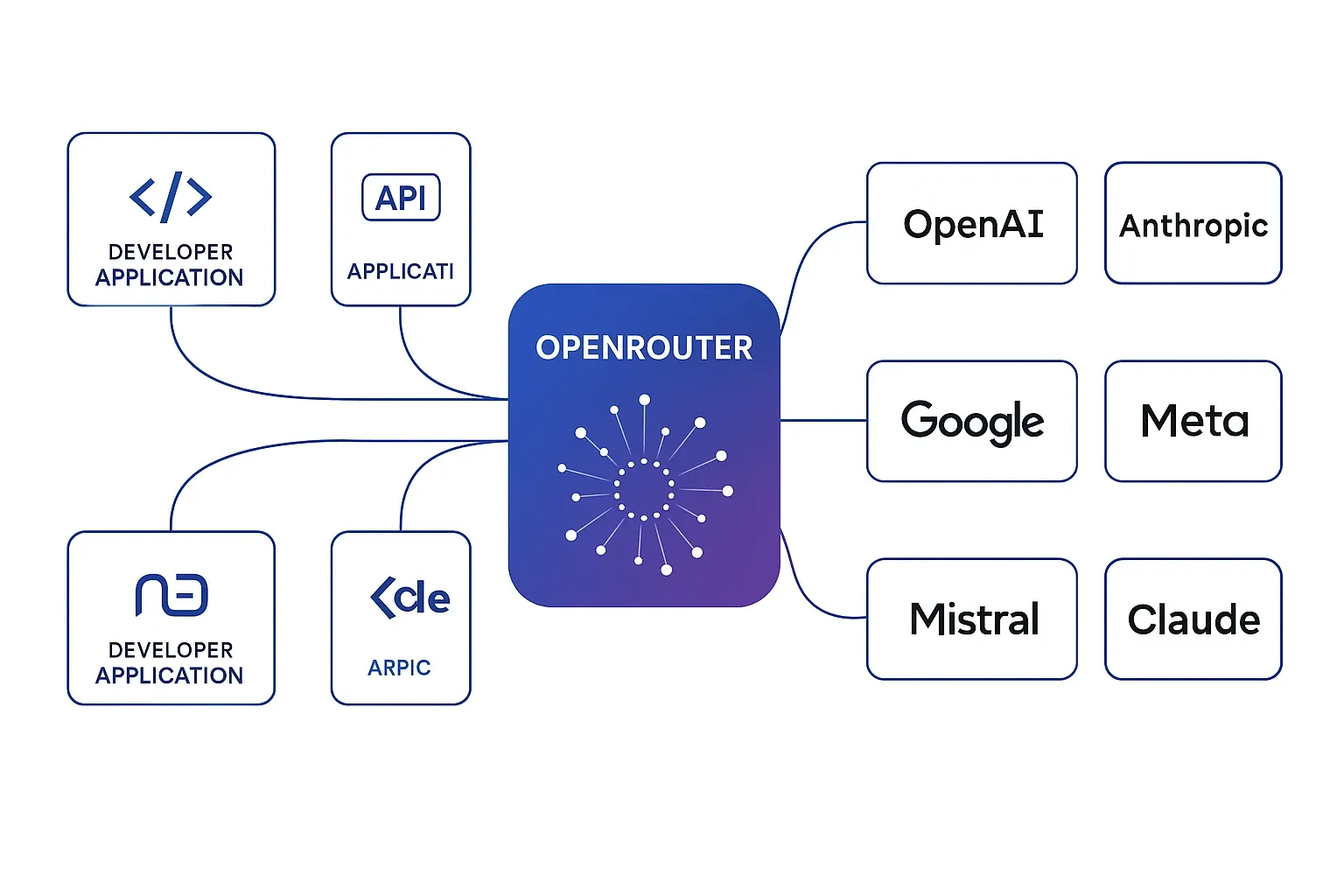
OpenRouter’s greatest feature is providing single API access to over 400 models from 60+ providers including OpenAI, Anthropic, Google, Meta, and Mistral2.
Previously, developers needed to implement different APIs for each provider and handle varying pricing structures and specifications to utilize multiple AI models. OpenRouter eliminates this complexity by providing unified access through an OpenAI-compatible API.
Intelligent Routing
OpenRouter’s core technology lies in “intelligent routing.” This feature automatically distributes requests to optimal providers, offering the following benefits:
| Feature | Details |
|---|---|
| Automatic Fallback | Automatically switches to another provider when errors occur |
| Load Balancing | Distributes requests across multiple providers for high availability |
| Optimized Routing | Selects optimal models based on price, speed, and accuracy |
| Latency Minimization | Maintains fast processing with typically ~25ms additional latency |
Flexible Pricing Structure
OpenRouter passes provider pricing through for inference without adding a markup4. It takes its cut elsewhere: purchasing credits carries a 5.5% fee via Stripe (with a $0.80 minimum) or 5% via cryptocurrency (Coinbase)4. For BYOK — bringing your own API keys — a 5% fee applies to usage above the plan’s free allowance, calculated against what the same model and provider would normally cost on OpenRouter4. The per-token rate for inference stays the same as contracting directly with a provider, while users get a unified management interface and API.
Analysis of Rapid Growth Factors
Perfect Market Timing
OpenRouter’s growth perfectly coincides with the explosive expansion of the AI market. Following the ChatGPT boom in early 2023, enterprise AI adoption accelerated rapidly, increasing demand for efficient management of multiple AI models.
Focus on Developer Experience
One reason OpenRouter receives high praise from the developer community is its simple adoption process. Code using existing OpenAI APIs can be migrated to OpenRouter with just a few line changes2.
# Existing OpenAI API
import openai
client = openai.OpenAI(api_key="your-openai-key")

# Change to OpenRouter (just 2 lines)
client = openai.OpenAI(
    base_url="https://openrouter.ai/api/v1",
    api_key="your-openrouter-key"
)
Enhanced Enterprise Features
OpenRouter serves not only individual developers but also offers robust enterprise features:
- Data Privacy Control: Restrict to providers that don’t collect data
- Budget Management: Set usage limits and detailed usage monitoring
- High Availability: 99.9%+ uptime through distributed infrastructure
- Detailed Analytics: Comprehensive monitoring of latency, cost, and model performance
Investor Attention and Funding
Path to Series A
OpenRouter completed $40 million in funding across its seed and Series A rounds in just two years since founding1. The rounds were led by Andreessen Horowitz (a16z) and Menlo Ventures, with participation from Sequoia Capital and prominent industry angel investors1. The funding brought the company’s valuation to $500 million1. Both were announced in June 2025 — a16z on June 265 and Menlo Ventures on June 256.
What Is Growing Is Customer Spend on Inference
The growth figure investors point to is not OpenRouter’s own revenue but what users spend through the platform. a16z writes that users are spending 10x more on inference than they were just seven months earlier5. Menlo Ventures says annual token volume scaled roughly 10x over the past year, from about 10 trillion to over 100 trillion tokens6.
Alex Atallah’s Background and Philosophy
Journey as a Tech Entrepreneur
Alex Atallah’s entrepreneurial spirit began in college. With experience at Y Combinator and Palantir, he has worked on multiple projects3:
- Campaign Trail: Political campaign management game
- Dormlink: Social network for college dorms
- Wificoin: WiFi sharing service (prototype for later OpenSea ideas)
- Window AI: Browser extension connecting LLMs to the web
Belief in Decentralization
Through his OpenSea experience, Atallah became convinced of the importance of decentralized technologies to counter centralized control. OpenRouter also embodies a design philosophy emphasizing diversity over dependence on specific AI providers.
“Inference costs are the fastest-growing expense for forward-looking companies, often coming from four or more different models,” Atallah states, positioning solving this complexity as OpenRouter’s mission1.
Why OpenRouter is Gaining Popularity
1. Complexity Reduction
One of AI development’s biggest challenges was managing multiple providers and models. OpenRouter significantly reduces developer burden by consolidating this complexity into a single API.
2. Cost Optimization
OpenRouter’s price comparison feature allows developers to easily identify the most cost-effective models for the same tasks. For companies, AI cost management is a critical issue, making this feature highly valuable.
3. High Reliability
Automatic fallback functionality ensures service continuity even when individual providers experience outages. This reliability is essential for companies using AI in production environments.
4. Smooth Migration Experience
Since existing OpenAI API code can be used almost unchanged, developers can benefit from OpenRouter while minimizing learning costs.
Challenges and Future Outlook
Differentiation from Competitors
The AI infrastructure market includes similar services like LiteLLM and Requesty AI2. While OpenRouter maintains advantages through first-mover benefits and substantial funding, continued technical differentiation is crucial.
Ensuring Scalability
Processing 8.4 trillion tokens monthly is massive scale, but further scalability will be required as the AI market grows. Continuous infrastructure strengthening is key to business growth.
New Feature Development
Regarding OpenRouter’s future, Atallah states they will “keep shipping at the speed developers expect while delivering the uptime, privacy, and IT guarantees that enterprises demand”1. Enhanced enterprise features are expected to be particularly important.
OpenRouter’s Significance
OpenRouter goes beyond being a simple API aggregation service to play an important role in AI democratization. By providing developers and companies access to diverse AI models without dependence on specific major AI companies, it promotes healthy competition and development across the AI industry.
Born from the combination of Alex Atallah’s technical insights and entrepreneurial spirit with perfect market timing, OpenRouter is establishing itself as critical infrastructure for the AI era. The company’s future development will serve as an important indicator of the AI industry’s overall direction.
Sources
- OpenSea co-founder Alex Atallah raises $40 million for AI startup OpenRouter - The Block (Official announcement on OpenRouter funding and growth)
- OpenRouter: A Unified Interface for LLMs - KDnuggets (Detailed explanation of technical features and functionality)
- Alex Atallah - Alex Atallah Official Site (Founder’s background and experience)
- FAQ - OpenRouter official documentation (fees and pricing mechanics; accessed August 19, 2026)
- Investing in OpenRouter - Andreessen Horowitz (June 26, 2025)
- Investing in OpenRouter: the one API for all AI - Menlo Ventures (June 25, 2025)
Was this article helpful?
Thank you!
Received. Thank you!