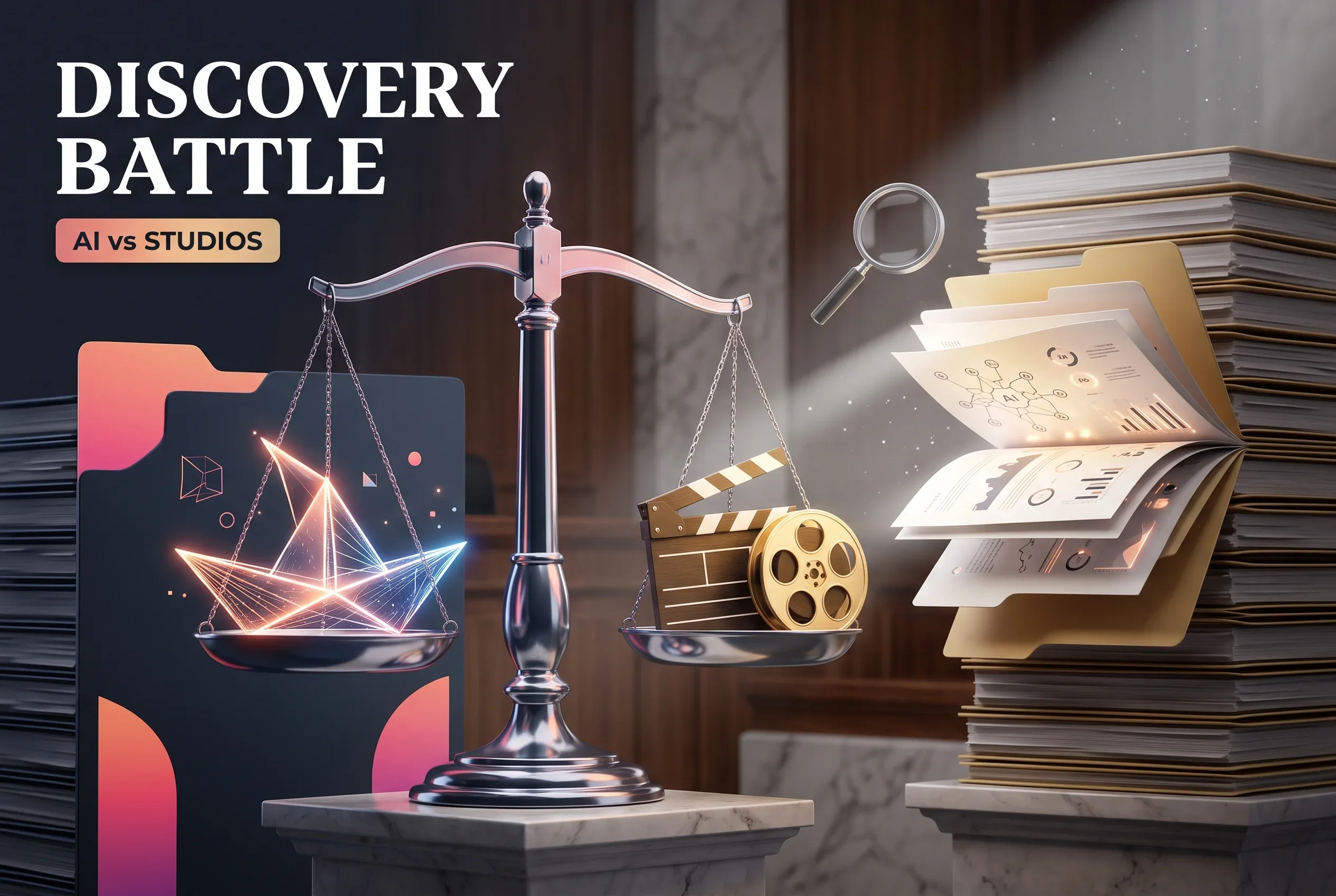
Midjourney Asks Court to Make Disney and Other Studios Disclose Their Internal AI Use
Sued for copyright infringement, Midjourney is challenging a magistrate judge's order that limited discovery to the studios' 'consumer-facing' AI use. It seeks the studios' AI business plans, training datasets, and internal AI production use, calling them central to its fair use defense. A hearing is set for August 17.
Midjourney, the image-generation AI company being sued for copyright infringement by Disney, Universal, and Warner Bros., is going on the offensive over the studios’ own internal AI use. On June 29, 2026, Midjourney asked District Judge John A. Kronstadt of the U.S. District Court for the Central District of California to review a magistrate judge’s order that narrowly limited what the studios must disclose1. A hearing is scheduled for August 171.
The underlying case dates to 2025, when Disney and Universal sued Midjourney for copyright infringement, with Warner Bros. following later that year2. The studios argue that Midjourney’s AI image tools enable users to generate content that copies or closely imitates their copyrighted characters2.
The Dispute: A June 15 Order Limited Discovery to “Consumer-Facing” AI Use
The immediate trigger for the motion is an order issued on June 15, 2026 by Magistrate Judge A. Joel Richlin. While granting Midjourney’s discovery request in part, the judge limited what the studios must produce to their “consumer-facing” AI use, rejecting broader material as irrelevant to Midjourney’s infringement liability13.
Midjourney is challenging that limitation under Federal Rule of Civil Procedure 72(a), which allows a district judge to review a magistrate judge’s order1. Under the current framework, Midjourney argues, the studios can “cherry-pick only those documents they believe support their market harm claims”2.
From Business Plans to Model Weights: What Midjourney Wants
According to reports, Midjourney is seeking a broad set of materials that would show how the studios use AI internally: AI business plans and research reports, training datasets, model weights, and board presentations3. It also wants the prompts the studios themselves entered into Midjourney’s platform and the resulting outputs - not just those that produced allegedly infringing images23. Evidence of internal AI development and use for “storyboarding or ideating content for film or TV” is also on the list2.
In its motion, Midjourney argues that the documents the studios are withholding “are precisely those that would reveal whether, behind closed doors, they are doing exactly what they are suing Midjourney for doing”2. The company maintains that training AI on publicly available images can be fair use, and contends that the studios’ own AI practices support both its fair-use defense and an unclean-hands defense - the principle that a party engaged in the same conduct cannot seek relief for it3.
The Studios’ Position, and Discovery Fights Running Both Ways
David Singer, lead counsel for the studios, counters that they “do not seek to stop AI technology or even shut down Midjourney’s business” - what they want is for Midjourney to “stop copying their movies and TV shows”2.
Meanwhile, the discovery battle is running in both directions. Court records show the studios have moved to compel Midjourney to produce the training source code for its V8 image-generation model and a related repository; Midjourney filed its opposition on June 22, supported by declarations including one from CEO David Holz1. Each side is trying to reach inside the other’s AI.
A Hearing That Could Shape AI Copyright Litigation
Many lawsuits over generative AI and copyright are underway, but this case is a leading example of the world’s largest content companies squaring off directly against a major image-generation AI company. With “how do the plaintiffs themselves use AI internally?” now front and center in discovery, a ruling for Midjourney could set a precedent in which content companies suing AI firms take on disclosure risk over their own AI practices. For businesses adopting generative AI while also caring about rights protection, the outcome offers a practical read on where AI-generated content and copyright debates may land.
Judge Kronstadt’s hearing is set for August 17, and the parties are also scheduled to hold an informal discovery conference on July 141.
Sources
- Disney Enterprises Inc. v. Midjourney Inc., 2:25-cv-05275 - Docket - CourtListener (federal district court docket)
- Midjourney wants Hollywood studios to reveal the details of their AI usage - TechCrunch
- Midjourney Asks Court to Expand Studio AI Discovery - WinBuzzer
Was this article helpful?
Thank you!
Received. Thank you!