OpenAI Codex Micro: a $230 Keypad for Controlling AI Coding Agents With Physical Buttons
OpenAI's first branded hardware is Codex Micro, a $230 limited-run keypad built with Work Louder. Agent Keys glow with live agent status and a dial adjusts reasoning depth. What it does, and what it says about OpenAI's hardware ambitions amid the Apple lawsuit.
OpenAI released “Codex Micro” on July 15, 2026 — a compact keypad purpose-built for its AI coding agent Codex2. Co-designed with keyboard maker Work Louder and priced at $230, it is OpenAI’s first full-fledged branded hardware product2. Sales are limited-quantity, available through OpenAI’s Supply Co. page and Work Louder’s store13.
At first glance it’s a developer gadget. But as a product built around the idea of controlling multiple AI agents with physical buttons and dials, it reflects a real shift in how people work with AI.
What It Does - Agent Status You Can See in Light
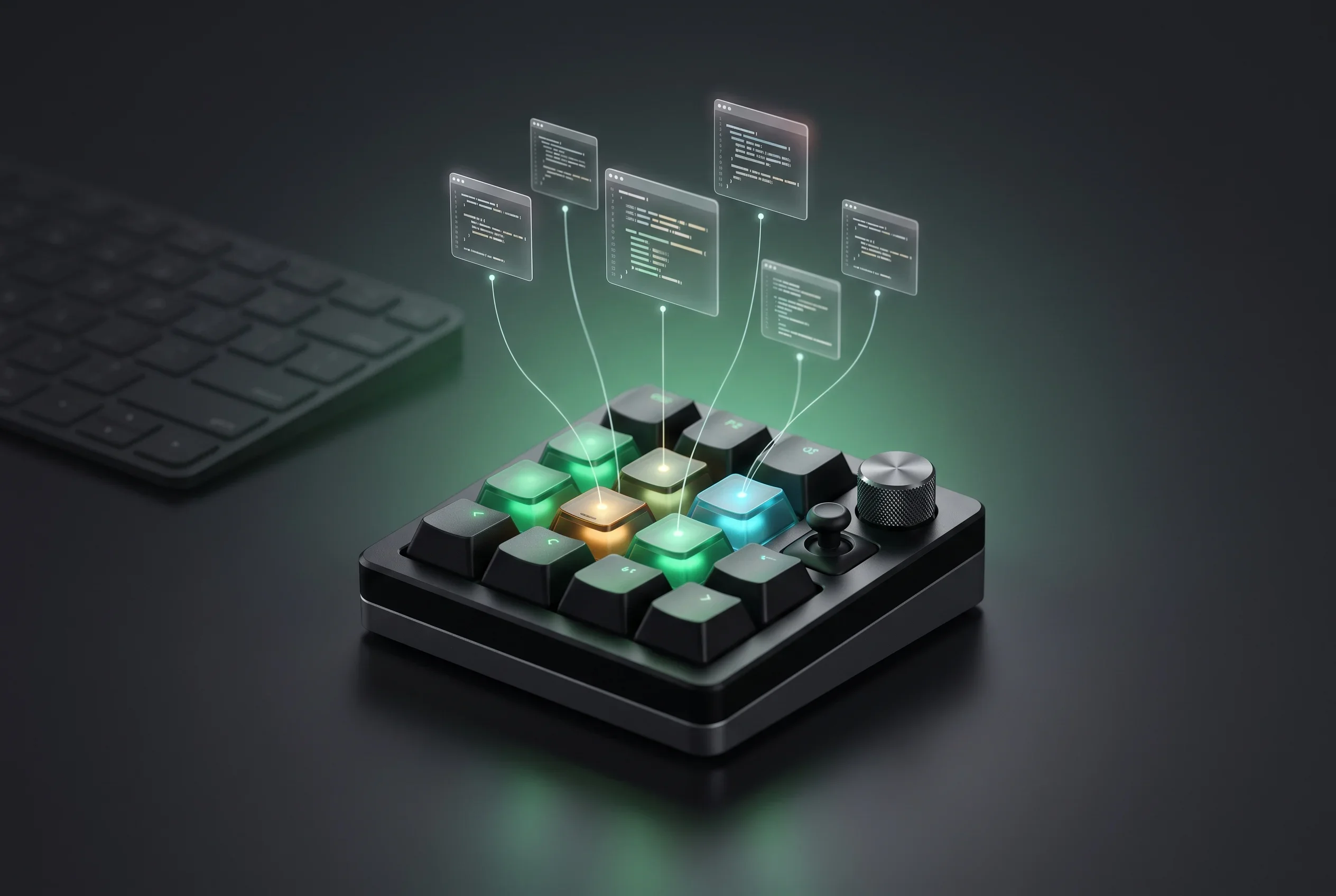
At the center of Codex Micro are the “Agent Keys,” which dynamically reflect the state of tasks assigned to your agents in Codex1. According to 9to5Mac, each Agent Key lights up with a live RGB status from Codex3 — so while running multiple agents, you can tell at a glance which ones are done and which are still working, from the glow at your fingertips.
“Command Keys” can be assigned to accepting changes, rejecting outputs, push-to-talk voice input, starting new chats, and triggering custom actions1. The joystick holds four preset or custom skills1, and a rotary dial controls how deeply your agent thinks1 — physicalizing a setting that until now lived deep inside software configuration screens.
The body is a unibody sandblasted polycarbonate frame on a base milled from a solid block of aluminum1. It comes in two versions — clicky and silent3 — and ships with 32 icon keycaps, 11 solid-color keycaps, and a USB-C to USB-C cable1. It supports Mac and Windows and is directly integrated into Codex1.
Why a Keypad? - The Rise of Parallel Agent Workflows
The case for dedicated hardware comes from how AI coding is changing. Coding agents like Codex are evolving from tools you prompt and wait on into fleets you supervise, with multiple tasks running in parallel. OpenAI itself introduced an “ultra” setting in GPT-5.6 that runs four agents in parallel, making “managing a swarm of agents” a real workflow.
When supervising multiple agents, switching windows just to check status is itself a cost. If a glowing key tells you the state and accept/reject is one physical button away, you can supervise without giving up screen real estate. With AI coding tools converging on similar features and pricing, this is also an attempt to differentiate on a different layer: the physical experience of operating agents.
Launched Mid-Lawsuit - Where OpenAI’s Hardware Strategy Stands
The timing is delicate. Just last week, Apple sued OpenAI for alleged trade secret theft, claiming OpenAI used Apple’s confidential information in developing its own hardware device — an allegation OpenAI denies2. As covered in our article on the Apple v. OpenAI lawsuit, the dispute centers precisely on OpenAI’s hardware development efforts. TechCrunch reports that former Apple engineers are involved in OpenAI’s hardware development2.
That said, TechCrunch notes the keyboard is not the main event. Citing Bloomberg reporting, OpenAI’s long-haul hardware product is a portable, screenless smart speaker in development, with this keyboard positioned as more of a “novelty item”2. Codex Micro is a limited-run collaboration12 — best read not as a revenue pillar but as an experiment in branding and in what “operating agents” should feel like.
AI Control Returns to Physical Devices
Codex Micro itself is a limited-run developer product, not something most readers will buy. But it carries two signals.
First, parallel agent workflows have become routine enough that a dedicated physical interface is worth building. Supervising agents that do work for you is a pattern that will likely spread beyond coding, and the supervision experience — visible status, instant approve/reject — directly affects productivity. When your organization adopts AI agents, how humans supervise them is now a genuine interface design question.
Second, OpenAI has stepped beyond software into hardware. If the rumored smart speaker-style device ships, contact points with AI will extend beyond phone and PC screens. Together with the outcome of the Apple lawsuit, “AI companies going hardware” is a theme worth watching as it reshapes the industry map.
Sources
- Codex Micro - Work Louder official product page (co-developer)
- Amid hardware legal battle, OpenAI releases a $230 keyboard for Codex - TechCrunch
- OpenAI selling $230 Codex Micro hardware product - 9to5Mac
Was this article helpful?
Thank you!
Received. Thank you!