OpenAI Makes GPT-5.6 Generally Available - Sol, Terra and Luna Tiers, Plus an 'ultra' Setting That Runs Four Agents in Parallel
OpenAI released the GPT-5.6 family on July 9, 2026: flagship Sol ($5/$30), balanced Terra ($2.50/$15), and low-cost Luna ($1/$6) per million tokens. The launch introduces 'ultra', which coordinates four parallel agents, and an unusual hardware-passkey requirement tied to the models' cybersecurity capabilities.
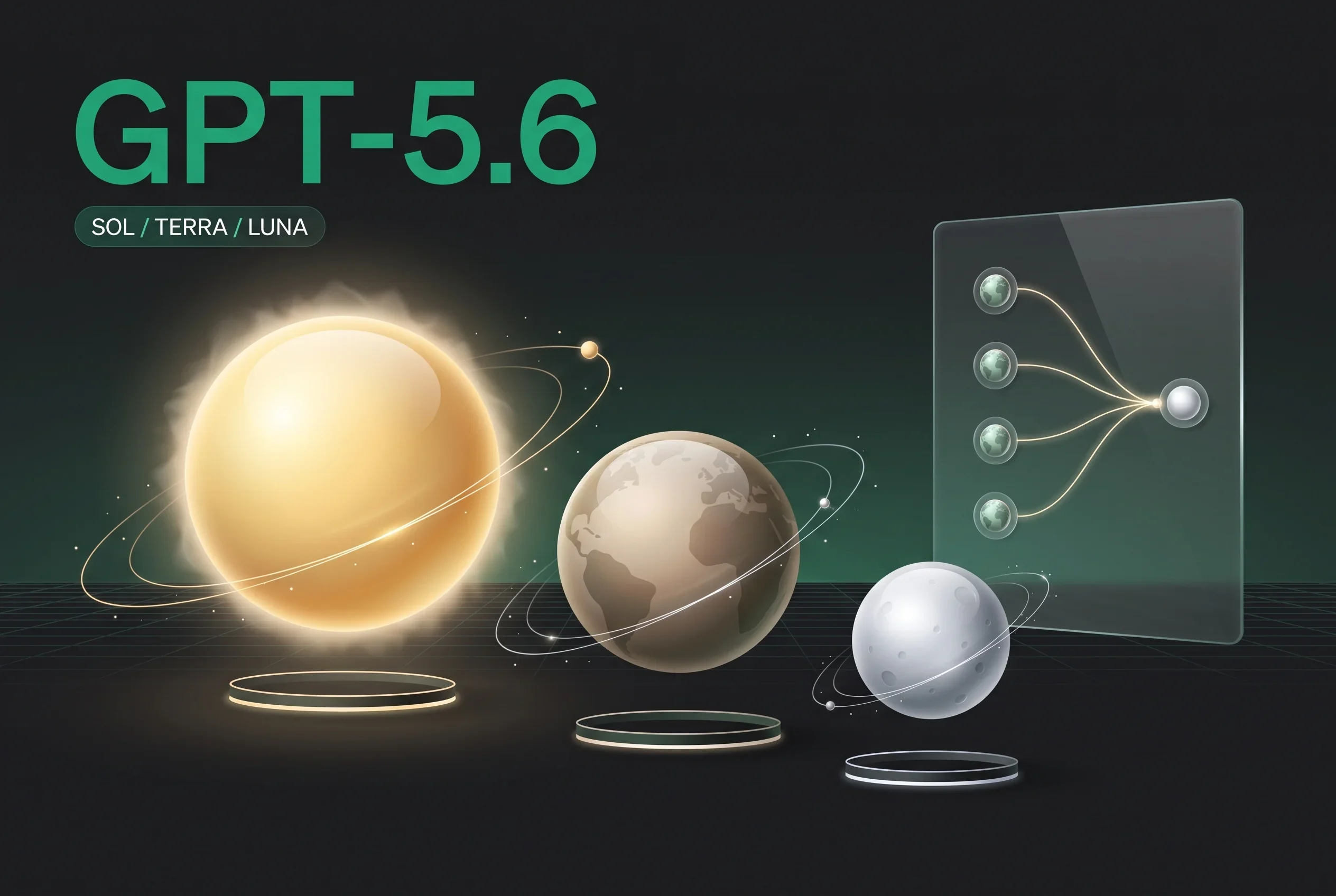
OpenAI began general availability of its next-generation model family, GPT-5.6, on July 9, 20261. The lineup consists of three models: the flagship “Sol,” the balanced everyday-work model “Terra,” and the most cost-efficient “Luna”1. The release follows a limited preview announced on June 262, with availability starting immediately across ChatGPT, Codex, and the OpenAI API and rolling out gradually to all users over 24 hours1.
This GPT-5.6 release is also unusual in that the limited preview took place with U.S. government involvement before the public launch. According to press reports, the late-June preview was restricted to a limited set of partner organizations following coordination with the government, leading up to the July 9 general release34.
Three Tiers and Pricing - “The Number Is the Generation, the Name Is the Tier”
GPT-5.6 brings a cleaned-up naming scheme. The number (5.6) identifies the generation, while Sol, Terra, and Luna are durable capability tiers that can advance on their own cadence1.
API pricing per million tokens is $5 input / $30 output for Sol, $2.50 / $15 for Terra, and $1 / $6 for Luna1. Prompt caching has also been reworked, adding explicit cache breakpoints and a minimum 30-minute cache life. For GPT-5.6 and later models, cache writes are billed at 1.25x the uncached input rate, while cache reads keep the 90% discount1.
In ChatGPT, Plus, Pro, Business, and Enterprise users get Sol at medium and higher reasoning-effort settings, and Pro and Enterprise users can additionally select Sol Pro1. In ChatGPT Work and Codex, Free and Go users get Terra, while paid users can choose among Sol, Terra, and Luna and set a reasoning-effort level for each1.
“ultra” - A New Delivery Model Built on Four Parallel Agents
The most eye-catching part of the announcement is the top-end execution setting, “ultra.” By default it coordinates four agents in parallel, trading higher token consumption for better results and faster completion on complex tasks1. OpenAI published comparisons by agent count on BrowseComp, SEC-Bench Pro, and Terminal-Bench 2.1, including 16-agent configurations1. ultra is available to Pro and Enterprise users in ChatGPT Work, and to Plus and higher plans in Codex1.
For developers, a multi-agent capability is available in beta, letting a single API request run concurrent subagents and synthesize their work1. “Programmatic Tool Calling” also lets the model write and run lightweight in-memory programs that coordinate tools, and is described as Zero Data Retention (ZDR) compatible1. These AI-agent-style execution modes are emerging as a competitive axis beyond raw single-model performance.
Performance Pitch Centers on Token Efficiency - But It’s Not a Clean Sweep
OpenAI’s emphasis is on efficiency rather than absolute performance alone; the announcement leads with “More intelligence from every token, stronger performance per dollar”1. By the company’s own numbers, Sol sets a new high of 53.6 on Agents’ Last Exam, which measures long-running professional workflows across 55 fields, and reaches a state-of-the-art 80 on the Artificial Analysis Coding Agent Index at max reasoning - beating Claude Fable 5 by 2.8 points while using less than half the output tokens at roughly one-third less cost1.
At the same time, OpenAI’s own comparison tables show Anthropic’s Claude Fable 5 well ahead on SWE-Bench Pro, which tests fixes in real codebases, at 80% versus Sol’s 64.6%, and slightly ahead on the knowledge-work benchmark GDPval-AA v21. A footnote also notes that the latency and cost figures are estimates from OpenAI’s own offline simulations1. Which model wins likely depends on the task. Competition in this space has intensified this month with the arrival of Claude Sonnet 5 and Grok 4.5.
A Jump in Cyber Capability - and a Passkey Requirement to Match
GPT-5.6 shows steep gains in cybersecurity performance: 73.5% on ExploitBench, which measures building exploits from vulnerabilities (GPT-5.5: 47.9%), and 71.2% on SEC-Bench Pro (GPT-5.5: 45.8%), according to OpenAI1. While stressing that defensive uses should not be blocked, the company is starting with conservative settings - Sol’s cyber safeguards block roughly ten times more potentially harmful activity than previous models - and offers a fallback to retry prompts on lower-capability models when benign requests get caught1.
The change that directly affects users is a new access requirement. To retain access to OpenAI’s most cyber-capable frontier models, individual users must enable “Advanced Account Security” with hardware-backed passkeys by September 1; those who do not will return to default access1. Users without hardware passkeys can get preferred pricing through a partnership with Yubico1. OpenAI is also tightening access for high-risk entities and jurisdictions1.
The First Frontier Model Released Through a Government Review
The release process itself has drawn scrutiny. In an article titled “How did the government decide OpenAI’s frontier model was safe to release?”, TechCrunch points out that little has been disclosed about the evaluation’s procedures and criteria, with experts raising the structural question of who acts as gatekeeper and grants permission3. Government figures named in connection with the process include Commerce Secretary Howard Lutnick, Treasury Secretary Scott Bessent, and National Cyber Director Sean Cairncross3.
OpenAI says it ran its most extensive safety evaluation to date before general availability, including testing with external experts and approximately 700,000 A100e GPU hours of black-box automated red teaming, and that while capabilities improved in both biology and cybersecurity, neither crosses the company’s “Critical” threshold1. Details are published in the system card1. Following the export controls placed on and then lifted from Claude Fable 5, government involvement is becoming a precondition for frontier model releases.
Sources
- GPT-5.6: Frontier intelligence that scales with your ambition - OpenAI official blog (July 9, 2026)
- Previewing GPT-5.6 Sol: a next-generation model - OpenAI official blog (June 26, 2026)
- How did the government decide OpenAI’s frontier model was safe to release? - TechCrunch (July 9, 2026)
- OpenAI gets permission to roll out GPT-5.6 to the public on July 9 - Engadget
Was this article helpful?
Thank you!
Received. Thank you!