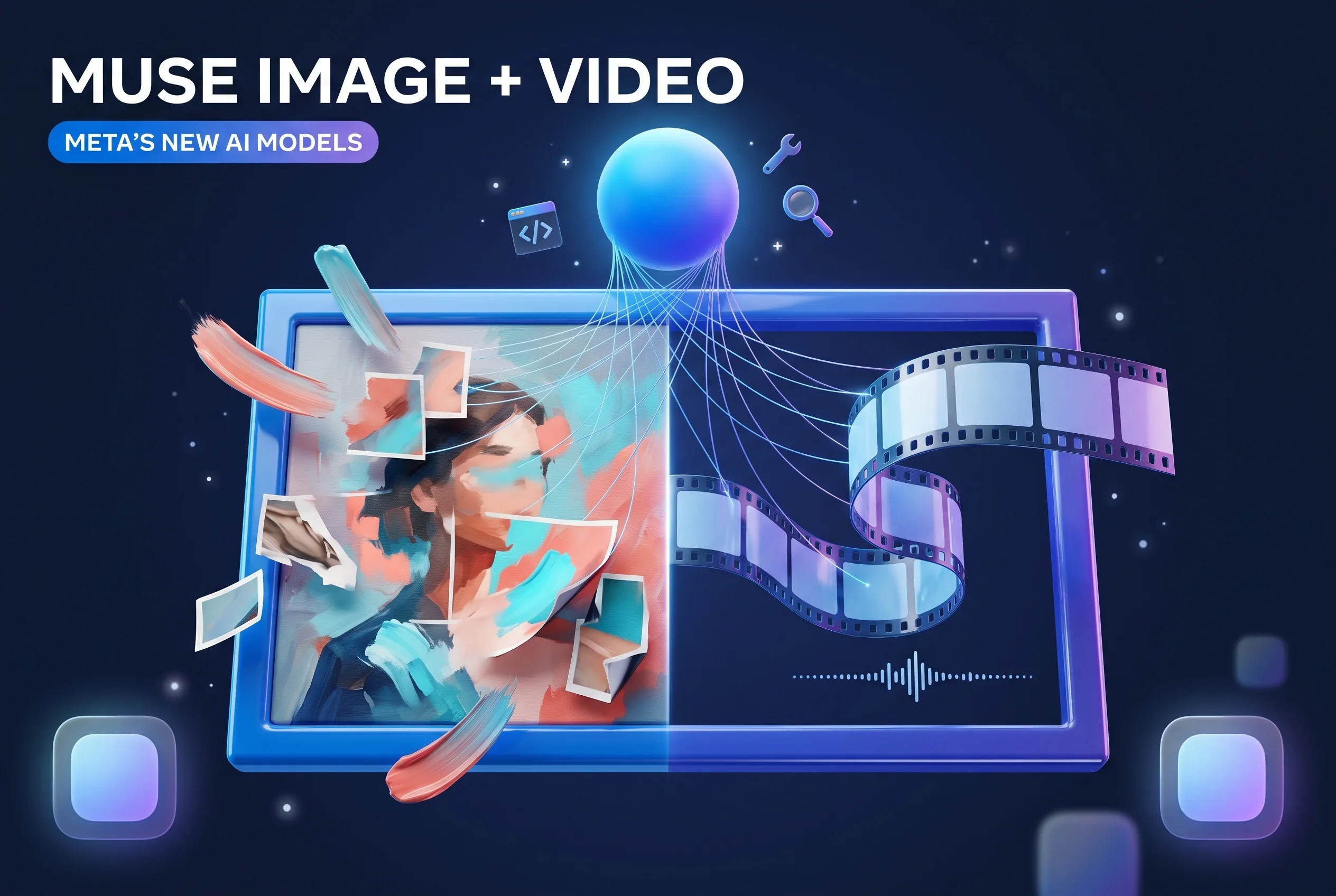
Meta Launches Muse Image and Muse Video - The First Media Generation Models from Superintelligence Labs
Meta announced Muse Image on July 7, 2026, the first media generation model from Meta Superintelligence Labs. It works agentically — writing code and searching the web while it creates — and is available in the Meta AI app and Instagram Stories in the US. Muse Video enters early preview with native audio.
Meta announced on July 7, 2026 the launch of its image generation model Muse Image and an early preview of its video generation model Muse Video1. They are the first media generation models developed by Meta Superintelligence Labs, the company’s AI research organization1. Muse Image is available starting the same day across the Meta AI app and meta.ai, Instagram Stories in the US, and WhatsApp in limited countries, with Facebook support coming soon1.
Meta Superintelligence Labs debuted its first large language model, Muse Spark, in April 20263, making Muse Image and Muse Video the lab’s second major release. After a period of upheaval — including the departure of key members from the Llama team — Meta’s AI development is now extending its new organization’s output beyond text into other modalities.
An Image Model That Acts Like an Agent
What sets Muse Image apart is that it behaves like an agent rather than simply converting a prompt into pixels. The model has learned to write and execute code1, which it uses for elements that demand precision, such as plots and QR codes. It can also search the web on its own to ground its generations in facts1.
The model also exhibits self-refinement, reflecting on and improving its own work1. Quality scales with the amount of compute used at generation time: according to Meta, it shows an approximately log-linear scaling relationship with test-time compute1. It can also blend multiple photos into a single high-quality creation and uses advanced reasoning to understand complex prompts2.
On the Arena leaderboards, Muse Image holds the No. 2 spot for text-to-image, single-image editing, and multi-image editing (as of July 5, 2026)1.
Muse Video Previews with Native Audio
Muse Video, released as an early preview, is built on the same foundation as Muse Image and generates video with native audio support1. It ranks No. 3 in human-preference Elo for text-to-video on Arena (as of the same date)1. Meta acknowledges remaining gaps in audio-video synchronization and physically accurate fast motion1. It is planned to roll out to creators and in Meta AI.
Generated content carries Content Seal, an invisible watermark embedding a provenance signal that stays intact through editing, making AI-generated content identifiable1.
Built Into Instagram and WhatsApp from Day One
Notably, this launch is not a standalone model release — it ships embedded in Meta’s flagship apps. Instagram Stories gains more than 30 new AI-powered effects2, and WhatsApp users can generate images in direct chats with Meta AI, starting in limited countries2. Messenger support is also planned2. Advertisers and agencies will be able to tap into Muse Image through Advantage+ creative2.
The image generation race remains crowded: Google released its Nano Banana 2 Lite image model and Gemini Omni Flash video model in July, as major players compete on both cost and quality. Meta’s distinct advantage is distribution — placing a generative image model directly inside Instagram and WhatsApp, apps billions of people already use daily. Rather than users going out to find AI tools, AI arrives inside the apps they already open. For readers in marketing and advertising, the Advantage+ integration is the change most likely to reach day-to-day work.
Technical details are available in the announcement on the Meta AI blog.
Sources
- Introducing Muse Image and Muse Video - Meta AI official blog (July 7, 2026)
- Introducing Muse Image: Image Generation Built for Your World - Meta official newsroom
- Meta debuts Muse Image, its first AI image model built under Alexandr Wang’s lab - The Next Web
Was this article helpful?
Thank you!
Received. Thank you!