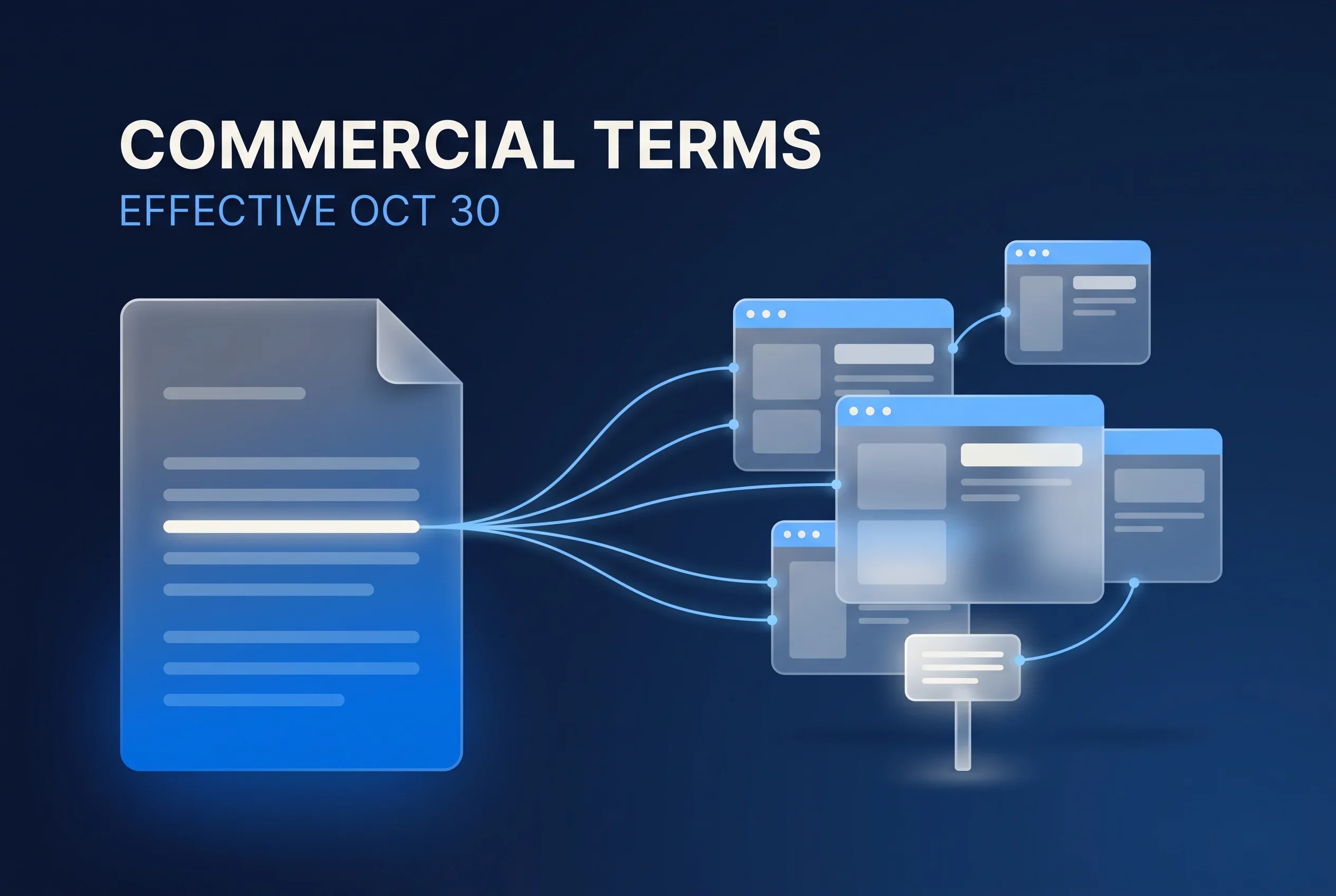
Meta's Commercial Terms Change on October 30 - New Clause Lets Meta Crawl Business Users' Associated Sites and Use Them to "Train" Products
Meta has revised its Commercial Terms, effective October 30, 2026. A new clause says Meta may crawl domains associated with the products and services of users who use ads, Facebook Pages and similar tools for business, and may use that content to develop and train its products. The current version has no such clause. Meta says it is consolidating existing language and that robots.txt can still be used to manage access.
Meta has revised the Meta Commercial Terms, which govern business and commercial use of its products, and the new version takes effect on October 30, 20261. It adds a clause under which Meta may crawl domains and web pages “associated” with a user’s products or services using automated software, and may use that content to develop and train Meta’s products.
The change is not limited to news organizations. The terms list business or commercial purposes as including running ads or sending marketing messages, selling goods, developing apps, maintaining product catalogs, running a Facebook Page or Group, working in business tools like Ads Manager and Meta Business Suite, and relying on Meta’s measurement services, whatever the type of entity1. A company that runs its own website falls under these terms as soon as it advertises or manages a Page on Meta.
What the new crawling clause says
The addition sits in the section titled “Licenses & Rights You Provide Meta”1. In summary:
- The user permits Meta, or anyone acting for it, to use automated software (web scrapers, bots, spiders, crawlers, user agents and the like) and to set up test credentials so it can reach the covered domains, pages and URLs, and then crawl, index, store copies of, analyze and gather their content
- The covered material is anything tied to the user’s products or services, or made available when the user or other people use Meta’s products. Meta may also pull updates from those locations on a recurring basis
- Meta may use what it gathers for running, building, improving, researching and training the products, services and features covered by the Commercial Terms plus supplemental terms, and for keeping them secure
The terms do not define which domains count as “associated.”
The revised version also adds an “AI Features” clause, under which users accept that AI features can produce wrong results and take responsibility for the risks of those features and the content they produce, along with a rule against altering or stripping AI-generated watermarks or content-authentication metadata. A new section incorporates supplemental terms by reference, including the Self-Serve Ad Terms, the Business Tools Terms that cover Meta Pixel and the Conversions API, and the Meta Business Agent terms, among others1.
How it differs from the current terms, and Meta’s explanation
Comparing the version now in force (effective March 6, 2024) with the revised one shows that the crawling and training clause, the AI Features clause and the section incorporating supplemental terms are all absent from the current text2.
Speaking to Nieman Lab, a Meta spokesperson said crawling language had previously been spread across different terms, such as the terms covering generative AI for advertising, and that this update gathers it in one place4. He also said the change will not alter how Meta crawls going forward and that site owners remain able to control access with robots.txt. Meta declined to answer the list of questions Nieman Lab sent.
What robots.txt can do
In its developer documentation on crawlers, Meta says it lets site owners express preferences through industry-standard methods such as robots.txt instead of nonstandard signals like NoAI tags3. Site owners add a disallow rule for each crawler they want to block, and the documentation describes crawlers by purpose, including:
- Meta-ExternalAgent: for work such as training foundation models, or improving products through direct indexing of content
- Meta-ExternalAds: for work such as making ads and other business offerings better
- Meta-WebIndexer: used to improve the quality of Meta AI search results
The same documentation states that Meta-ExternalFetcher, which fetches individual links when a user asks, and FacebookExternalHit, when it runs security or integrity checks, may bypass robots.txt3. It also notes that robots.txt changes can take up to 24 hours to take effect.
Issues raised by legal experts
According to Nieman Lab, three legal experts who read the terms at the publication’s request said the wording could support an argument that Meta may gather news-site material and train its AI on it4. The experts also said it gives Meta room to argue that the terms override other blocking instructions such as robots.txt.
On the test credentials, Cornell Law School professor James Grimmelmann said they would technically let Meta register as a fake user on sites that require sign-up and get past the registration barrier4. Meta did not answer whether the credentials would be used to get around paywalls or other subscriber-only material.
The experts added that whether training on content gathered this way would be allowed still depends on open legal questions over fair use in AI training4. In the United States, the Justice Department filed a statement arguing that training itself is fair use, but that statement does not bind courts. Some publishers, as in the Seattle Times and Newsday lawsuit against OpenAI and Microsoft, argue in their complaints that their robots.txt files prohibited crawling.
What to check before October 30
The update clause in the revised terms says that continuing to use Meta’s products for business after notice of an update means agreeing to the new terms, and that a user who does not agree may stop business use1. Nieman Lab reports that business accounts have no way to opt out of this clause alone before October 304.
For companies that manage how their website content is used, these are the points to check before the effective date:
- Whether the company uses Meta in ways covered by the Commercial Terms (ads, Page management, Business Suite, Meta Pixel and so on)
- How robots.txt treats Meta-ExternalAgent and Meta-ExternalAds, and which crawlers show up in server logs
- How much content behind sign-up or login is published on the assumption that outsiders could retrieve it
Meta also released the open-weight Muse Spark Open on October 15, 2026. Whether the scope Meta claims for training under these terms or a site’s robots.txt preference prevails in practice likely will not be settled until Meta explains how it reads the clause or a legal ruling arrives. The next thing to watch is whether Meta clarifies its practice in documentation or responses after the terms take effect.
Sources
- Meta Commercial Terms (version effective October 30, 2026) - Meta (revised terms)
- Meta Commercial Terms (current version) - Meta (effective March 6, 2024)
- Meta Web Crawlers - Meta for Developers
- Meta’s new commercial terms will allow the scraping of news sites, legal experts say - Nieman Lab (October 15, 2026)
Was this article helpful?
Thank you!
Received. Thank you!