Explaining similarity-ts: A Code Duplication Detection Tool for the AI Era
Introducing similarity-ts, a tool that rapidly detects code duplicates in TypeScript projects. Learn about high-precision similarity detection using AST analysis and the TSED algorithm.
As AI-generated code from tools like Claude Code becomes commonplace, there’s a growing trend of similar code accumulating within projects. Such duplicate code reduces maintainability and contributes to technical debt. The tool we’re introducing today, “similarity-ts,” is a high-speed code duplication detector developed to address these challenges1.
similarity-ts is implemented in Rust and supports multiple programming languages including TypeScript/JavaScript, Python, Rust, Go, and Java. Notably, TypeScript/JavaScript support has reached “Production Ready” status, operating at high speed even in large-scale projects2.
Key Features and Functionality
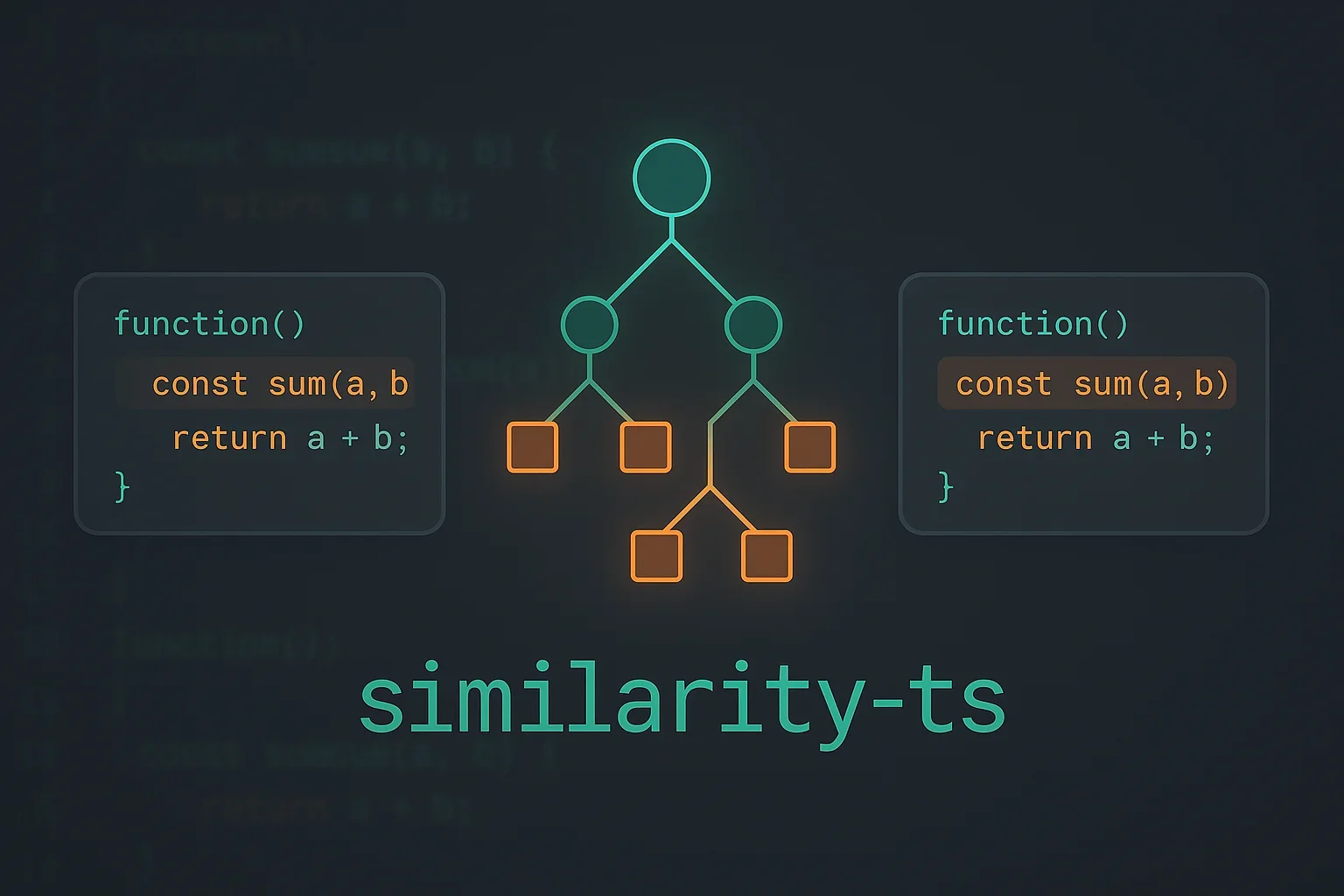
The primary feature of similarity-ts is its adoption of Abstract Syntax Tree (AST)-based structural comparison. This enables detection of structurally similar code even when variable names differ.
Zero Configuration
Using the tool is remarkably simple. Just run the following command in your project’s root directory to start detecting duplicate code1.
# Installation
cargo install similarity-ts

# Execution
similarity-ts

# Display detailed results
similarity-ts . --print
Multi-language Support
Currently supported languages and their maturity levels2:
- Production Ready: TypeScript/JavaScript
- Beta: Python, Rust
- Experimental: Go, Java, C/C++, C#, Ruby, Elixir
Optimized parsers are used for each language, with oxc-parser for TypeScript/JavaScript and tree-sitter for Python and Rust.
Technical Architecture: The TSED Algorithm
At the core of similarity-ts is the TSED (Tree Similarity of Edit Distance) algorithm. Based on a paper published on arXiv, it determines code similarity by calculating tree structure edit distances1.
Algorithm Overview
The TSED algorithm builds upon APTED (All Path Tree Edit Distance), applying penalties based on actual code volume to calculate similarity. This detects structural similarities that simple string comparisons would miss3.
Performance Optimizations
Developer mizchi notes that while initially implemented in TypeScript, the computational complexity caused crashes in large projects. After rewriting in Rust, the following optimizations were applied1:
- Bloom filter pre-filtering: Rapidly excludes clearly different function pairs (~5x speedup)
- Multi-threaded processing: Parallelizes file reading and analysis (~4x speedup)
- Efficient memory management: Optimizations leveraging Rust’s ownership system
These optimizations achieved approximately 50x overall speedup.
Usage Examples and Output
Running similarity-ts produces output like1:
Similarity: 89.09%, Score: 8.0 points
  src/utils/getUserById.ts:4-12 getUserById
  src/utils/findUserById.ts:8-16 findUserById
This example shows that the getUserById and findUserById functions have 89.09% similarity. The score is calculated based on edit distance, with lower scores indicating higher similarity.
Use Cases and Future Outlook
Primary Use Cases
- AI code generation quality control: Detecting and consolidating similar AI-generated code
- Refactoring: Identifying and consolidating duplicate code
- Code reviews: Checking if new code duplicates existing code
- Technical debt visualization: Measuring project-wide duplication
Future Outlook
The developer lists the following planned improvements1:
- Faster type definition literal comparison
- Code quality measurement features
- More advanced semantic similarity detection
similarity-ts presents a new approach to code quality management in the AI era. It’s a tool that efficiently detects duplicate code developers inadvertently generate, contributing to more maintainable codebases.
For project details and installation instructions, please refer to the GitHub repository. Those interested in the technical details of the algorithm may find the related academic papers helpful.
Sources
- Introduction to similarity-ts - Zenn (Explanation by mizchi)
- similarity-ts GitHub Repository - Official GitHub repository
- Revisiting Code Similarity Evaluation with Abstract Syntax Tree Edit Distance - arXiv (Paper on the TSED algorithm)
Was this article helpful?
Thank you!
Received. Thank you!