Handy: A Free, Open-Source, Offline Speech-to-Text (Dictation) App
Handy is a free, open-source, fully offline speech-to-text app: hold a shortcut, speak, and your words appear at the cursor. How CJ Pais built it after breaking a finger, plus its accuracy and MIT-licensed design.
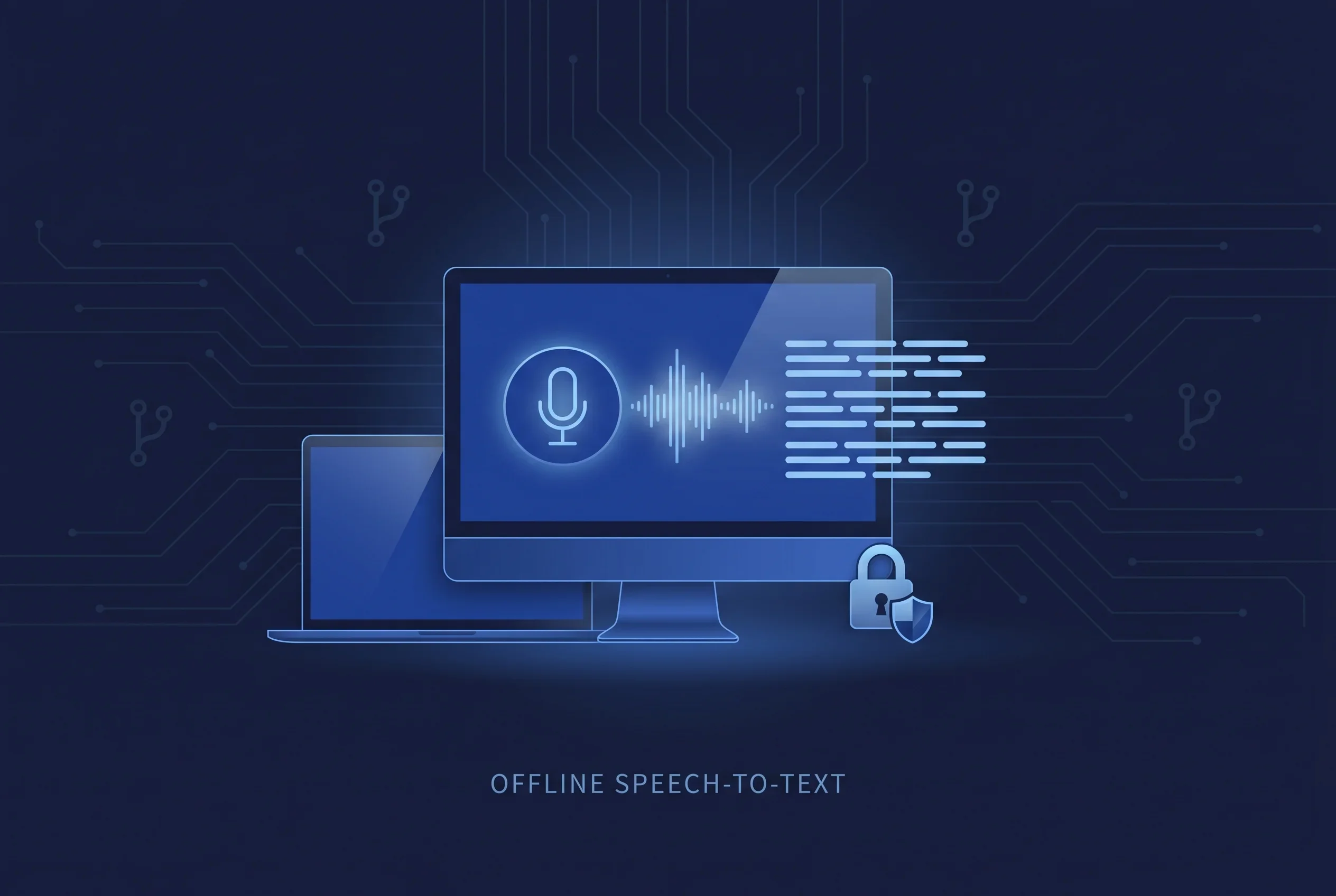
Hold a keyboard shortcut, speak, release the key—and what you said appears right at your cursor. That is the entire workflow of “Handy,” a speech-to-text application. Your audio is never sent to the cloud; transcription happens entirely on your own computer1. Released as open-source software under the MIT license, it runs on macOS (Intel/Apple Silicon), Windows, and Linux3. With roughly 23,500 GitHub stars as of June 20263, it has become an increasingly visible option among free, local speech-to-text tools.
A Tool Born from a Broken Finger
Handy began with the developer’s own injury. As the official About page puts it: “I broke a finger, was put into a cast and as a result my hand was out of commision”2. Unable to type, the developer tried the available dictation apps, but “none were open source and extensible”2. Building one himself became the project’s starting point.
What stands out is the project’s stated philosophy: “Handy isn’t trying to be the best speech-to-text app. It’s trying to be the most forkable one”2. The project aims to provide a codebase that people who need accessibility features, or who want to experiment with voice computing, can truly own and modify2—a design stance that values hackability over feature completeness.
Who Is CJ Pais?
Developer CJ Pais describes himself as a “Software Artist” and works independently7. He studied Math and Computer Science at UC San Diego, worked on molecular dynamics simulations of organic semiconductors in a research lab, and then spent two years at Qualcomm working on 5G Layer 1 software7. He left that job about five years ago and has been freelancing since, with open-source contribution as a central focus7.
On his personal site he says he pursues “technology that gets out of the way, that helps us live more presently”7, and he is deeply involved in outdoor pursuits such as multipitch trad climbing and surfing7. Beyond Handy, his GitHub account also hosts transcribe-rs, a transcription library for Rust6.
Architecture and Supported Models
Handy is a desktop app built on Tauri V2, combining a Rust backend with a React + TypeScript frontend3. It is assembled from Rust-ecosystem libraries: whisper-rs for speech recognition, the developer’s own transcribe-rs for CPU-optimized models, and vad-rs for voice activity detection3.
Users can choose among multiple speech recognition models: four Whisper variants—Small (487MB), Medium (492MB), Turbo (1600MB), and Large (1100MB)—plus Parakeet V2 and V3, which are CPU-optimized and support automatic language detection3. Two recording modes are available: push-to-talk, which records while the key is held (the default), and a toggle mode that starts and stops on each press1. In contrast to cloud-based, full-duplex voice models such as OpenAI’s GPT-Live, announced in July 2026, Handy is built around fully local processing that works without a network connection.
How Accurate Is It?
A review by the maker of competing product Voibe (April 2026) rates Handy 7.5/10 overall and 8/10 for accuracy, calling it the most reliable free open-source offline dictation tool5. For English dictation, the review states that “Handy with Whisper Large delivers accuracy comparable to cloud dictation services”5.
The same review also lists limitations: “first-word clipping” at the start of utterances, a 2-5 second processing delay, minimal automatic punctuation, no AI text cleanup, no mobile app, and limited Linux Wayland support5. Since this is a competitor’s review, some discounting is warranted—but Hacker News commenters likewise report good results in Spanish and German4, and the Bluetooth latency complaints described below overlap with the review’s findings, so the overall picture is broadly consistent.
What the Community Says
Handy was featured on Hacker News around February 2026, drawing 247 points and 110 comments4. Commenters praised its speed—“Parakeet v3 works great with it…Strongly recommend!” and “Super fast, super simple, doesn’t get in my way”—as well as its UI: “The ui is well thought out, just the right amount of setting” and “Use it daily. Looks and works great.”4
The most common complaint concerned latency with Bluetooth microphones. One user reported “there was always a 1-2sec delay before it would actually start transcribing,” and the developer acknowledged that “using Bluetooth devices does not work super well at the moment”4. The developer was an active participant in the thread, revealing that LLM post-processing exists behind a debug menu, and staying true to the fork-friendly ethos: “I’d just try it and fork handy if it doesn’t work how you want”4.
On cost, the aforementioned Voibe review compares three-year totals: Handy at $0, versus $149 for the one-time-purchase Voibe, $254.97 for the subscription-based Superwhisper, and $432 for Wispr Flow5. As subscription dictation tools multiply, the combination of free, offline, and freely modifiable makes Handy’s position distinctive.
For anyone who uses voice input daily, having an option to try without privacy or cost concerns is welcome. Its deliberately minimal push-to-talk design means paid tools still win if you want punctuation cleanup or AI editing, but if you want speech-to-text you can truly own, Handy is worth trying first. Downloads are available on the official site, and the source code is on GitHub.
Sources
- Handy - Official site
- About Handy - Official site (origin story and philosophy)
- cjpais/Handy - GitHub repository
- Handy – Free open source speech-to-text app - Hacker News thread
- Handy Review 2026 - Voibe (review by a competing product’s maker)
- cjpais (CJ Pais) - Developer’s GitHub profile
- About CJ Pais - Developer’s personal site
Was this article helpful?
Thank you!
Received. Thank you!