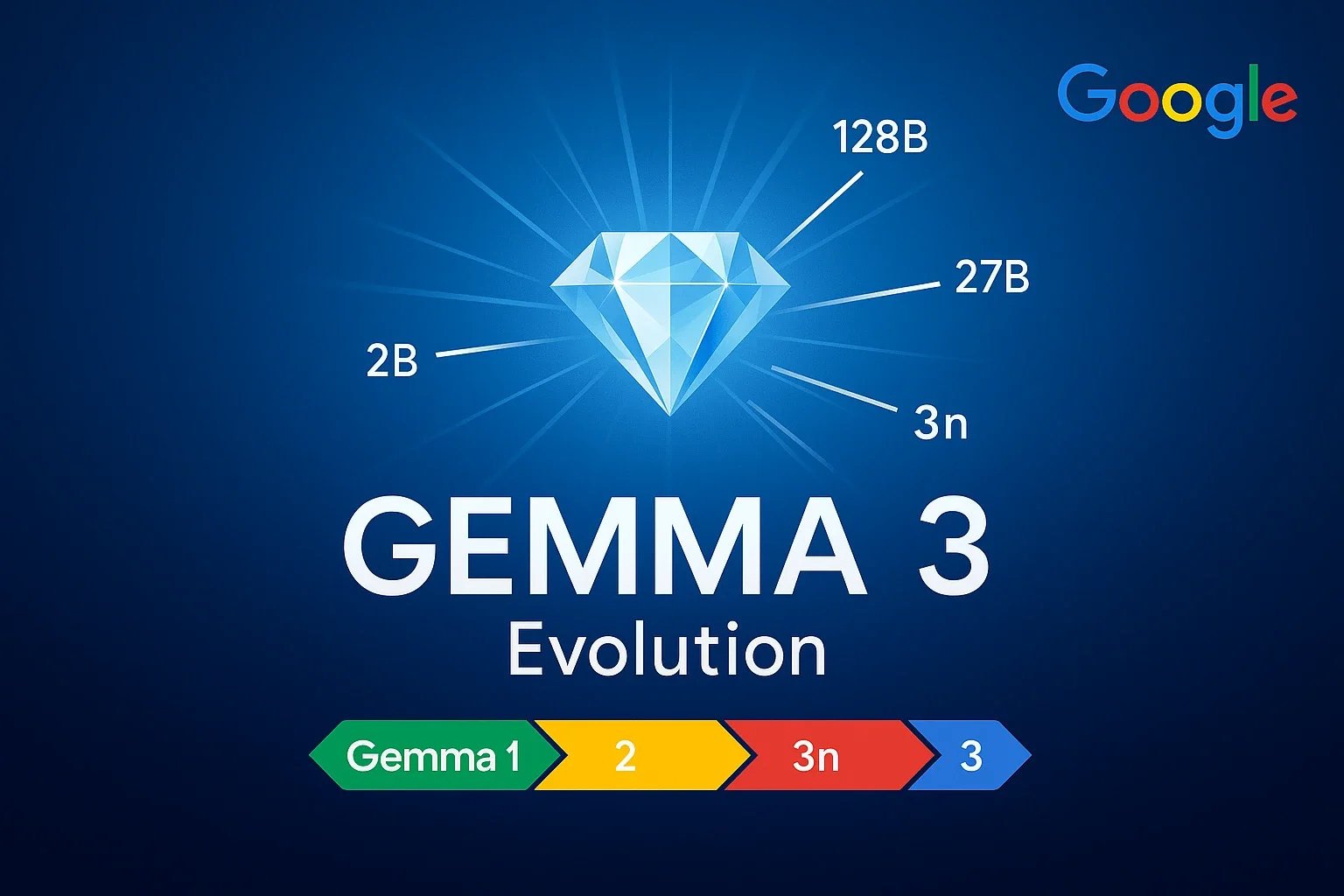
Google Gemma: The Evolution and Strategy of Lightweight, High-Performance Open Models
A comprehensive look at Google's open LLM 'Gemma' evolution over 18 months, from its February 2024 debut to the latest Gemma 3, exploring technical innovations and strengths
When Google unveiled Gemma in February 2024, it brought a fresh breeze to the world of open-source LLMs. This model family, built on Gemini technology, has undergone rapid evolution in just 18 months, reaching its fourth generation as Gemma 3 in June 2025. With over 100 million downloads marking its success, let’s look back at Gemma’s journey and its technical strengths.
The name Gemma derives from the Latin word meaning “precious stone”1. This name expresses its connection to the company’s flagship Gemini model while representing its existence as a smaller, more manageable “gem.” From the first Gemma to the latest Gemma 3, each generation has steadily improved in performance and functionality, significantly impacting the open-source community.
The Evolution Timeline of Gemma Series
First Generation Gemma (February 2024)
On February 28, 2024, Google first introduced Gemma to the world1. Developed through collaboration between Google DeepMind and teams across Google, the model was offered in two sizes: 7B parameters (for GPU/TPU) and 2B parameters (for CPU/device). Each came with two variants: base and instruction-tuned models.
The defining characteristic of the first Gemma was its lightweight nature. Compared to the large-scale models prevalent at the time, it delivered excellent performance while being operable on consumer-grade hardware.
Gemma 2 (June 2024)
Just four months after the initial release, Google announced Gemma 2 in June 20242. This second generation significantly expanded the model size lineup: three sizes of 2B, 9B, and 27B parameters were offered. Notably, the 27B model achieved the groundbreaking feat of delivering performance comparable to Llama 3 70B at less than half the size.
Gemma 3n Preview (May 2025)
On May 22, 2025, Google announced the preview version of Gemma 3n3. This was the first open model to adopt a new architecture, specifically optimized for mobile device operation. Compared to Gemma 3 4B, it achieved approximately 1.5x faster response times on mobile with significantly improved quality.
Gemma 3 (June 2025)
Then on June 25, 2025, Google introduced the latest Gemma 34. Built on Gemini 2.0 technology, this fourth generation became the most capable and versatile model to date.
Gemma Series Specification Comparison
| Version | Release Date | Parameter Sizes | Context Length | Key Features |
|---|---|---|---|---|
| Gemma 1 | Feb 2024 | 2B, 7B | 8K tokens | Lightweight, efficient, basic language processing |
| Gemma 2 | Jun 2024 | 2B, 9B, 27B | 8K tokens | Performance boost, Llama 3 70B-level performance at 27B |
| Gemma 3n | May 2025 | 2B, 4B | 32K tokens | Mobile-optimized, nested architecture |
| Gemma 3 | Jun 2025 | 1B, 4B, 12B, 27B | 128K tokens | Multimodal support, 140+ language support |
Technical Strengths of Gemma 3
1. Innovative Architecture
Gemma 3 incorporates several key technical innovations5. Through efficiency improvements via Grouped-Query Attention (GQA), enhanced training stability with QK-normalization, and adoption of the Gemini 2.0 SentencePiece tokenizer (262k vocabulary), multilingual support and code processing capabilities have been significantly enhanced.
2. Multimodal Capabilities
The Gemma 3 4B, 12B, and 27B models support not only text but also image inputs6. Using a frozen SigLIP encoder to process images, they can efficiently handle 896×896 resolution images. Compared to PaliGemma 2, they achieve approximately 10x transfer efficiency at the same resolution.
3. Long Context Processing
With a massive 128K token context window, Gemma 3 enables complex document processing and maintaining long conversations4. The new interleaved local/global attention mechanism effectively mitigates the KV cache memory bottleneck.
4. Multilingual Support
Gemma 3 is pre-trained on over 140 languages and is immediately usable in over 35 languages6. By increasing the proportion of multilingual data and adopting advanced sampling strategies to manage language imbalances, it strongly supports global application development.
Gemma Ecosystem and Derivative Models
Beyond the basic Gemma models, Google has developed derivative models specialized for specific use cases:
- CodeGemma: Specialized for code generation
- RecurrentGemma: RNN-based model for efficient inference
- PaliGemma: Vision-language understanding model (VLM)
These models are available on various platforms including Hugging Face, Kaggle, and Google Cloud Vertex AI, and integrate with major frameworks like JAX, PyTorch, and TensorFlow.
Performance Benchmarks and Real-World Applications
Benchmark Results
Gemma 3 has shown excellent results in multiple evaluations6. In human evaluations, it outperformed large models like Llama-405B, DeepSeek-V3, and o3-mini. What’s particularly noteworthy is that it delivers performance comparable to these giant models while being operable on a single GPU or TPU host.
Edge Device Applications
Each Gemma 3 model can be deployed to NVIDIA Jetson family embedded computing boards6. The 1B and 4B models can run on small devices like the Jetson Nano, while the 27B model can handle high-load applications on the Jetson AGX Orin.
The Future of Open AI as Shown by Gemma
The success of the Gemma series reaffirms the importance of open-source AI models. By providing high-performance models based on cutting-edge research in a form that researchers and developers can freely use, Google contributes to the democratization of AI technology.
Gemma 3 in particular, with its efficiency, versatility, and accessibility, has opened pathways for organizations of all sizes to leverage AI technology. Its ability to perform enterprise-level tasks while being operable on a single GPU makes it an attractive choice for many developers.
Google’s open-source strategy and Gemma’s continuous evolution will serve as an important driving force in accelerating the democratization and innovation of AI technology.
Sources
- Gemma: Google introduces new state-of-the-art open models - Google Official Blog (First Gemma Announcement)
- Google launches Gemma 2, its next generation of open models - Google Official Blog (Gemma 2 Announcement)
- Announcing Gemma 3n preview: powerful, efficient, mobile-first AI - Google Developers Blog (Gemma 3n Announcement)
- Gemma 3: Google’s new open model based on Gemini 2.0 - Google Official Blog (Gemma 3 Announcement)
- Gemma 3 Technical Deep Dive - Architecture, Performance, and Implications - Technical Deep Dive
- Welcome Gemma 3: Google’s all new multimodal, multilingual, long context open LLM - Hugging Face Official Blog
Was this article helpful?
Thank you!
Received. Thank you!