What Is a Vector Database? Its Role in RAG and Semantic Search
What is a vector database? A plain-language guide to how it searches data by 'closeness in meaning' rather than keyword matches, covering embeddings, similarity search, and approximate nearest neighbor (ANN) search. We explain its role as the core component behind RAG's retrieval, based on Elastic's official guide.
You ask an AI that searches internal documents about a “smartphone,” and documents that say “mobile phone” or “handset” come up properly too—this kind of search that “looks by meaning, not the words themselves” is supported by the vector database. As internal AI and AI search using RAG (retrieval-augmented generation) spread, it quietly plays an important role behind the scenes.
A vector database is a specialized database for converting text and images into “a sequence of numbers that represents meaning,” storing them, and quickly finding semantically close items. This article explains what a vector database is, why it can search by meaning, and what role it plays within RAG, based on Elastic’s official guide and other sources, for a non-specialist audience. Reading it alongside embeddings—the mechanism that turns words into numbers—will give you the full picture of AI search.
What Is a Vector Database: A Storehouse for Searching by Meaning
Elastic’s explainer defines a vector database as “a specialized database that stores, manages, and searches high-dimensional vector embeddings to enable semantic similarity search”1. The wording is a bit stiff, but in essence it is “a storehouse that converts data into ‘numbers representing meaning,’ keeps them, and lets you search for things close in meaning.”
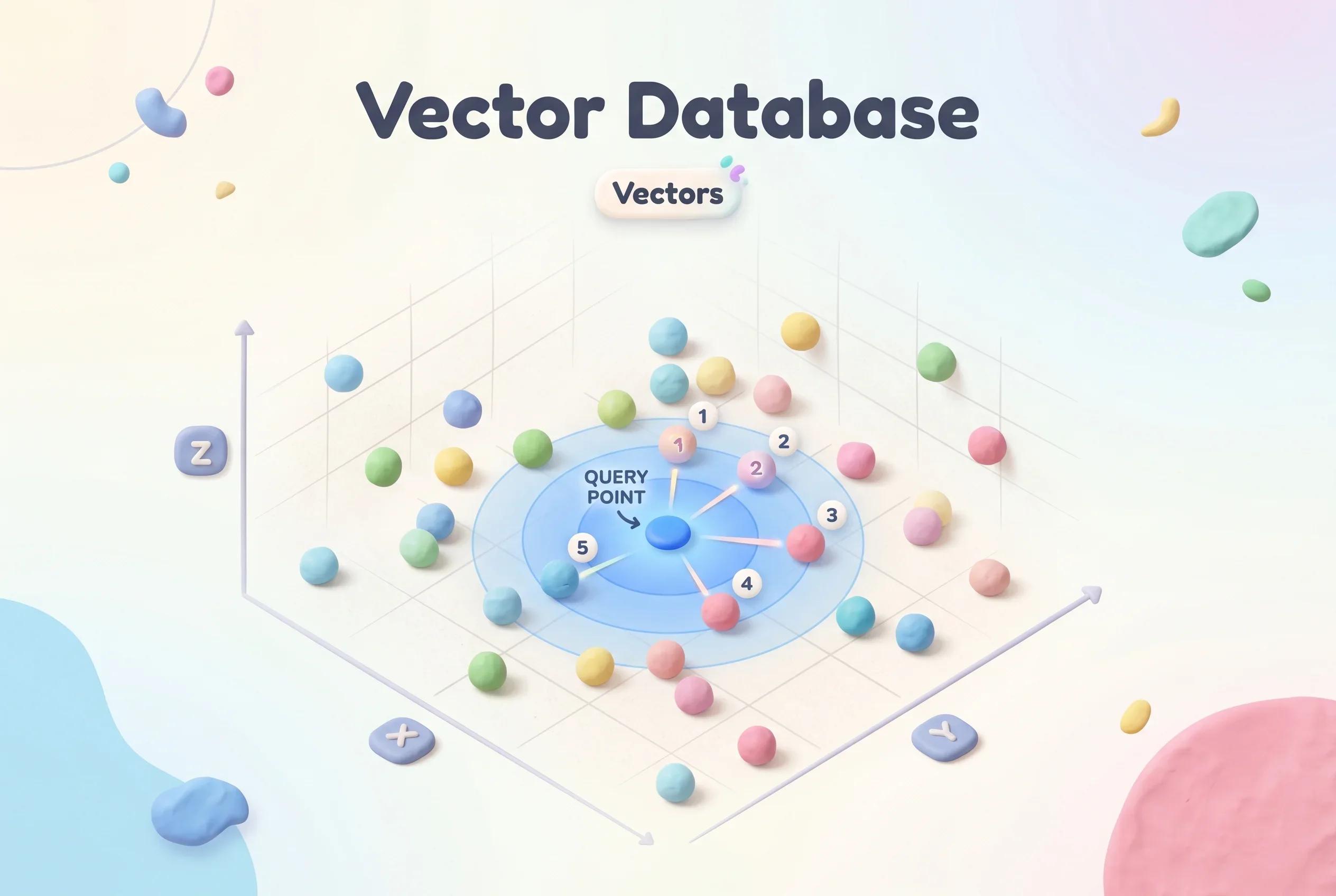
Another explainer describes it as “a database that stores all kinds of data in vector form and enables similarity search”3. The vectors here represent the concepts of things and words as multi-dimensional numbers, making it possible to calculate “positional relationships in space” by quantifying concepts3. Whereas an ordinary database manages characters and numbers as-is in tables, a vector database manages “coordinates of meaning”—thinking of it this way makes the difference easier to picture.
How It Works: Embeddings and Similarity Search
At the heart of a vector database are embeddings. Elastic explains an embedding as “a numerical array of floating-point values that represents data and functions as a point in high-dimensional space”1. An embedding is the result of converting a sentence or image into a sequence of hundreds to thousands of numbers using a machine learning model, and this is the actual entity stored in the vector database.
Why can numbers like these handle “meaning”? The key is that the conversion is done so that the relationship “close in position = close in meaning” holds3. For example, “mickey” and “mouse” are entirely different as strings, but because they are semantically related, they are plotted close together in vector space3. When searching, the query text is also converted into numbers in the same way, and indices like cosine similarity are used to find “nearby vectors”2. In this way, “similarity can be calculated per word and per sentence, and highly relevant information can be extracted”2.
There is a caveat about embeddings, however. Elastic points out that “an embedding created by one provider’s model is not understood by another provider”1. This means the model used to create the embeddings and the model used for searching need to match—a point worth keeping in mind in actual operation.
How It Differs from Keyword Search
The value of a vector database stands out when compared with traditional keyword search.
Traditional keyword search “can only find records that contain a specific keyword”3. Because it does not hit unless the same string as the searched word is included, it can miss related documents simply due to different wording. By contrast, vector search “enables search based on semantic similarity”3, picking up things that are close in meaning even if the phrasing differs. The opening example of “smartphone” also bringing up “mobile phone” is exactly this difference.
That said, vector search is not all-powerful in every situation. For searches where an “exact match” matters, such as model numbers or proper nouns, keyword search is strong, and many practical AI search systems adopt a configuration that combines the two.
Speeding It Up with Approximate Nearest Neighbor (ANN) Search
Even if you want to find the nearest vectors in meaning, comparing distances one by one against every stored vector takes longer as the data grows. What makes this practical in terms of speed is approximate nearest neighbor (ANN) search.
According to Elastic, ANN is “a modern approach that prioritizes efficiency,” searching only a promising subset (a narrowed set of candidates) instead of scanning all vectors1. A representative algorithm for this is HNSW, which is said to achieve “a significant speedup” while maintaining accuracy1. As the word “approximate” suggests, it does not guarantee returning the single strictly nearest item, but returns nearly the nearest one quickly—this trade-off is what produces practical search speed even with large-scale data.
Its Role and Position in RAG
Where vector databases attract the most attention is as the core component of RAG (retrieval-augmented generation). RAG is a mechanism in which the LLM searches an external knowledge base for relevant information before answering, and answers based on that information.
Elastic states that a vector database functions as the retrieval layer of the RAG architecture, so that “the LLM derives responses based on trustworthy data and reduces the risk of hallucination”1. In RAG, “vector search is used to retrieve relevant information,” and that result is “appended to the question to enrich the prompt,” producing more accurate, context-appropriate answers3.
The quality of this retrieval greatly determines how well RAG performs overall. That is because “in RAG, how appropriately you let the LLM reference information is important,” and “retrieving information highly relevant to the user’s question directly affects RAG’s performance”2. No matter how high-performance an LLM you use, if you cannot correctly pull in the information to reference, answer accuracy will not improve. The vector database is the foundation that handles that “correctly pulling in” part.
If embeddings are the technology that turns words into vectors of meaning, and RAG is the mechanism that uses search results to curb an LLM’s hallucinations, then the vector database is the “storehouse you can search by meaning” that connects the two. When considering AI that leverages internal data, knowing how this storehouse works makes it easier to grasp why retrieval design is so emphasized in RAG.
Sources
- What is a vector database? | A comprehensive guide to vector databases - Official guide by Elastic (embeddings, ANN, HNSW, RAG retrieval layer)
- What is vector search? Why is it essential for improving RAG accuracy? - Japanese explainer by Data Science Career Note
- What are vector search and RAG? The basics of AI search technology and a Salesforce use case, explained clearly - Japanese explainer by Frogwell
Was this article helpful?
Thank you!
Received. Thank you!