Google Releases DiffusionGemma, an Experimental Open Model Using Text Diffusion - Up to 4x Faster on GPUs
Google released DiffusionGemma on June 10, 2026, a 26B MoE experimental open model using text diffusion. It reaches 1000+ tokens per second on an H100, while Google openly notes output quality is lower than Gemma 4.
Google released DiffusionGemma on June 10, 2026, an experimental open model that adopts text diffusion for generation12. Unlike the sequential, token-by-token generation of typical autoregressive LLMs, it generates entire blocks of text simultaneously, claiming up to 4x faster text generation on GPUs1. The model is released under an Apache 2.0 license, with weights available on Hugging Face1.
Google positions the model as complementary to its autoregressive Gemma 4 models rather than a replacement1, offering it as an option for use cases that prioritize speed over quality.
Like Image Generation: Draft Everything at Once, Then Refine
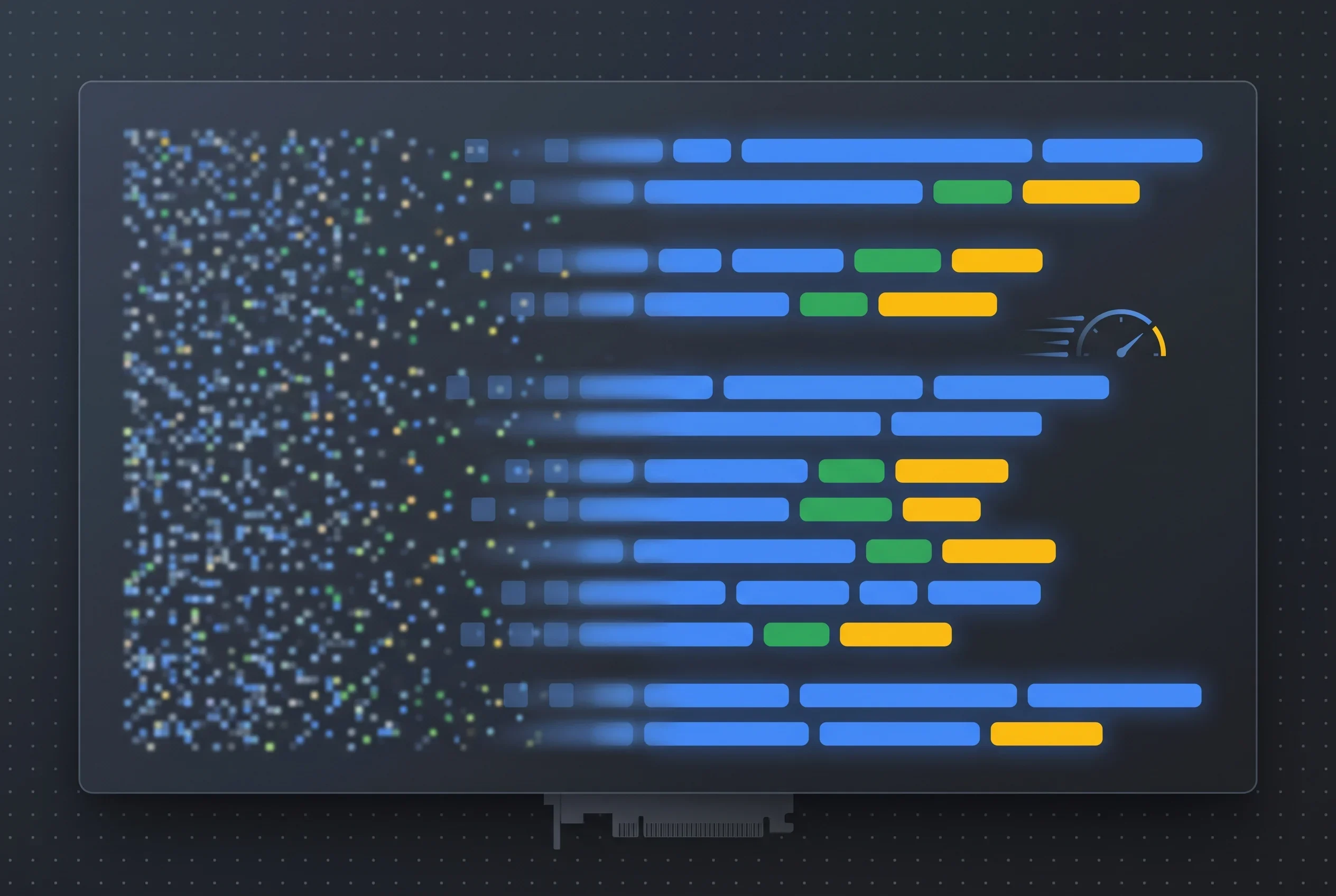
DiffusionGemma’s generation process resembles image diffusion models. It starts with “a canvas of random placeholder tokens,” then makes multiple passes, locking in correct tokens and using them as context clues to refine the rest1. Instead of writing one token at a time in order, the model drafts the whole passage at once and polishes it in stages.
This is enabled by bi-directional attention, generating 256 tokens in parallel with each forward pass12.
Performance and Architecture: A 26B MoE with 3.8B Active Parameters
On performance, Google reports generation speeds of 1000+ tokens per second on a single NVIDIA H100 and 700+ tokens per second on the consumer NVIDIA GeForce RTX 509012.
The architecture is a 26B parameter Mixture of Experts (MoE) model that activates only 3.8B parameters during inference1. When quantized, it fits within the 18GB VRAM limits of high-end consumer GPUs, a design clearly aimed at local execution1.
For deployment, it supports MLX, vLLM, and Hugging Face Transformers, and is also available through the Gemini Enterprise Agent Platform Model Garden and NVIDIA NIM1.
Quality Trade-Off Stated Up Front - No Benefit on Apple Silicon
Notably, Google itself is explicit about the limitations. The official blog states that “DiffusionGemma’s overall output quality is lower than standard Gemma 4” and recommends deploying standard Gemma 4 for applications that demand maximum quality1.
The speed gains are also limited to dedicated GPUs and do not apply to unified-memory architectures like those in Apple Silicon Macs1. Recommended use cases are speed-critical, interactive local workflows such as in-line editing and rapid iteration1.
Diffusion-based text generation has been explored as a research direction for some time, but production-scale open models with released weights under Apache 2.0 remain rare. For developers who want to try it on their own GPUs with the speed-quality trade-off in mind, this is an accessible release. Details are in Google’s official blog post1, and the weights are available on Hugging Face.
Sources
- DiffusionGemma: 4x faster text generation - Google official blog (June 10, 2026)
- Google open-sources speedy DiffusionGemma text diffusion model - SiliconANGLE (June 10, 2026)
Was this article helpful?
Thank you!
Received. Thank you!