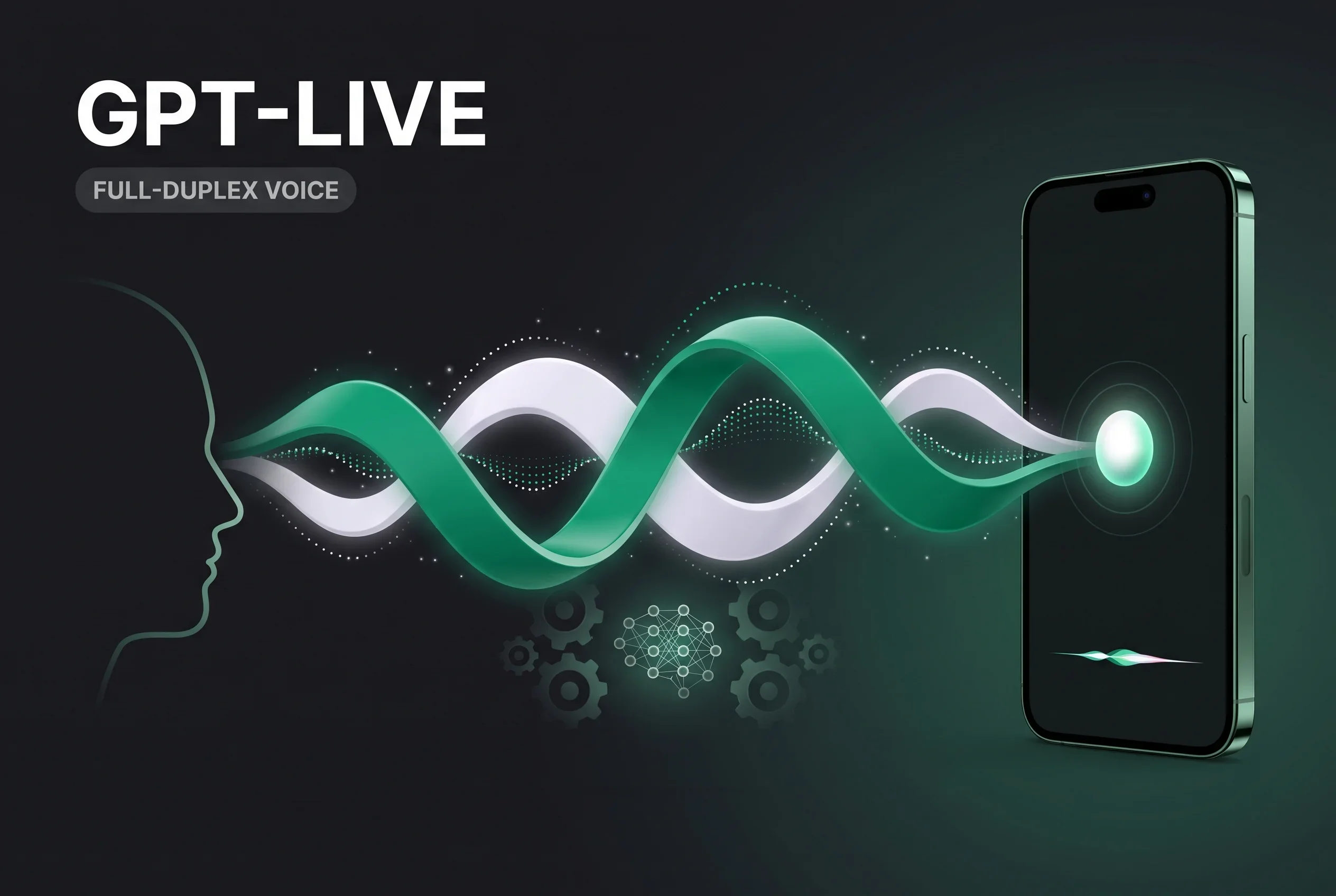
OpenAI Unveils GPT-Live - Full-Duplex Voice Models That Listen While Speaking, Now Powering ChatGPT Voice
OpenAI announced GPT-Live on July 8, 2026, a new generation of voice models built on a full-duplex architecture that listens and speaks at the same time, enabling natural backchannels and interruptions. It delegates deeper work to GPT-5.5 while keeping the conversation going, and is rolling out globally as the default for ChatGPT Voice, used by over 150 million people weekly.
OpenAI announced GPT-Live, a new generation of voice models, on July 8, 20261. Designed to make talking with AI feel much more like a real conversation, two versions—GPT-Live-1 and GPT-Live-1 mini—began rolling out globally to ChatGPT users the same day1. It’s a high-impact update that replaces the foundation of ChatGPT’s voice features (Voice and Dictation), which more than 150 million people use each week1.
The headline feature is a “full-duplex” architecture that lets the model listen and speak at the same time1. Instead of waiting for turns, GPT-Live can acknowledge what you’re saying with phrases like “mhmm,” stay quiet while you gather your thoughts, and interrupt when appropriate—much closer to how humans actually converse1.
Three Generations of Voice AI - Why It Felt Unnatural Until Now
In the announcement, OpenAI frames the evolution of voice AI in three generations. The original ChatGPT Voice was a “cascaded” system chaining three models in sequence: speech-to-text (STT), a large language model, and text-to-speech (TTS). It made talking to frontier models possible for the first time, but information was lost between models and responses were slow and stilted1.
Advanced Voice Mode then unified audio processing and generation in a single model, cutting latency significantly. But because it detected the end of a turn based on silence, a brief pause to think could be mistaken for “done speaking,” causing the model to interrupt at unnatural times1.
GPT-Live replaces this with a continuous structure that processes input while generating output. Because it makes decisions—speak, keep listening, pause, interrupt, invoke a tool—many times per second, it supports fast back-and-forth exchanges and even live translation as the conversation unfolds1.
GPT-5.5 Works in the Background While You Talk
The other key design choice is decoupling conversation from deeper work. For questions requiring web search, complex reasoning, or agentic capabilities, GPT-Live delegates the task to a frontier model behind the scenes and keeps the conversation going while it waits for results1. At launch, GPT-5.5 handles the background work, and the underlying model will be updated as new frontier models ship1.
Users can choose from three reasoning levels—Instant, Medium, and High—with Medium and High using GPT-5.5 Thinking1. In OpenAI’s evaluations, GPT-Live-1 was strongly preferred over Advanced Voice Mode in matched 5–10 minute human-evaluated conversations, and it also outperformed on GPQA (scientific reasoning), BrowseComp (agentic web search), and τ³-Voice Telecom, which simulates phone-based support tasks1. The direction is clear: not just natural conversation, but bringing AI agent-style practical capability into voice.
What Changes in ChatGPT Voice
For users, the experience behind the Voice button is being replaced with the GPT-Live-powered version. Highlights include active listening with backchannels, waiting patiently while you think, better resistance to background noise, and remastered versions of the nine distinct ChatGPT voices1. ChatGPT can now also display rich visual cards during conversations for topics like weather, stocks, and sports1.
On plans, GPT-Live-1 becomes the default model for paid Go, Plus, and Pro users, while GPT-Live-1 mini becomes the default for free users12. The rollout spans iOS, Android, and ChatGPT.com, with API availability planned soon1.
There are limitations. At launch, GPT-Live does not support voice with video or screen sharing (support is planned), and some languages may have non-native accents or gaps in fluency1. The legacy Standard and Advanced Voice Modes remain available for now1.
Safety Designed Specifically for Voice
Real-time voice conversations don’t allow the luxury of moderating output after the fact. OpenAI built safeguards into GPT-Live that act while the model is speaking: when potentially unsafe output is detected, the system can steer toward a safer response, surface support resources, or end the conversation in higher-risk cases1. For conversations involving self-harm, ChatGPT’s expert-vetted crisis helpline support flows have been adapted for voice1.
For teen users, age-appropriate behavior is trained directly into the model, parents can control voice access through Parental Controls, and linked parents may be notified in higher-risk situations involving signs of potential self-harm or suicidal intent1. To prevent voice impersonation, GPT-Live uses only a set of predefined voices in ChatGPT, with safeguards against imitating a real person’s voice1.
Voice is also an area where emotional reliance on AI can develop easily, and OpenAI says it will continue longer-term measurement and post-launch monitoring focused on emotional reliance1. The more natural the experience becomes, the closer it gets to “feeling like talking to a person”—which is exactly why the balance between advancing the experience and maintaining safeguards will keep drawing scrutiny.
Sources
- Introducing GPT-Live - OpenAI official blog (July 8, 2026)
- OpenAI releases new voice models for more natural live conversations - TechCrunch
Was this article helpful?
Thank you!
Received. Thank you!