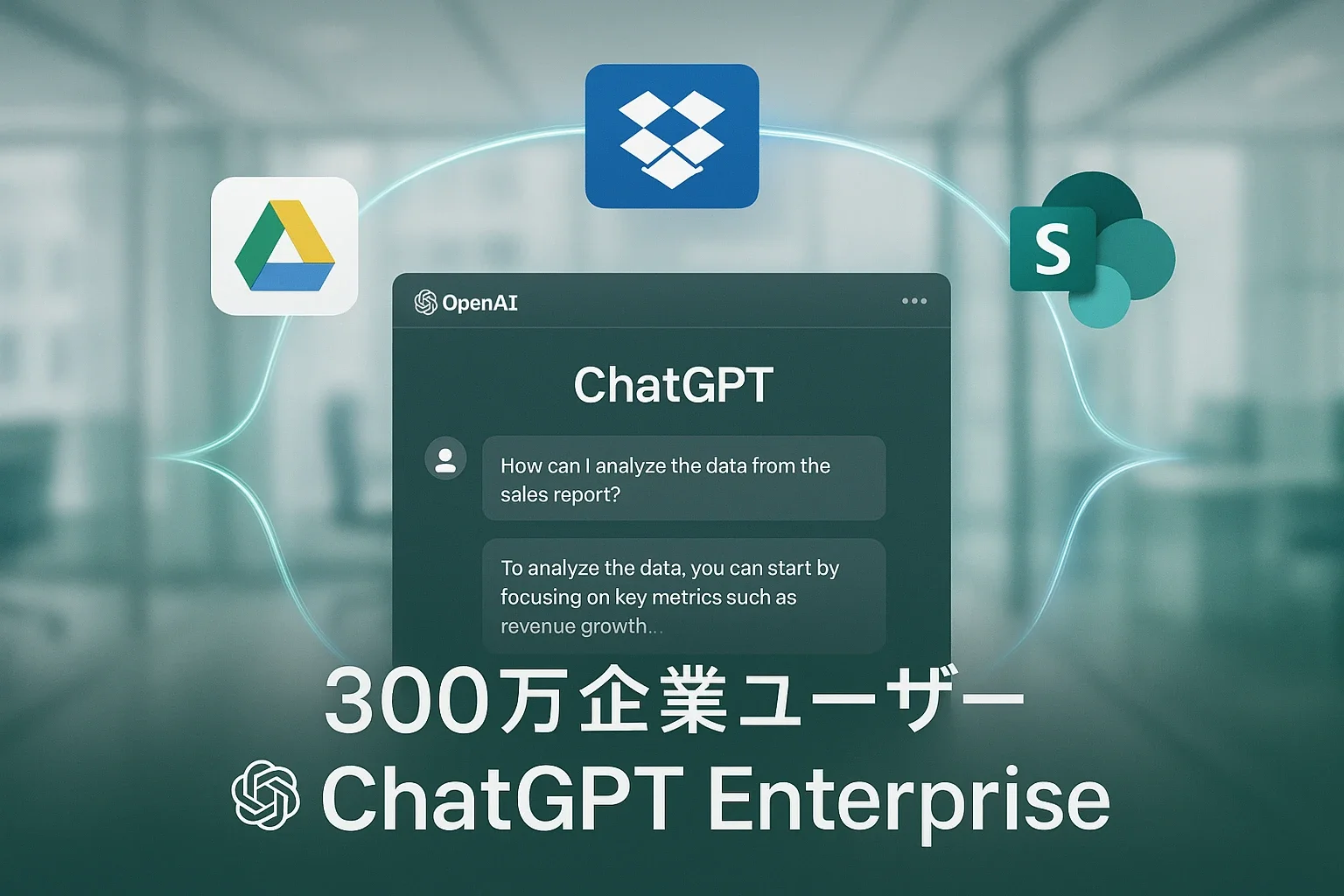
ChatGPT for Business at the Forefront: Business Innovation Practiced by 3 Million Enterprise Users
OpenAI's ChatGPT for Business surpasses 3 million enterprise users. Japanese companies are rapidly adopting it, with dramatic improvements in business efficiency through new features like connectors and record mode. This article introduces specific use cases across various industries.
In June 2025, OpenAI announced a staggering figure: the number of paid enterprise users of ChatGPT for Business had surpassed 3 million. Considering it was only 2 million just four months earlier in February, the growth rate can be described as phenomenal. Behind this number lies the fact that over 80% of Fortune 500 companies have integrated ChatGPT into their business workflows. Enterprise adoption of generative AI has clearly moved beyond the experimental phase into full-scale implementation.
Particularly noteworthy is the proactive adoption stance of Japanese companies. In global ChatGPT desktop traffic, Japan accounts for 3.0%, ranking 5th after the United States, India, Colombia, and the Philippines1. Furthermore, Japan has one of the world’s highest per capita ChatGPT usage rates, with survey results showing that 20-50% of Japanese companies are utilizing generative AI in their operations in some form2. Behind this rapid proliferation are the new features announced in June 2025 and the accumulation of concrete success stories.
Latest Feature Updates for ChatGPT for Business
The June 2025 update brought groundbreaking new features to ChatGPT Team and ChatGPT Enterprise users. The most attention-grabbing is the “Connectors” feature. This allows users to retrieve data from third-party tools such as Google Drive, Dropbox, SharePoint, Box, and OneDrive without leaving ChatGPT3. In other words, an environment has been established where previously scattered corporate data can be utilized centrally.
Another innovative feature is “Record Mode.” This automatically records and transcribes meetings, and can further integrate with internal documents and files. The efficiency of post-meeting follow-ups and meeting minutes creation has improved dramatically, preventing the oversight of important decisions and action items3.
Security has also been significantly enhanced. ChatGPT Enterprise provides enterprise-grade security including SOC 2 compliance, encrypted data protection, and Single Sign-On (SSO) support. Moreover, it guarantees that corporate data will not be used for OpenAI’s model training, creating an environment where even highly confidential sectors like finance and healthcare can use it with confidence.
Advanced Use Cases by Global Companies
Early adopters of ChatGPT Enterprise include renowned companies such as Block, Canva, Carlyle, Estée Lauder, PwC, and Zapier. Additionally, Lowe’s, Morgan Stanley, and Uber are actively advancing their utilization, while Coca-Cola, Snapchat, Quizlet, Instacart, Shopify, and Speak have also integrated ChatGPT into their products and services1.
Looking at specific areas of application, the most effective results are seen in content creation and marketing. 70% of companies expect enhanced content creation, and indeed, a major healthcare company has succeeded in reducing content creation time by up to 60% through the use of ChatGPT for Business1. It is being utilized for a wide range of purposes including blog posts, newsletters, social media content, and SEO-optimized marketing copy.
Significant results are also being reported in customer service. Research shows that ChatGPT implementation can improve customer service productivity by 30-45%, with 58% of companies achieving personalized customer experiences1. 24/7 support has become possible, contributing to improved customer satisfaction.
In technical development, 66% of companies are utilizing ChatGPT for coding tasks. Efficiency improvements are progressing throughout the development process, including debugging, code improvement, code snippet generation, and technical documentation creation. It has received particularly high praise as a learning support tool for junior engineers.
Japanese Enterprise Implementation Cases and Results
Among Japanese companies, SoftBank Group is conducting particularly advanced initiatives. Starting in May 2024, they began providing ChatGPT Enterprise environment to all 20,000 employees, and in February 2025, announced a joint venture with OpenAI called “SB OpenAI Japan.” They are developing and providing “Cristal intelligence,” an advanced enterprise AI solution for Japanese companies2.
NEC has significantly expanded its internal AI utilization areas, including automatic code generation in software development, summary AI for candidate screening in HR departments, and IoT data anomaly detection in manufacturing sites. Particularly in the development department, code review time has been reduced by 30%, contributing to quality improvement.
In the financial industry, Mitsubishi UFJ Financial Group (MUFG) is attracting attention. As Japan’s largest financial institution group, the company signed a memorandum of understanding with OpenAI in October 2024 regarding business reform using generative AI and began internal use of ChatGPT Enterprise2. They have achieved qualitative improvements in customer service through more efficient document creation and advanced inquiry response.
Rakuten Securities has developed an “Investment AI Assistant” combining its proprietary AI model with ChatGPT. By providing an environment where even investment beginners can access specialized investment information, they have succeeded in acquiring new customers. Additionally, Panasonic Holdings has developed “PX-GPT” utilizing ChatGPT technology and deployed it to approximately 90,000 employees in Japan, promoting business efficiency and creative problem-solving2.
Major trading company ITOCHU Corporation announced the introduction of ChatGPT to all company operations by June 2023. They established a specialized organization for preventing information leaks and improving accuracy, actively utilizing it while ensuring safety. Integrated with internal communication tools, approximately 5,000 uses are recorded per day2.
Industry-Specific Usage Patterns and Return on Investment
Looking at adoption by industry, as of 2023, the technology sector leads with 251 companies, followed by education with 209 companies and business services with 98 companies1. By occupation, 64% of journalists, 63% of software developers, and 65% of marketing professionals are utilizing ChatGPT, with rapid proliferation centered on knowledge workers.
Remarkable results are also being reported in terms of return on investment. 25% of American companies have achieved cost savings of $50,000-$70,000 through ChatGPT utilization, with 11% of companies succeeding in savings of over $100,0001. Furthermore, companies that have invested in AI have achieved 3-15% revenue growth, realizing value creation beyond mere cost reduction.
In manufacturing, cases have been reported where defect rates decreased by 20% through automation of quality control processes, and inventory costs were reduced by 15% through supply chain optimization. In retail, results show that personalized product recommendations increased average purchase amount per customer by 12%.
Strategic Approach for Successful Implementation
A phased approach is crucial for successful ChatGPT implementation. Start with small-scale pilot projects, gradually expanding the scope of application while verifying effectiveness. Many successful companies begin implementation with non-critical operations, accumulating know-how before proceeding to apply it to core operations.
Employee education is also key to success. It’s important not just to provide tools, but to conduct training on how to write effective prompts and collaborate with AI. One major manufacturer reported that after conducting company-wide AI literacy training, business efficiency improved by an average of 25% six months after implementation.
Ensuring security and compliance is also essential. Particularly for Japanese companies, compliance with the Personal Information Protection Law and Basic Act on Cybersecurity is necessary. It’s required to maximize the use of ChatGPT Enterprise’s security features while ensuring alignment with internal security policies.
In the future, there is likely to be a significant gap in productivity and competitiveness between companies that have and haven’t implemented ChatGPT. 97% of executives believe ChatGPT will have a positive impact on their business1, with 53% expecting workflow efficiency improvements. The utilization of generative AI is becoming not just an option but an essential management issue.
Sources
- ChatGPT Statistics in Business [January 2025] - Master of Code Global (ChatGPT Business Statistics Data)
- 【12月最新版】ChatGPTを導入した日本企業の活用事例84選・24業種を徹底調査! - GOATMAN (Japanese Enterprise ChatGPT Implementation Cases)
- OpenAI tops 3 million paying business users, launches new features for workplace - CNBC (OpenAI’s Latest Announcement)
Was this article helpful?
Thank you!
Received. Thank you!