Australian Standards for AI Explained: Data Centres Must Be Net Power Generators, Unlicensed AI Training Is 'Theft'
Australia's PM Albanese unveiled a national AI framework on July 15, 2026: an Office of AI, a legal duty for large data centres to add more power to the grid than they take, and no copyright exemption for AI training.
Australian Prime Minister Anthony Albanese announced a national AI regulatory framework, the “Australian Standards for AI,” in a speech at the University of Sydney on July 15, 20261. The plan centers on a new AI office inside the Prime Minister’s department, energy and water obligations for large data centres, and protection of creators’ rights in AI training, with legislation targeted for early 20271.
Albanese framed AI as “a bigger challenge and a bigger opportunity than social media”2, declaring: “to seize and shape and share the generational opportunity that AI represents our Government will establish a set of Australian Standards for AI”1.
Three Pillars: National Standards, an Office of AI, and Data Centre Obligations
The first pillar is a single, nationwide set of AI standards — one national framework for AI and its infrastructure rather than a patchwork of state or sector rules. Albanese said he will seek agreement from state Premiers and Chief Ministers at a National Cabinet meeting he is convening next month, with legislation to be brought to Parliament early next year1.
The second is a new command center. “Effective today, I am establishing The Office of AI in my own Department of the Prime Minister and Cabinet,” Albanese said, tasking it with coordinating AI policy across government1.
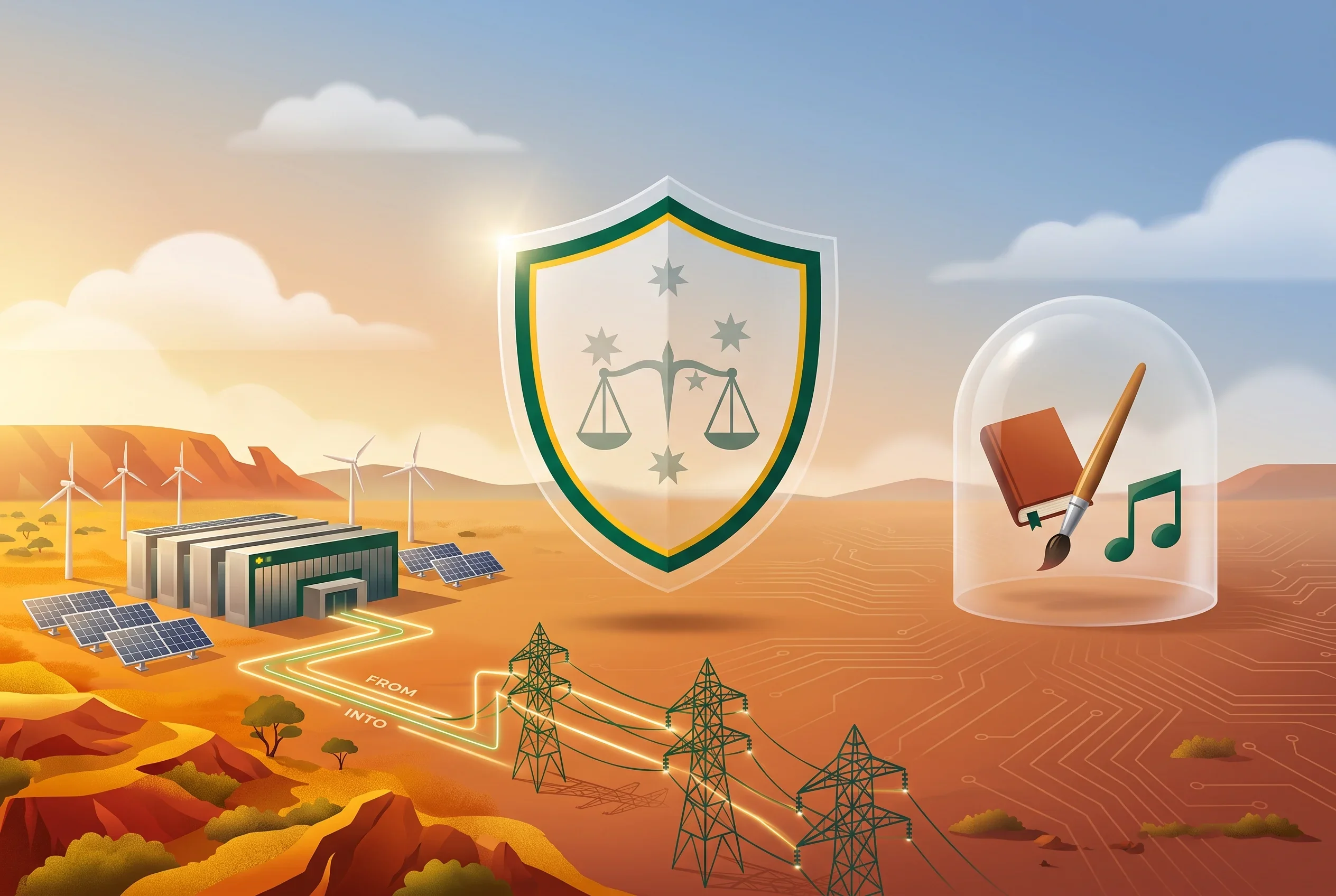
The third — and most concrete — pillar covers data centres. The next generation of large-scale data centres will face a legal obligation to underwrite new power supply and “to put at least as much energy into our grid as they take out of it”1. In other words, large data centres must be net generators of power, not net consumers. The rules will also require them to minimise water use, maximise energy efficiency and pay for any additional water infrastructure required1, while avoiding increases to household electricity bills2.
”Anything Less, Is Theft”: No Copyright Exemption for AI Training
The strongest language in the speech was reserved for copyright. “Australian writers, musicians, artists and journalists must retain ownership and control of their work… No company should use Australian books, music, art or news to build or train AI without the artist’s control,” Albanese said — concluding, “Anything less, is theft.”1
This reaffirms Australia’s position that AI developers must pay for creators’ content. The Conversation notes this diverges from the direction of the US, EU and Japan, which allow copyright exemptions for text and data mining in various forms2. The specific mechanism for making sure payments actually reach artists and musicians, however, remains undefined2.
The Backstory: A Distinctly Australian Model in a Crowding Field
AI regulation has multiplied across layers in the past year. In the US, states are legislating individually — Illinois now mandates annual third-party audits for frontier AI — while the UN has begun coordinating internationally through the Global Dialogue on AI Governance joined by more than 170 countries. On data centres, New York just imposed a moratorium pausing permits for large new projects for up to a year.
Australia’s design differs from each of these. Where New York chose to “pause and think,” Australia is not halting construction — it will accept data centres conditionally, with the net-power-generation obligation attached; the government has in fact rejected calls to pause data centre construction2. Its single national framework resembles the comprehensive EU AI Act approach more than America’s fragmented one. That said, The Conversation calls the government’s “first country in the world” framing overstated given the EU’s 2024 AI Act2, and flags the absence of mandatory guardrails against misinformation and deepfakes as an open gap2.
Why It Matters: A Third Model for Data Centre Regulation
For readers tracking AI infrastructure, the significance is that a third model now exists between New York’s moratorium and unconditional courting of data centre investment: conditional acceptance, with an obligation to generate net-new renewable power. If implemented, that condition effectively requires data centre operators to invest in power generation — reshaping project economics and siting decisions. As data centre power loads become a live policy issue in more countries, which model each jurisdiction picks will matter for infrastructure investment and market-entry decisions.
On copyright, a national government has now explicitly committed to paid AI training data. If that stance spreads, the cost of training data will vary substantially by jurisdiction. Australia’s legislation is due in Parliament in early 20271; the payment mechanism — and how global AI companies respond to this market — are the next things to watch.
Sources
- AI in Australia’s interests | Prime Minister of Australia - Prime Minister of Australia (full speech)
- Australia wants to ‘manage’ AI. What will that look like? - The Conversation
- AI in Australia’s interests | Ministers for the Department of Industry, Science and Resources - Australian Department of Industry, Science and Resources
Was this article helpful?
Thank you!
Received. Thank you!