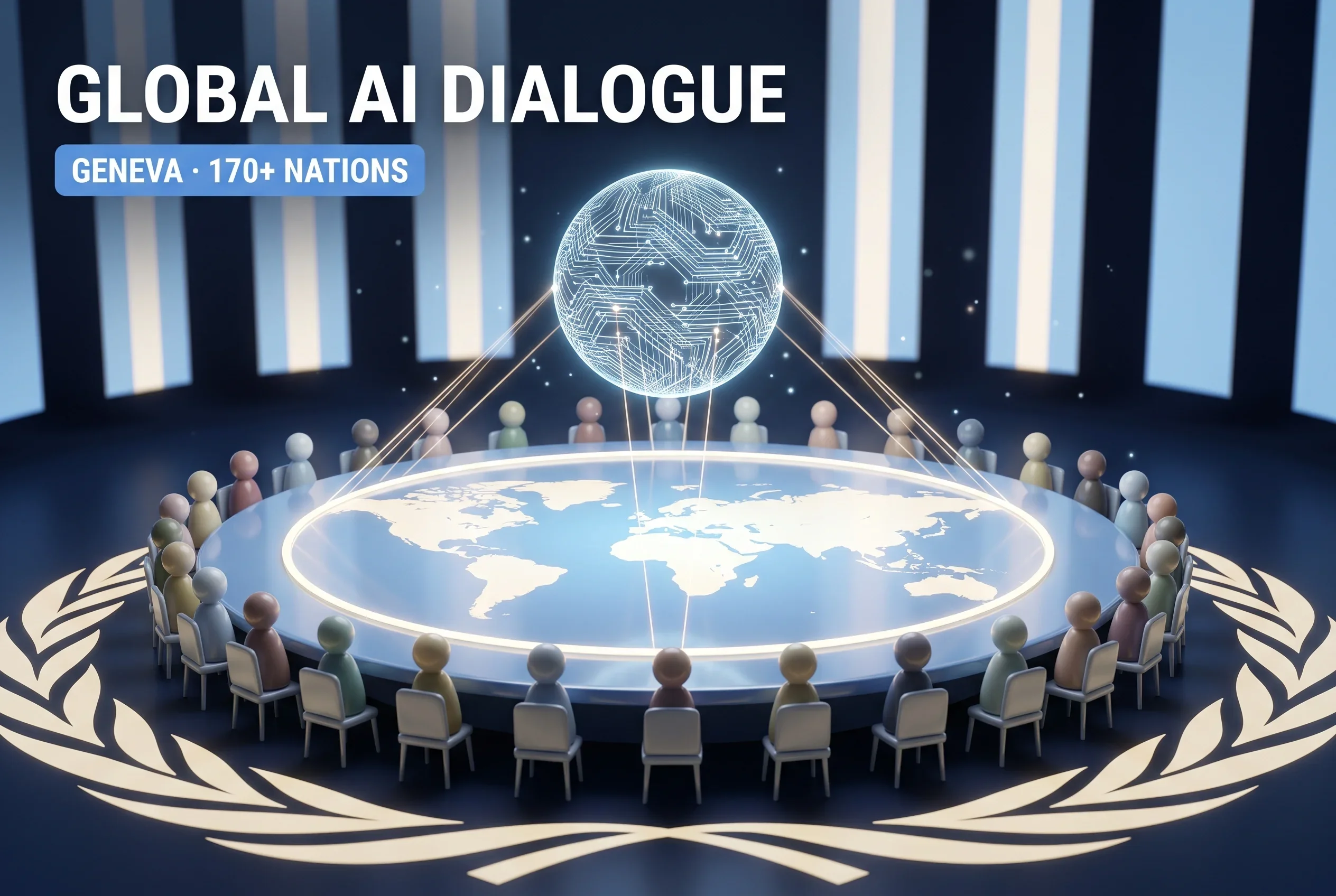
UN Holds First Global Dialogue on AI Governance - 170+ Countries Attend, New Pledges on Child Safety and Energy
The UN's inaugural Global Dialogue on AI Governance took place in Geneva on July 6-7, 2026. Secretary-General Guterres proposed an AI Child Safety Pledge and renewable-powered data centers by 2030, and warned about military AI. The 40-member scientific panel published its first report on July 1; the next session is set for May 2027 in New York.
The United Nations held its first Global Dialogue on AI Governance in Geneva on July 6-7, 202613. Representatives of more than 170 countries gathered alongside scientists, entrepreneurs, civil society, international organizations, and technical communities4, creating the first forum where all member states discuss international rules for AI on equal footing. The Dialogue was mandated by the Pact for the Future and the Global Digital Compact, both agreed at the UN in 20241.
Opening the event, Secretary-General António Guterres warned that AI is advancing at “runaway speed” and being deployed faster than institutions can manage4. “Machines can inform, but humans must decide, and answer,” he said, calling for governance that keeps human judgment and accountability at the center1.
Concrete Proposals on Child Safety and the Environment
The most specific element of the Secretary-General’s address was his proposed AI Child Safety Pledge. It calls on AI developers to prove their systems are safe through child-specific safety testing and independent oversight, to maintain zero tolerance for child sexual abuse material with mandatory detection and removal, and to ensure that when a child shows signs of distress, the system stops and connects them to real human support1.
On the environment, he urged commitments to power every data center with renewable energy by 2030 and for AI companies to publicly disclose their carbon, water, and land footprints1. On military applications, he warned in stark terms that increasingly powerful AI chips are shifting to the battlefield, where “killer robots” are already becoming the norm1.
Inequality was another central theme. “We cannot allow the digital divide to harden into an AI divide,” Guterres said, warning it could become a development, security, and sovereignty gap1, and noting that computing power, data, and talent remain concentrated, leaving many countries — particularly developing ones — with limited influence4. More than 20 countries have expressed support for a UN Global Network for AI Capacity Building aimed at developing nations1. General Assembly President Baerbock added that AI cannot be governed by a few actors alone and must be addressed through the UN4.
A 40-Member Scientific Panel Delivers Its First Report
Paired with the Dialogue is the Independent International Scientific Panel on AI, made up of 40 experts from every region of the world serving in their personal capacity, selected from more than 2,600 candidates23. It is co-chaired by Yoshua Bengio (Canada) and Maria Ressa (Philippines)2. The Panel published its first report on July 1, beginning what is planned as an annual scientific assessment of AI’s opportunities and risks23.
The Dialogue itself was structured around four themes — AI opportunities and implications, bridging AI divides, safe, secure and trustworthy AI, and respecting, protecting and promoting human rights2 — and consultations ahead of the event drew more than 1,500 written submissions2.
No Binding Power, but “the Beginning of a Process”
The Dialogue is not a treaty negotiation and produces no binding rules; it is a process for sharing views and evidence. Still, at a time when jurisdictions are regulating separately — the EU’s code of practice on labelling AI-generated content, the US executive order on AI security — a common table open to every UN member state is significant. Officials framed the event as the beginning of a broader process rather than a one-off4, with a second Dialogue scheduled for May 2027 in New York12.
The Dialogue follows closely on the launch of the ITU’s AI for Good Global Commission on July 5, as international venues for AI policy multiply. Proposals like child-specific safety testing and environmental footprint disclosure carry no legal force today, but they may find their way into national regulations and corporate procurement requirements over time. For companies building AI into their business, the Dialogue offers a read on which issues — transparency, child protection, environmental disclosure — international consensus is starting to form around.
Full records of the Dialogue are available from UN News and the UN’s official site.
Sources
- From AI to ‘killer robots’: UN chief issues urgent governance call - UN News (July 6, 2026)
- Inaugural Global Dialogue on AI Governance convenes in Geneva - United Nations official site
- Global push for AI governance amid warnings of ‘catastrophic harm’ - UN News (July 5, 2026)
- UN opens Global Dialogue on AI Governance with call for inclusive and evidence-based cooperation - Digital Watch Observatory
Was this article helpful?
Thank you!
Received. Thank you!