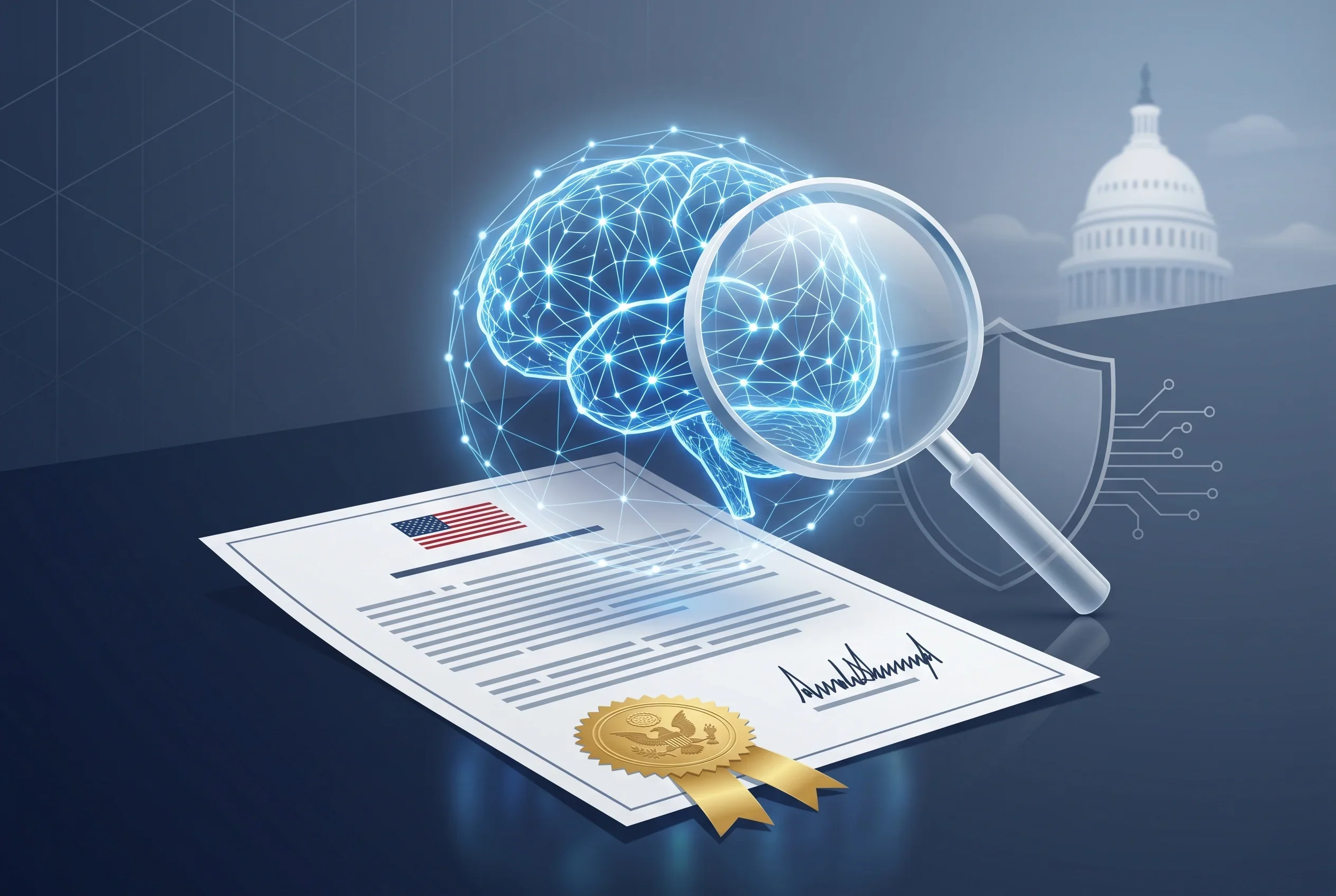
Trump Signs AI Security Executive Order Introducing Voluntary Pre-Release Model Review
On June 2, 2026, President Trump signed an executive order establishing a voluntary framework for AI companies to submit frontier models for government review up to 30 days before release, along with an AI cybersecurity clearinghouse. We also cover how the review window was cut from 90 to 30 days.
On June 2, 2026, President Trump signed an executive order titled “Promoting Advanced Artificial Intelligence Innovation and Security”1. The order directs the creation of a framework under which AI companies can voluntarily submit their most advanced models for government review for up to 30 days before public release — a turning point for an administration that has championed deregulation, as it steps into pre-release review of frontier AI.
The executive order maintains the administration’s long-standing position, stating that the United States “refuses to stifle this innovation with overly burdensome regulation,” while also acknowledging that “Advanced AI capabilities make our Nation stronger, but also introduce new national security considerations”1. Its defining feature is the adoption of a voluntary framework built on collaboration with the private sector, rather than a mandatory licensing regime.
What the Executive Order Contains
The order declares that “it is the policy of the United States to promote AI innovation and security by working collaboratively with the private sector”12, and issues a series of deadline-bound directives to federal agencies.
At its core is the voluntary review framework for frontier models. AI developers will be able to (1) work with the federal government to determine whether their models qualify as “covered frontier models,” (2) provide the government with access to models for up to 30 days before release, subject to appropriate confidentiality protections, and (3) collaborate with the federal government on selecting trusted partners1.
The order does not include an explicit definition of a “covered frontier model.” Instead, the Treasury Department, the NSA (National Security Agency), and CISA (Cybersecurity and Infrastructure Security Agency) are directed to develop a classified benchmarking process within 60 days to assess AI models’ cyber capabilities, and models exceeding certain thresholds will receive the designation. The final determination is made by the NSA Director in consultation with relevant agencies1.
At the same time, the order explicitly states that “nothing in this section shall be construed to authorize the creation of a mandatory governmental licensing, preclearance, or permitting requirement for the development, publication, release, or distribution of new AI models”1, leaving participation entirely up to each company.
Cybersecurity Directives
Alongside the review framework, strengthening the government’s own cyber defenses is a second pillar. Within 30 days, CISA is to issue Binding Operational Directives to expedite and prioritize the cyber defense of civilian federal government information systems13. Also within 30 days, the Treasury Department, NSA, and CISA are to establish an “AI cybersecurity clearinghouse” to coordinate scanning for software vulnerabilities and distributing patches with industry and critical infrastructure operators13.
The order further directs the OMB (Office of Management and Budget) Director to determine within 30 days whether federal grant programs can fund advanced AI vulnerability detection, and the OPM (Office of Personnel Management) Director to expand the United States Tech Force cybersecurity specialist hiring and placement pathways within 60 days1. The Attorney General will prioritize prosecuting illegal AI-enabled computer access and data theft under existing federal laws1.
The Review Window Was Cut from 90 to 30 Days
According to an analysis by the Council on Foreign Relations (CFR), the executive order was largely complete by May 2026, but an earlier version with a 90-day review window was withdrawn over concerns that it “would blunt U.S. labs’ competitiveness with China.” The final version cuts the review period to 30 days2. The change suggests an ongoing balancing act within the administration between national security concerns and wariness of stifling innovation.
The CFR analysis describes the order as “best understood as an attempt to engineer a cybersecurity window,” while also noting that “the administration will need to find a more comprehensive approach”2. Speaking to Federal News Network, a PwC executive and former FBI official said a key question is whether the new clearinghouse can effectively deliver vulnerability information to organizations3.
Will a Voluntary Framework Work?
This executive order does not make releasing an AI model subject to government approval. Whether to submit a model is each company’s decision, and there are no penalties. Even so, the fact that the government has built a system for assessing models’ cyber capabilities through classified benchmarks and formally established a framework for requesting pre-release access marks a shift in U.S. AI governance.
In the same week, Anthropic argued that the industry should preserve the option of a globally coordinated pause on frontier AI development, citing the risks of recursive self-improvement (related article). With both developers and the government now moving toward mechanisms for verifying safety before frontier models ship, the effectiveness of voluntary cooperation is likely to become the central question going forward.
The full text of the executive order is available on the White House website. For organizations assessing the impact on their own AI use and security posture, we recommend consulting the primary source.
Sources
- Promoting Advanced Artificial Intelligence Innovation and Security - The White House (full text of the executive order)
- Assessing Trump’s Executive Order on AI Oversight - Council on Foreign Relations (analysis)
- AI executive order sets stage for new cybersecurity directives - Federal News Network (news report)
Was this article helpful?
Thank you!
Received. Thank you!