Alibaba Directs an HK$80 Billion Share Placement Entirely to AI, With Quarterly Capex Up 75%
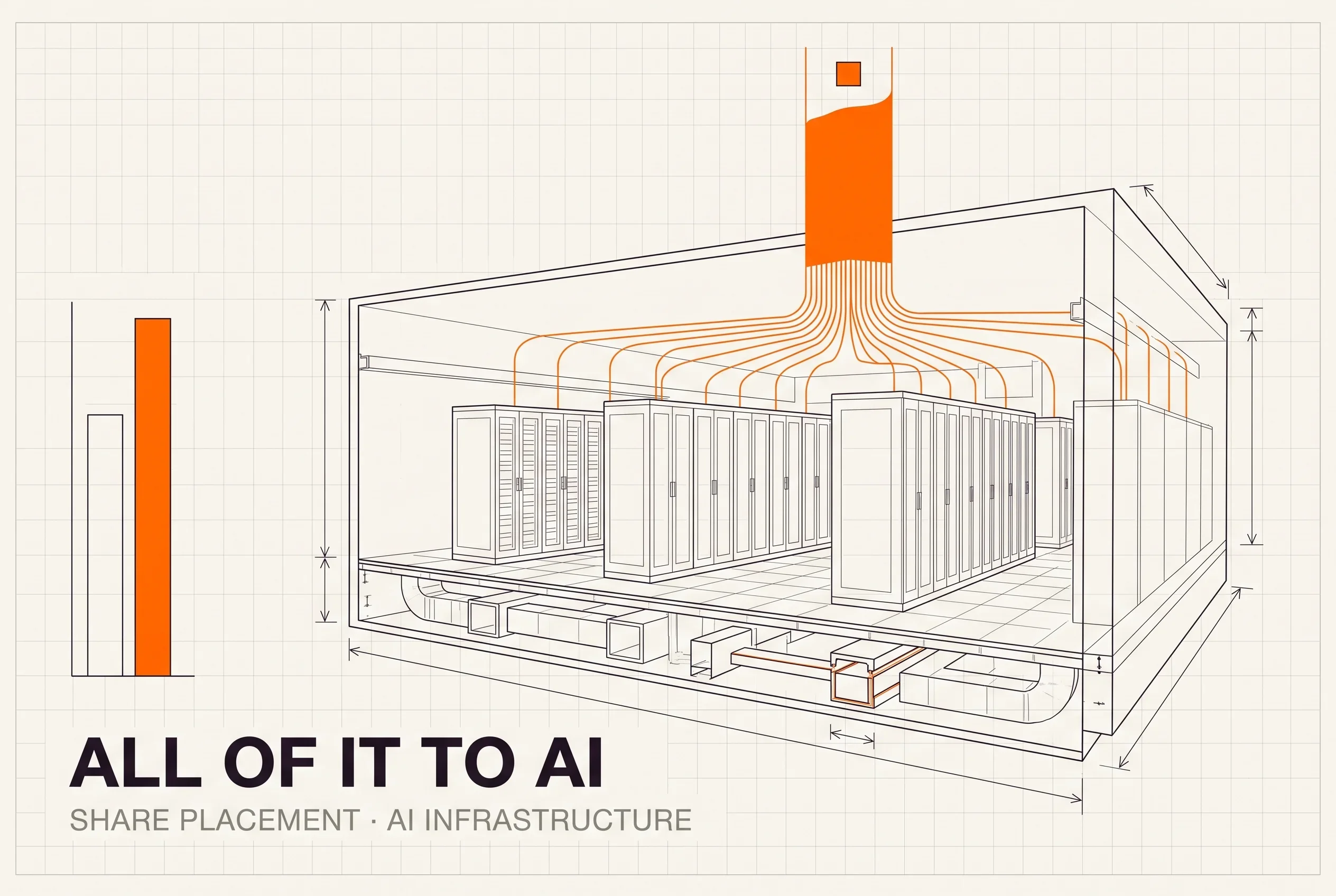
Alibaba announced an HK$80 billion share placement in Hong Kong on August 23, 2026, and a release carrying the same date priced it at HK$112.70 for 710 million shares. The company says 100% of net proceeds will go to its full stack AI capabilities. Its June quarter results, released August 20, showed capital expenditures up 75% year over year.
Alibaba Group announced on August 23, 2026 that it would issue HK$80 billion of new shares on the Hong Kong market2. A release carrying the same date disclosed pricing: 710,000,000 shares at HK$112.70 each, with the placement expected to close on August 261 (the company posted that release to its site on August 24).
The purpose is stated plainly. The company says the placement is being undertaken to extend its global AI leadership, and that it intends to use 100% of the net proceeds to invest in its full stack AI capabilities, including expanding and enhancing its AI infrastructure12. Not a portion — the whole amount.
Terms of the placement
The shares are not registered under the US Securities Act and are being sold only to certain non-US persons in offshore transactions in reliance on Regulation S12. They may not be offered or sold in the United States absent registration or an exemption1.
Worth noting: this is not a completed transaction. The press release itself states that closing is subject to customary conditions and that there can be no assurance the placement will be completed1. Until August 26 passes, it remains expected rather than done.
Dollar-converted figures for the amount circulate in press coverage, but Alibaba’s own releases carry no dollar denomination12. This article uses HK$, as the company does.
Setting the number against the quarterly results
Saying a company will “invest in AI” conveys nothing about scale on its own. Placing the figure next to the results Alibaba published three days earlier gives the HK$80 billion some context.
According to the results for the quarter ended June 30, 2026, released August 20, capital expenditures came to RMB67,678 million (US$9,975 million), up 75% from RMB38,676 million a year earlier3. The company describes this as continued investment in AI infrastructure to meet strong and growing customer demand3. It attributes the increase to fluctuations in procurement cycles, an increase in CPU-compute capacity driven by anticipated adoption of AI agents, and higher pricing across a broad range of chip components3.
In other words: a company already spending roughly $10 billion per quarter on capital expenditures is raising HK$80 billion on top of that and directing all of it to AI.
The weight of that spending shows in cash flow. Free cash flow for the quarter was an outflow of RMB44,670 million (US$6,584 million), widening from an outflow of RMB18,815 million a year earlier3. The company attributes this mainly to increased cloud infrastructure expenditure3. Cash and other liquid investments stood at RMB474,505 million as of June 303.
The business absorbing the investment
Revenue from the receiving end appears in the same results. AI Cloud and Compute Services brought in RMB48,437 million (US$7,139 million), with growth accelerating to 45% year over year for both total and external customer revenue3. The segment was formed by combining Cloud Intelligence Group with the chip unit T-Head3.
Within it, AI-related product revenue reached RMB12,376 million (US$1,824 million), marking a twelfth consecutive quarter of triple-digit growth3. CEO Eddie Wu noted that Alibaba Cloud’s external revenue growth accelerated to 45% and that AI-related product revenue delivered triple-digit growth for a twelfth straight quarter3. On market position, the company cites in its results a report by research firm Omdia, “AI Cloud Market: China - 2025,” which it says ranked Alibaba Cloud first in China’s AI cloud market with a 38.1% share3.
Group profitability, meanwhile, reflects the weight of that investment. Total revenue was RMB268,953 million (US$39,639 million), up 9%, but income from operations fell 57% to RMB15,161 million (US$2,234 million) and net income fell 75% to RMB10,444 million (US$1,539 million)3. Adjusted EBITA declined 30%, which the company attributes primarily to investment in technology3. CFO Toby Xu said that as synergies across core businesses deepen and AI monetization ramps up, the company has greater financial flexibility to make disciplined and sustained investments in full-stack AI capabilities3.
The results and the placement were separate announcements, and neither release contains any statement linking the two.
The foundation beneath a company that gives models away
Alibaba has spent recent months moving its Qwen family toward open weights. On August 3 it formally released its flagship Qwen3.8-Max and said it would publish weights for a Max-class model for the first time, and in mid-August those weights arrived, with the 27B model under Apache 2.0 and the 2.4-trillion-parameter version under a license of its own. The company description in the press release states that its AI technology is based on “the Qwen family of large language and multimodal models”1.
This placement puts capital into the compute base that trains and serves those models. Whether a company can afford to give model weights away depends on how much infrastructure it can carry. NVIDIA putting capital into data center sites with secured power around the same time operates at a different layer, but reflects the same contest over physical foundations.
For anyone sizing their own AI budget, these figures serve two purposes. One is as a yardstick for order of magnitude. The other is as material for assessing, when selecting a cloud or model vendor, how much capacity and intent that vendor has to keep investing. In this case the intent is written down as a share of proceeds: all of it.
Sources
- Alibaba Group Announced Pricing of HK$80 Billion Placing of New Shares in Hong Kong - Alibaba Group official press release (posted August 24, 2026)
- Alibaba Group Announced Proposed Placing of New Shares in Hong Kong - Alibaba Group official press release (August 23, 2026)
- Alibaba Group Announces June Quarter 2026 Results - SEC Form 6-K Exhibit 99.1 (August 20, 2026)
Was this article helpful?
Thank you!
Received. Thank you!