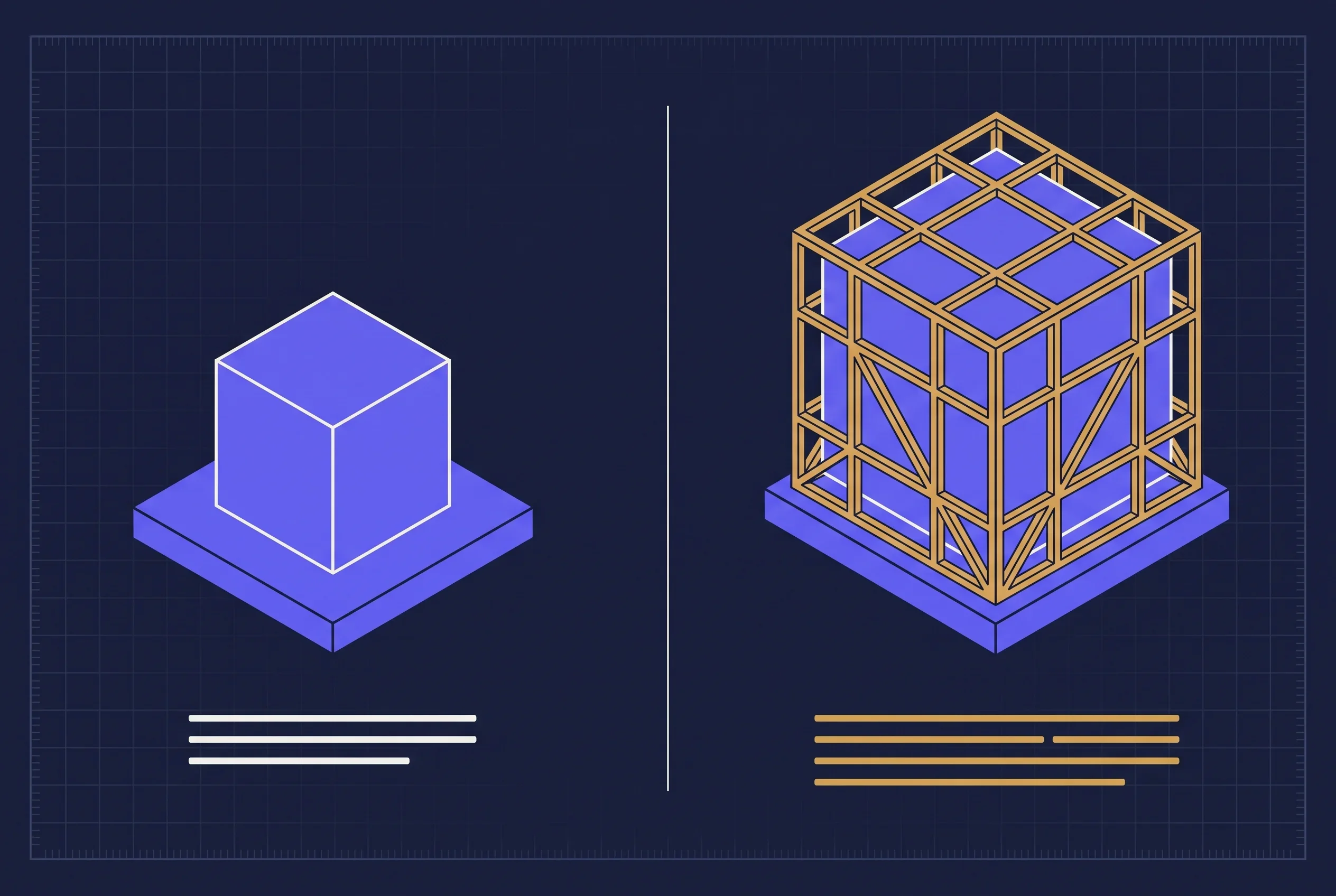
Qwen3.8 Open Weights Land: 27B Is Apache 2.0, the 2.4T Max Model Is Not
Alibaba's Qwen published weights for Qwen3.8-27B and Qwen3.8-2.4T-A95B. The 27B ships under Apache 2.0; the Max-class 2.4T model ships under a custom license whose obligations depend on your revenue and what business you are in.
Qwen, Alibaba’s AI model team, has published the weights for its Qwen3.8 series on Hugging Face: Qwen3.8-27B, a compact model that also handles images and video, and Qwen3.8-2.4T-A95B, with 2.4 trillion total parameters12.
The notable part is that the two licenses diverged. The 27B is Apache 2.01. The 2.4-trillion-parameter model is not — it ships under a custom “Qwen3.8-Max License”23. When we covered the official release of Qwen3.8-Max on August 3, we noted that there was no information available yet to judge whether commercial use was permitted. That part is now readable as actual license text.
The 27B: a compact multimodal model under Apache 2.0
Qwen3.8-27B is a dense model with 27B parameters, 64 layers and a hidden dimension of 5,120, described on the model card as a causal language model with a vision encoder1. It natively understands images and video, with Qwen citing everything “from STEM diagrams and documents to hour-scale videos”1. Context length is 262,144 tokens natively, extensible up to 1,000,0001.
The architecture is a hybrid of Gated DeltaNet linear attention and Gated Attention1. It builds on the Qwen 3.5 architecture, which it shares with the 2.4-trillion-parameter model12.
Inference control is spelled out as well. Thinking mode is on by default but can be disabled per request, and reasoning depth is tunable through reasoning_effort at three levels: xhigh (the default), medium and low1. Reasoning context from earlier messages is retained via preserve_thinking1. Deployment is supported through Hugging Face Transformers, vLLM, SGLang and TokenSpeed, among others1.
Qwen also plans a hosted version of the 27B on Qwen Cloud with more production features — a 1M context window by default and official built-in tools — but the model card lists it as “coming soon,” so it has not started yet1.
The benchmarks split by category
The model card includes a comparison table. All of these figures were measured and published by Qwen itself; none are independently verified. The comparison columns Qwen chose are Qwen3.6-27B, Qwen3.7-Plus, Muse Glimmer-30B and Opus4.6 Max1.
The main coding and agent numbers are below1.
| Benchmark | Qwen3.8-27B | Qwen3.6-27B | Qwen3.7-Plus | Opus4.6 Max |
|---|---|---|---|---|
| Terminal Bench 2.1 (Terminus) | 73.0 | 63.4 | 64.0 | 78.2 |
| SWE-bench Pro | 61.7 | 53.5 | 57.6 | 53.4 |
| NL2Repo-Bench | 42.3 | 36.2 | 41.1 | 47.6 |
| DeepSWE 1.1 | 42.2 | 13.3 | 14.2 | — |
| LiveCodeBench v6 | 90.3 | 83.9 | 89.6 | 88.8 |
| OSWorld-Verified (computer use) | 84.3 | 63.9 | 73.3 | 72.7 |
| GPQA Diamond | 89.2 | 87.8 | 90.3 | 91.3 |
| HLE | 30.8 | 24.0 | 34.7 | 40.0 |
Some gains over the previous Qwen3.6-27B are large — DeepSWE 1.1 goes from 13.3 to 42.21. The comparison against Opus4.6 Max, though, splits by category: the 27B posts higher numbers on SWE-bench Pro and OSWorld-Verified, and lower ones on Terminal Bench 2.1, NL2Repo-Bench, GPQA Diamond and HLE1. This is not a case that summarizes as “a small model overtook a larger one.”
The measurement conditions are also asymmetric. A footnote states that for SWE-bench Pro, only Opus4.6 Max uses its officially reported score while everything else was evaluated with the Claude Code harness1. The table also carries QwenSWEBench (79.0) and CoWorkBench (70.7), which the source explicitly identifies as Qwen’s own in-house benchmarks1. Cross-vendor comparisons need those two kinds of numbers kept apart.
The 2.4T model: the released weights are not the cloud product
Qwen3.8-2.4T-A95B has 2.4 trillion total parameters with 95 billion activated, 92 layers, and a mixture of experts with 512 experts of which 10 routed plus 1 shared fire per token2. Context length is 262,144 tokens natively, extensible to 1,010,0002. The model card states that this is the first time a Qwen-Max-class model has been brought to open release2.
The easy thing to miss here is that the published weights and the product served in the cloud are not the same thing. The model card says Qwen3.8-Max is “the official version based on Qwen3.8-2.4T-A95B with more features, such as vision input & non-thinking support, 1M context length by default, official built-in tools”2. Since those are described as features the cloud version adds, the natural reading is that running the weights yourself does not get you vision input or non-thinking mode. Evaluating on the cloud version and then moving to your own environment could produce a gap between expectation and reality.
The supported frameworks differ too: this card lists vLLM, SGLang and TokenSpeed, and does not mention Hugging Face Transformers2.
What the Qwen3.8-Max License actually asks for
A custom license sounds restrictive, but the backbone of the text is a broad grant. Use, copying, modification, merging, publication, distribution, sublicensing, sale, deployment, hosting, fine-tuning and the creation of derivative works are all permitted free of charge3. Two conditions sit on top of that3.
The first is attribution. If the software is used in a commercial product or service with more than 100,000,000 monthly active users or more than US$20,000,000 in monthly revenue, the model name must be prominently displayed on that product’s user interface3.
The second turns on the kind of business you are in and its size. If the licensee or any of its affiliates conducts a “Model as a Service” or “AI Work Assistant” business, and the combined revenue of the licensee and its affiliates exceeds US$50,000,000 during any consecutive twelve months, a separate license must be obtained from Qwen before any commercial use3. Internal use by the licensee is excluded — provided that such use does not make the software, its outputs, or its underlying model capabilities available to any third party3.
Both terms are defined. “Model as a Service” means giving a third party access to language model inference or fine-tuning, via an API or hosted endpoint for example, in a way that lets them exercise meaningful control over inputs, parameters or training data; merely relaying requests to models hosted by other third parties does not count3. “AI Work Assistant” means an independent AI product primarily designed for AI-assisted coding or office productivity, with Qoder and QwenWork named as examples3. The text explicitly excludes single-purpose AI tools such as translation tools, assistants aimed primarily at other domains, and assistants that are a feature of a product whose primary purpose is something else3.
Beyond that, there is an as-is warranty disclaimer and a requirement to comply with applicable law and not infringe third-party intellectual property3.
The order to check things in
At the July 19 preview, benchmarks, license and release timing were all unannounced. Benchmarks and pricing arrived on August 3, and with weights and license now out, the decision inputs are broadly complete.
If you plan to run this yourself, the license is what to read before the performance numbers. Using the model purely for internal business work may fall under the internal-use carve-out in condition 2, but whether your particular setup counts as not making capabilities available to third parties is something to check against the text and your actual architecture. If you serve it as an API, or embed it in an AI coding or office-productivity product you sell, it is worth working through both the definitions and the revenue thresholds with whoever handles your contracts.
The 27B’s Apache 2.0, by contrast, comes without those branches. A dense 27B that handles images and video with a 262,144-token context, under a license with few conditions, makes on-premises and air-gapped evaluation considerably easier to start. As when LG AI Research released K-EXAONE 2.0 under Apache 2.0, it is the stated terms that decide whether a model can be adopted at work.
Release timing shows differing judgments across labs, too. Z.ai said it would hold GLM-5.3’s weights back for two weeks pending safety evaluation and hardening. Qwen, in the August 3 announcement referenced above, said weights would follow “next week”; the Hugging Face repositories were last updated on August 12 for the 2.4-trillion-parameter model and August 14 for the 27B (both UTC, checked August 16, 2026)12.
Reception on Hugging Face differs as well. At the time of checking, the 27B had 91,917 downloads and 9,734 likes; the 2.4-trillion-parameter model had 6,381 downloads and 963 likes12. The two went up two days apart, so the figures are not directly comparable — but whether a model is a size you can actually run appears to be doing work here. Few organizations can serve a 2.4-trillion-parameter model for inference themselves, so for most readers the significance of Max-class weights being published is less that the model became runnable and more that its internals and its terms became inspectable.
Sources
- Qwen/Qwen3.8-27B - Official Qwen model card on Hugging Face
- Qwen/Qwen3.8-2.4T-A95B - Official Qwen model card on Hugging Face
- Qwen3.8-Max License - Official Qwen license text
Was this article helpful?
Thank you!
Received. Thank you!