Mistral Releases Weights for the 1-Trillion-Parameter Mistral Large 4 - Modified MIT License Requires Model-as-a-Service Operators to Sign a Separate Deal for Commercial Use
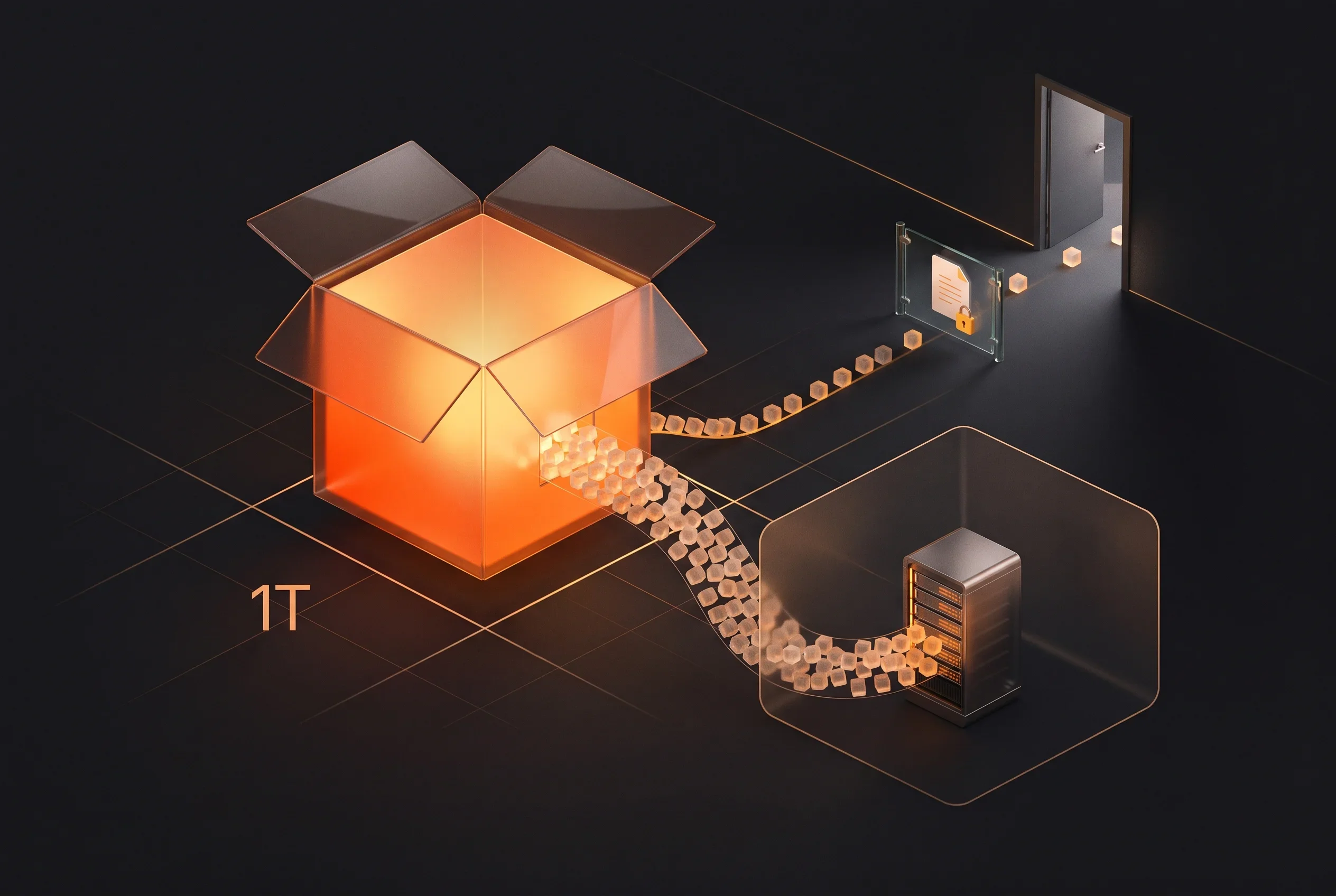
Mistral has released the weights of Mistral Large 4, which it first offered as a public preview. The MoE model has about 1 trillion parameters (49B active per token) and a 1M-token context. Its MIT-based license sets no revenue threshold and requires businesses that operate Model-as-a-Service offerings to sign a separate license before commercial use. Internal use is exempt. The API costs $0.70 per million input tokens.
Mistral has published the weights of Mistral Large 4, nicknamed Le Chonk1. The company had already put the model out as a public preview, and it says the weights released now belong to an improved version that kept going through reinforcement learning after the preview.
According to the model card, Mistral Large 4 is a Mixture of Experts (MoE) model with roughly 1 trillion total parameters and 49B active parameters per token (52B once the embedding and output layers are counted)2. For each token it picks 4 of 128 experts, and one shared expert sits alongside them. The context length is 1M tokens; it takes text and images as input and returns text, and it covers more than 160 languages, every official EU language among them. Mistral says it trained the model from scratch in data centers it runs in Europe, using 3,800 of NVIDIA’s Grace Blackwell GPUs.
Whether a large open-weight model makes sense for production work depends not only on benchmark scores but on the license terms and on where and how the model can actually run. This article covers those two points first, then looks at the performance figures Mistral published and how it is handling cybersecurity use.
What to check in the license
The model ships under Mistral’s own Mistral Ecosystem Open-Weight License, which takes the MIT license as its base and changes it3. It grants free permission to use, copy, modify, distribute, and sell the model, and to run, deploy, further train it, and build derivative works, subject to two conditions.
The first is that the copyright notice and permission notice must be included in copies of the model. The second is specific to Mistral: when a licensee, or a company affiliated with it, runs a Model-as-a-Service business, it needs its own commercial agreement with Mistral before putting the model, or anything derived from it, to commercial use.
The license uses the term Model as a Service for letting outside parties run inference on, or post-train, the model or a derivative, by API, hosted endpoint, or any other route, when those parties can meaningfully steer what goes in, the settings, or the data used for training. Two things are carved out of that definition:
- Products for end users in which the model only powers particular features or a fixed harness
- Merely passing requests along to a model that another party hosts
On top of that, the second condition does not apply at all to internal use, where the model is not offered to anyone outside the organization, or to use of the model through Mistral’s official products. In its blog post, Mistral sums up the terms this way: anyone may use, adapt, fine-tune, and build commercial products on the model, and only Model-as-a-Service operators need an extra license1.
The license contains no revenue or user-count threshold. The Muse Model License that Meta attached to Muse Spark Open, whose weights Meta released in October, asks for a separate agreement when a licensee whose total revenue, including affiliates, exceeds $20 million over 12 months uses the model in a Model-as-a-Service business. Mistral’s text does not draw the line by company size; it draws it by whether the company runs a Model-as-a-Service business at all. A company that does must sign with Mistral before commercial use of this model, whatever its size, unless the use is internal.
Where it runs, and how big a self-hosted setup is
According to Mistral, you can use Mistral Large 4 in the company’s Mistral Studio and Mistral API, and on OpenRouter1. The weights are on the Hugging Face hub and can be run on in-house servers using vLLM or SGLang. The model is also available through NVIDIA-hosted endpoints and an NVIDIA NIM container, and, for teams that want a managed service, through Microsoft Foundry. Microsoft, quoted in the same announcement, calls itself the first cloud vendor offering Mistral Large 4 to its customers.
On the Mistral API, pricing is $0.70 per million input tokens, $0.07 per million cached input tokens, and $2.10 per million output tokens.
For self-hosting, the model card’s launch examples give a sense of scale2. vLLM is the recommended inference engine, and its example uses a tensor-parallel size of 8. The SGLang example is likewise configured for a single node with 8 GPUs. A separate NVFP4 quantized checkpoint with lower memory use is available for Blackwell-generation GPUs. The model card advises using the Mistral API if local serving does not perform well.
The checkpoint includes a draft head for speculative decoding (DSpark). In Mistral’s measurements, throughput rose by up to 1.9x compared with serving the model without the draft head, though the company notes that gains vary with the hardware and the workload.
Reasoning effort has three levels, low, medium, and high, with high as the default. The model card suggests high for hard prompts and agent workflows, low for quick chat replies, and medium for everyday tasks.
Performance figures Mistral reported
All of the following numbers come from Mistral’s announcement1. Mistral says a complete technical report will follow, so detailed evaluation conditions have not been published yet.
- Coding agents: Artificial Analysis Coding Agent Index, 48%. Mistral says this is effectively level with GLM-5.3, which it calls the top open-weight model, and that its model needs 47% fewer tokens to finish a task on average
- Terminal work: 41% on Terminal-Bench 4.0, up 13 points from the preview, with 30% fewer output tokens
- Cybersecurity: Artificial Analysis Cyber Index, 51%. The index checks whether a model can locate security flaws in a code base, confirm them by reproducing them, and patch them while keeping existing features working
The comparison point, GLM-5.3, was released by Z.ai in August, and Z.ai said it would publish the weights two weeks after launch, once safety evaluation and hardening were complete. Using fewer tokens matters both for compute when self-hosting and for usage-based API bills. Still, every one of these comparisons uses metrics Mistral chose for its announcement.
Cyber guardrails are still being adjusted
Mistral devotes a section of the announcement to defensive security work. It says the model takes on legitimate defensive tasks without needless refusals, and that across the cyber-themed prompts taken from three safety benchmarks (JailbreakBench, StrongREJECT, AgentHarm) it turned down 96.6% of malicious requests on average, the highest among the open models the company measured1.
Mistral also describes a problem it found in operation. After the preview, it monitored cyber-related use in live traffic. The model would not go along with black-box attacks on real, running systems, but Mistral says it sees potential for the model to help carry out real attacks, so it is changing the guardrails and plans to keep updating them over the coming months.
More offensive work gets separate treatment. Mistral is giving a group of corporate design partners, Orange Cyberdefense among them, early access to a dedicated variant built for pen-testing, assessing vulnerabilities, and red-team exercises. Partners go through strict vetting and contractual safeguards, and testing is limited to systems the partner owns or has explicit permission to test.
So even for a model with published weights, the variant tuned toward offensive work is limited to vetted partners. Closed-model providers are also splitting access to cyber capabilities by who the user is: Anthropic reorganized its Cyber Verification Program into three tiers, giving vetted professionals a tier with fewer blocks.
Deciding whether to adopt it
For purely internal use, the license’s Mistral-specific condition does not apply, so the decision is mostly about hardware and operations. Since the official launch examples assume a single 8-GPU node, many organizations will likely start by trying the model via Mistral’s API or OpenRouter and then decide whether they need to host it themselves.
Companies that operate a Model-as-a-Service business, on the other hand, need a separate agreement before commercial use of this model, regardless of size. Embedding the model only within specific features of a product falls outside the definition, but whether a given offering lets users meaningfully control the model’s inputs or parameters has to be checked against the license text product by product.
For now, the performance numbers are Mistral’s own, and the evaluation conditions are worth confirming once the technical report is out.
Sources
- Mistral Large 4 (Le Chonk) is now open weight - Mistral official blog (October 29, 2026)
- mistralai/Mistral-Large-4-1T-A52B - Mistral’s official model card on Hugging Face
- Mistral Ecosystem Open-Weight License - License text for Mistral Large 4 (Hugging Face)
Was this article helpful?
Thank you!
Received. Thank you!