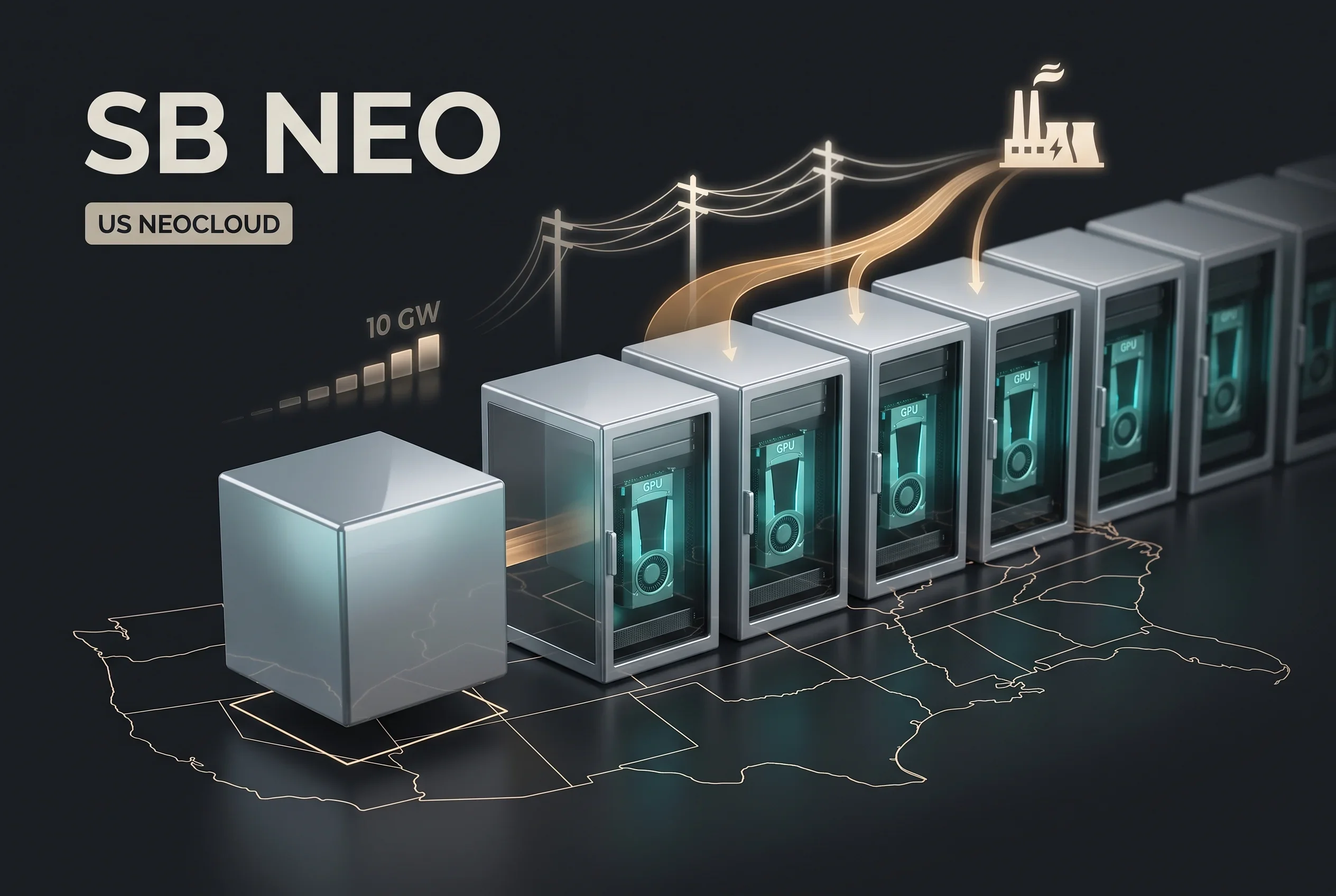
SoftBank Establishes 'SB Neo' Neocloud Company in the US, Planning to Scale to 10 GW of AI Infrastructure
SoftBank Corp. and SoftBank Group announced SB Neo on July 2, a new US company that will provide computing resources for AI. Service is set to launch in fiscal 2027 and gradually scale toward 10 gigawatts of AI infrastructure, entering a neocloud market crowded with CoreWeave and the major cloud providers.
SoftBank Corp. and SoftBank Group Corp. announced on July 2, 2026 that they are establishing SB Neo, Inc., a new company that will provide neocloud services in the United States1. SoftBank Corp. holds 51% and SoftBank Group 49%, making SB Neo a consolidated subsidiary of SoftBank Corp., incorporated in Delaware1.
The service is scheduled to launch in fiscal 2027 (the fiscal year ending March 31, 2028), targeting large US enterprises — including hyperscalers — that need computing resources for training and running large AI models1. Leveraging the 10-gigawatt-scale energy and AI infrastructure that SoftBank Group is currently developing, the company plans to expand in stages toward deploying AI infrastructure at a 10-gigawatt scale1.
What Is a Neocloud?
A neocloud is a relatively new and fast-growing segment of the cloud infrastructure business that specializes in renting access to GPUs and other AI accelerators2. Unlike traditional hyperscale clouds that offer a broad range of general-purpose services, neoclouds focus narrowly on the computing resources needed for AI training and inference2.
The market already includes CoreWeave, the leading neocloud pure-play, as well as the major cloud providers AWS, Microsoft, and Google Cloud, making for intense competition2. SB Neo adds a Japanese telecom group to that picture as a full-scale entrant.
The Technical Foundation: Infrinia AI Cloud OS, Already Running in Japan
The technical backbone of SB Neo is Infrinia AI Cloud OS, the software platform behind the GPU cloud service SoftBank has been offering in beta in Japan since May 20261. Designed for AI data centers, the software supports Kubernetes-as-a-service in multitenant environments and inference-as-a-service capabilities2, and SoftBank intends to apply the operational experience from Japan to the US business1.
As for differentiation, SoftBank President Junichi Miyakawa points to energy: he cited the ability to secure energy from gas-fired plants as a competitive advantage2. With power supply becoming the bottleneck in AI data center expansion, securing computing resources and energy as a package is increasingly what separates successful entrants from the rest.
Where SB Neo Fits in SoftBank’s AI Investments
SoftBank Group has been expanding its AI infrastructure investments, including its participation with OpenAI in Stargate, the $500 billion AI infrastructure project. SB Neo takes that a step further: an operating company in the US that owns and provides the infrastructure itself. On the financing side, Bloomberg has reported that SoftBank has reengaged with lenders to secure a $10 billion loan backed by its stake in OpenAI2.
There are also risk factors. A McKinsey & Co. report warns that the neocloud business model is “extremely fragile” because of its commoditized nature2 — hardware procurement alone may not sustain differentiation. For SB Neo, whether the Infrinia software layer and energy security can be that answer is the key question ahead of the fiscal 2027 launch.
Full details are available in SoftBank Group’s official press release. For the competitive landscape of the neocloud market, SiliconANGLE’s coverage is a useful reference.
Sources
- SoftBank Corp. and SoftBank Group Corp. Establish SB Neo, Inc. to Launch Neocloud Business in the U.S. - SoftBank Group official press release
- SoftBank unveils plans to enter the US neocloud business with SB Neo - SiliconANGLE
Was this article helpful?
Thank you!
Received. Thank you!