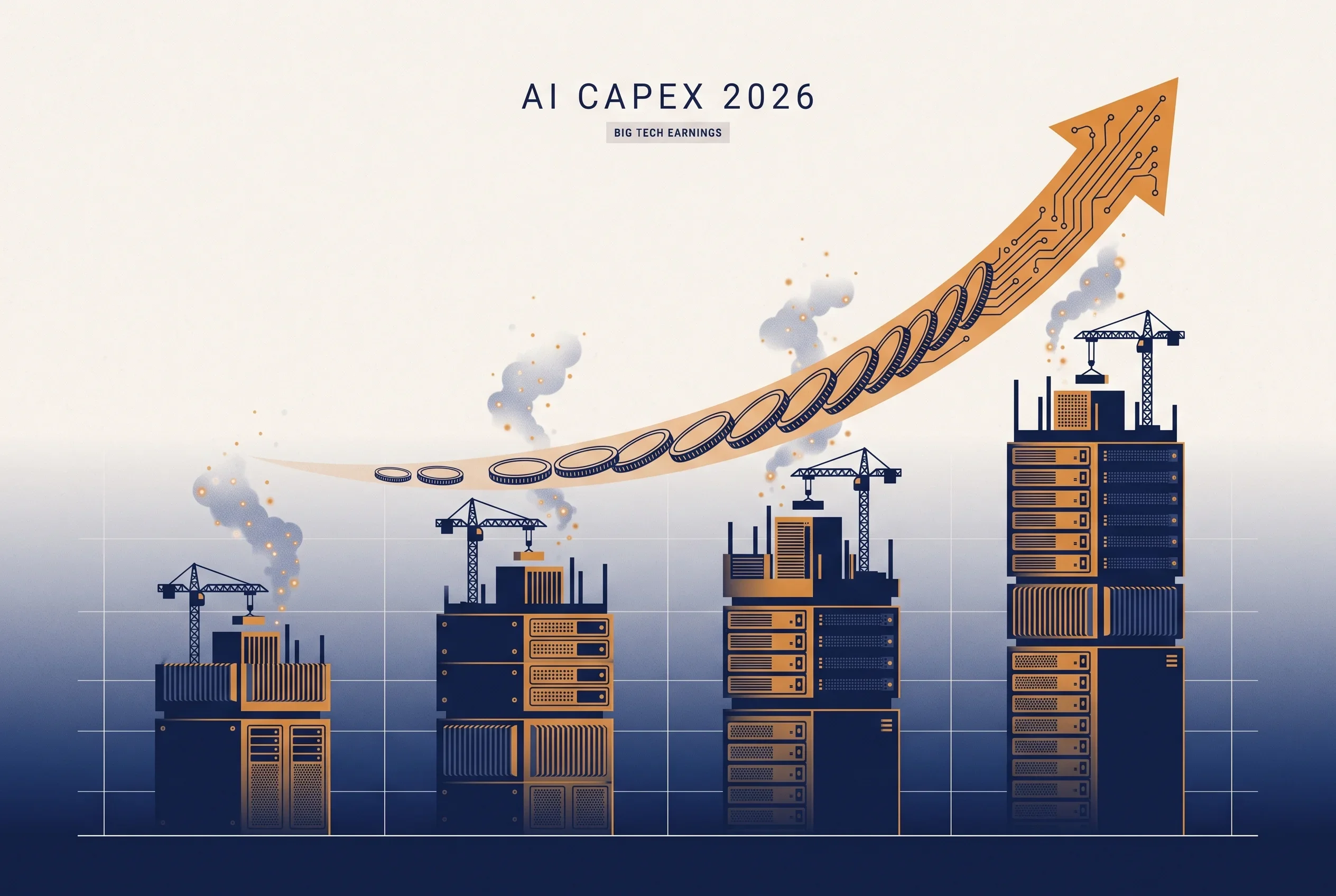
Big Tech AI Capex 2026: Alphabet, Meta, and Amazon Plan Up to $570 Billion Combined
Q2 2026 earnings locked in Big Tech's AI infrastructure spending: Alphabet raised 2026 capex guidance to $195-205B, Amazon lifted its plan to about $220B, Meta guides $130-145B, and Microsoft's fiscal 2026 spend was reportedly $115.95B. A breakdown of the numbers, the funding behind them, and the Anthropic gains flowing back.
By the end of July 2026, earnings from Microsoft (July 29), Meta (July 29), Amazon (July 30), and earlier Alphabet (July 22) had largely settled how much Big Tech will pour into AI infrastructure this year. For calendar 2026, capex guidance stands at $195-205 billion for Alphabet4, $130-145 billion for Meta5, and about $220 billion for Amazon7. Adding up just the top ends of those three plans yields $570 billion. Microsoft, whose fiscal 2026 ended in June, reportedly spent $115.95 billion for the full year2.
Beyond the sheer scale, what stands out this quarter is that all three calendar-year companies moved their plans upward. Alphabet raised its range from the previous $180-190 billion4, Amazon lifted its estimate from about $200 billion to about $220 billion7, and Meta raised the bottom of its prior $125-145 billion range to $130 billion5. The AI infrastructure race is still accelerating into the second half of 2026.
The Numbers Behind the Raises
Alphabet posted Q2 revenue of $119.8 billion, up 24% year over year, with Google Cloud accelerating 82% to $24.8 billion3. The company attributes the growth to enterprise AI Solutions and enterprise AI Infrastructure across Google Cloud Platform3. Q2 capex alone was $44.9 billion; on the earnings call, CFO Anat Ashkenazi said roughly 60% went to servers and 40% to data centers and networking equipment4. She also said the company continues to expect capex to increase significantly in 20274.
Meta reported Q2 revenue of $60.8 billion and diluted EPS of $6.18, with quarterly capex of $31.08 billion5. Its full-year guidance ($130-145 billion) includes principal payments on finance leases5. The company also recognized $2.4 billion in charges related to legal proceedings in the quarter5.
Amazon grew Q2 net sales 20% to $200.6 billion, with AWS up 37% to $42.2 billion - what the company calls its fastest growth in 18 quarters, reaching a $169 billion annualized revenue run rate6. AWS operating income was $16.6 billion, up from $10.2 billion a year earlier6. Capex was $54.2 billion in Q2 alone and $173.0 billion over the trailing twelve months6. On the earnings call, CEO Andy Jassy explained the raise to roughly $220 billion in capital expenditures as driven by higher memory costs, and is reported to have said that even at that level Amazon will not have enough capacity to meet all of its 2026 demand - a dynamic he expects to hold in 2027 as well7.
Microsoft reported fiscal Q4 (April-June) revenue of $90 billion, up 18%, with Microsoft Cloud at $59.3 billion (up 27%) and Azure growing 43%; annual Azure revenue crossed $100 billion for the first time12. Quarterly capex of roughly $35.8 billion more than doubled year over year, and full-year capex reportedly reached $115.95 billion, up nearly 80%2. CFO Amy Hood said about two-thirds of the capex went to short-lived assets such as CPUs and GPUs2.
Where the Money Comes From: Equity, Debt, and Compressed Free Cash Flow
Spending at this level is getting harder to fund from operating cash alone. In June 2026, Alphabet raised $49.6 billion in net proceeds by issuing common stock and mandatory convertible preferred stock, with the stated use including capital expenditures to scale AI infrastructure and global compute3. In the same quarter it also issued $20.3 billion in senior unsecured notes3. Even Alphabet, with its enormous advertising cash flows, recorded negative free cash flow of $5.9 billion in Q24.
Meta’s free cash flow shrank to $784 million5 - investing $31 billion in a quarter largely offsets the cash generated by more than $60 billion in revenue. Amazon generated a hefty $161.4 billion in operating cash flow over the trailing twelve months6, but its capex is running even higher, at $173.0 billion over the same period6.
At the same time, AI investment has started flowing back to the income side of the ledger. Amazon’s $62.6 billion Q2 net income includes $53.4 billion of non-operating pre-tax other income, primarily from its investments in Anthropic6. Microsoft reportedly booked about $3.2 billion in gains on its Anthropic investment in the quarter2. Alphabet’s $112.1 billion net income (EPS $9.11) likewise includes $98.0 billion of other income driven mainly by net unrealized gains on equity securities3. Valuation gains on AI investees lifting investors’ earnings is a pattern worth watching as a gauge of how heated the AI boom has become.
What the Combined Total Does - and Does Not - Tell You
Adding the top ends of the calendar-2026 guidance - Alphabet’s $205 billion, Meta’s $145 billion, Amazon’s $220 billion - gives $570 billion. Including Microsoft’s $115.95 billion fiscal-year actual brings the figure to roughly $690 billion. But caution is warranted: Microsoft’s July-June fiscal year does not align with the calendar year, Meta’s figure explicitly includes finance lease principal payments, while Alphabet’s and Amazon’s guidance comes without that breakdown, so the definitions do not line up. “About $690 billion across four companies” is a rough sense of scale, not a precise statistic.
The direction, though, is unambiguous: supply is not keeping up with demand. Jassy’s view that capacity shortfalls will persist into 20277 matches the pattern of AI labs locking in compute ahead of time through long-term deals and investments, as seen in the SSI-NVIDIA partnership and Recursive’s AWS compute deal. At the infrastructure layer, vertical integration like Nscale’s acquisition of Anyscale and new financing structures like loans collateralized by inference chips point to capacity acquisition becoming the main battleground across the compute stack.
For cloud customers, these numbers cut both ways. The added investment could ease capacity constraints and broaden AI service options over the medium term. But as long as demand outruns supply, GPU instance availability and pricing are likely to stay tight. When planning AI workload capacity or a multi-cloud strategy, it is worth treating the supply side’s investment cycle as a given - Alphabet has signaled capex will rise significantly in 20274, and Amazon expects capacity to stay tight through 2027 as well7.
Sources
- Microsoft FY26 Q4 Earnings Release - Microsoft IR (July 29, 2026)
- Microsoft’s cloud brings rain of revenue but modest M365 AI revenue harvest - The Register (July 30, 2026)
- Alphabet Announces Second Quarter 2026 Results - Alphabet IR (July 22, 2026)
- Earnings call transcript: Alphabet beats Q2 2026 estimates, shares fall on capex surge - Investing.com (July 22, 2026, earnings call transcript)
- Meta Reports Second Quarter 2026 Results - Meta IR (July 29, 2026)
- Amazon.com Announces Second Quarter Results - Amazon 8-K exhibit / earnings release (July 30, 2026)
- Andy Jassy said Amazon will spend $220 billion this year - Fortune (July 30, 2026)
Was this article helpful?
Thank you!
Received. Thank you!