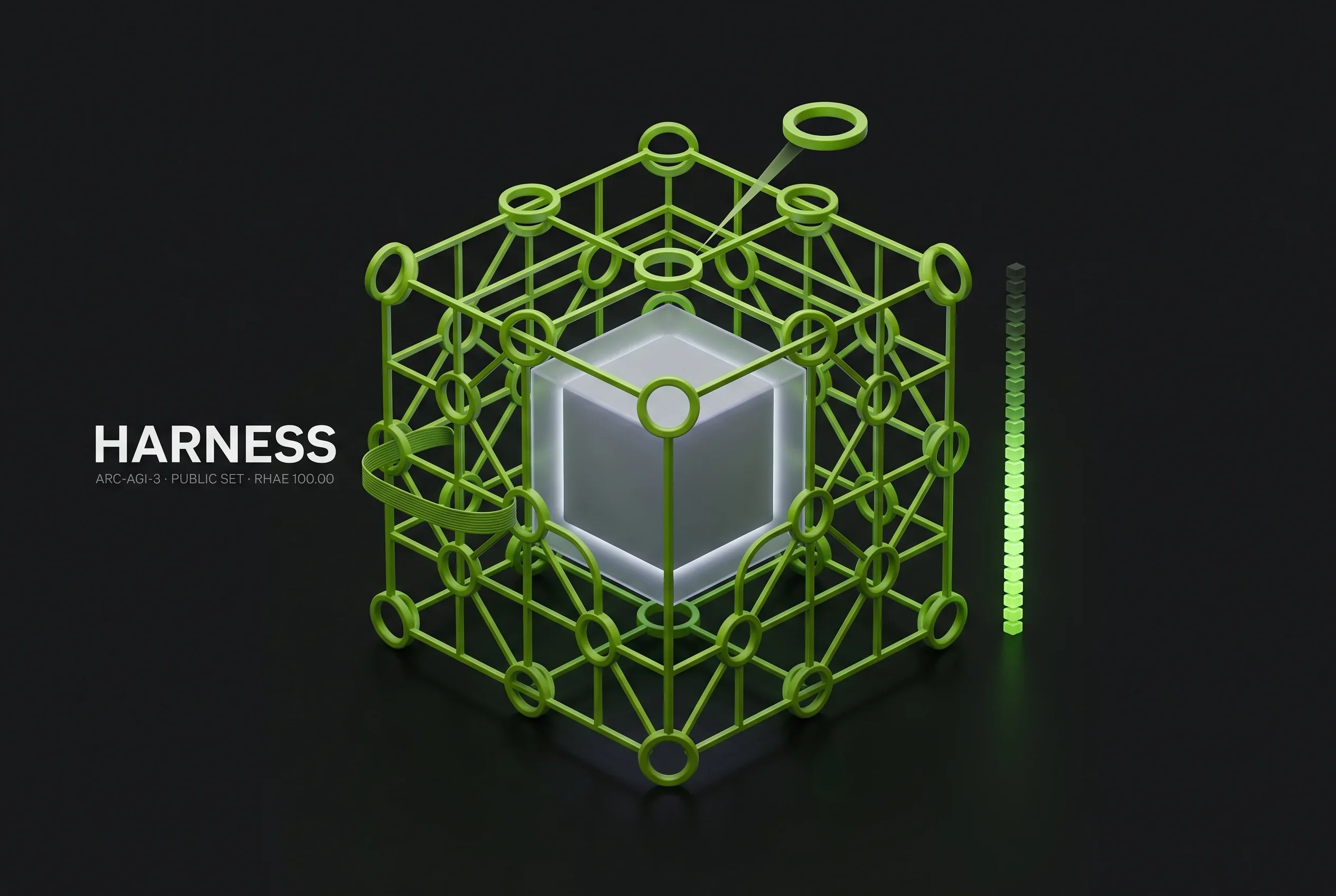
NVIDIA AVO Scores 100.00 on the ARC-AGI-3 Public Set by Changing the Harness, Not the Model
NVIDIA reported on August 21, 2026 that its AVO research project solved all 183 levels across the 25-environment ARC-AGI-3 public set with a 100.00 RHAE score using Claude Opus 5. ARC Prize separately reports about 30% for the same model at High reasoning effort.
When teams put an AI agent to work, the first decision is usually which model to use. A research report NVIDIA published on August 21, 2026 argues, with a public benchmark score, that there is another large variable sitting in front of that one1.
The company’s research project AVO (Agentic Variation Operators) completed all 25 environments and 183 levels of the ARC-AGI-3 public set with an RHAE score of 100.00, using 6,624 environment actions1. The model behind it was Anthropic’s Claude Opus 5. For the same model, ARC Prize separately reports approximately 30% at High reasoning effort1.
The harness that sits outside the model
NVIDIA opens the post by framing what an agent is made of. A frontier language model is only one component of an AI agent; the surrounding system — often called a harness — determines how the model receives context, uses tools, maintains state, responds to feedback, recovers from failure, and sustains progress over long-running tasks1.
AVO is built as a general-purpose coding agent that includes that harness. Like other modern coding agents, it inspects and edits code, runs commands, consults documentation, and validates its own work by execution. What NVIDIA calls its distinguishing focus is sustained autonomous operation across long horizons1.
Two mechanisms matter for that1.
The first is persistent memory, which carries forward prior implementations, evaluation results, compiler and profiler outputs, and accumulated reasoning, so the agent can resume from the current state rather than repeatedly reconstructing the search1.
The second is a supervisor. It monitors the broader trajectory for stagnation or repeated unproductive cycles and can redirect the main agent toward alternative strategies1. In the seven-day run described below, the main agent kept deciding what to inspect, change, test, and evaluate, while the supervisor helped maintain forward progress when the search plateaued1.
It started as a job for making GPU kernels faster
AVO was not built for ARC-AGI-3. Its first proving ground was GPU-kernel optimization, which is the easier of the two to read.
In the attention-kernel study, AVO operated continuously for seven days, explored more than 500 optimization directions, and produced 40 committed kernel versions1. On NVIDIA DGX B200 systems, the resulting multihead attention kernels outperformed cuDNN by up to 3.5% and FlashAttention-4 by up to 10.5% across the evaluated configurations1. Both figures are NVIDIA’s own measurements and both carry the “up to” qualifier. The agent then adapted the evolved kernel to grouped-query attention in roughly 30 minutes of additional autonomous work1.
What NVIDIA says this experiment demonstrates is less the final kernel numbers than the fact that AVO can sustain a productive engineering loop over many iterations without each step being manually prescribed1.
What it did on ARC-AGI-3
ARC-AGI-3 drops an agent into unfamiliar game-like environments with no instructions, no explicit rules, and no stated goal. The agent has to explore through interaction, infer the environment’s dynamics and objectives, and plan actions efficiently across progressively harder levels1. The metric, RHAE (Relative Human Action Efficiency), combines task completion with per-level action efficiency relative to first-time human baselines1.
Rather than centering the system on explicit programmatic world-model construction, as explored by Tycho, NVIDIA adopted the direct-interaction design principles described by VISTA and reimplemented the task interface independently1. The agent backend is different, though: VISTA instantiates the harness with Claude Opus 5 through Claude Code or GPT-5.6 Sol through Codex, whereas this system uses AVO with its persistent memory, supervision, and its own execution loop1.
The observation interface differs too. VISTA’s primary configuration uses a rendered 512 x 512 PNG, while in the AVO configuration the model operated in a text-only modality, with each observation supplied as an exact 64 x 64 text grid — no images or image tokens were sent to the model1. The agent received the available actions without descriptions of the game’s rules or goals and had to infer their effects through interaction1.
The result: AVO completed the 25-environment public set with a 100.00 RHAE score using Claude Opus 5, solving all 183 levels in 6,624 environment actions1. NVIDIA cites, for reference, that VISTA reports 7,542 environment actions for the same 183 levels, and writes that AVO therefore used approximately 12% fewer actions in this cross-system comparison1. The VISTA figure is quoted within NVIDIA’s post; this article did not consult VISTA’s own source material.
How to read the numbers
The report is unusually careful about its own figures. Here are the caveats that change the meaning if dropped.
100.00 is a public-set number. In an editor’s note at the end, NVIDIA says it updated the wording to more precisely distinguish the public set from the semi-private and private competition sets, and the body states that these results cover the 25-environment ARC-AGI-3 public set using the official scorecard and RHAE metric, and are not results on the semi-private or fully private competition sets1.
The gap from 30% to 100.00 is not a measurement of AVO’s contribution. The roughly 30% that ARC Prize reports separately came from the same model family under a different reasoning setting, a substantially different agent system, and a different evaluation setup — so these numbers should not be interpreted as a direct measurement of AVO’s performance contribution, NVIDIA writes1. What they illustrate instead is that model-level evaluation alone does not characterize the performance of a complete agent1. The 12% action-count difference against VISTA carries the same caveat: the two systems differ in agent backend, observation representation, memory, and context management, so it should not be interpreted as a controlled ablation1.
AVO is not a product. NVIDIA calls it a research project, and TechCrunch adds that this is not a new NVIDIA product; the company instead puts out open pieces of technology for building harnesses under the Nemo brand, some commercial and much of it openly available2.
The full public-set result used Claude Opus 5, but there was also a limited experiment pairing AVO with GPT-5.6 Sol on a challenging subset of games. Sol reached matched levels faster in wall-clock time in several cases, while Opus used fewer environment actions in matched-level comparisons — preliminary results that NVIDIA says suggest complementary operating profiles, with a broader systematic comparison left to future work1.
Reading it alongside OpenAI’s July report
OpenAI made a similar point about the same benchmark in late July. GPT-5.6 Sol scored 13.3% on the public set with the official harness, and 38.3% once two API settings used in ChatGPT and Codex — retained reasoning and compaction — were enabled, using one-sixth the output tokens (OpenAI Says Two API Settings Tripled Its ARC-AGI-3 Score). OpenAI concluded then that an evaluation measures a bundle of choices, including API settings and harness design, rather than the model on its own.
NVIDIA goes a step further. Instead of flipping two settings, it brought an entire harness with persistent memory and a supervisor, and solved the public set with it — and that harness was originally built for GPU-kernel optimization. NVIDIA says the most important result was not the 100.00 score but that the same agent architecture transferred from highly specialized GPU-kernel optimization to a very different interactive reasoning task1. The interfaces differ, but the loop is the same: form a hypothesis, act, observe evidence, update state, and continue1.
What changes in your own setup
If you run agents in production, the takeaway is not to wait for AVO — you cannot use it. What is useful is the order in which you check things when an agent misbehaves.
When a long-running task loops over the same ground, or loses context and starts over, the reflex is to swap in a larger model. But both mechanisms NVIDIA highlights — what carries across sessions (memory) and who notices stagnation and changes direction (the supervisor) — sit outside the model. Long-horizon capability is a property of the full system: memory determines what survives, tools determine what actions are possible, feedback grounds progress, and recovery allows work to continue beyond a single model invocation, as the company puts it1.
That framing also applies when you use off-the-shelf tools. Cursor recently added subscriptions that let a cloud agent wake itself on events, plus /goal, holding a goal until it is met and keeping a long session on track — features that live in the harness layer. Where humans watch and stop the work in progress is part of the harness too: Slack added dedicated “code channels” for coding agents, making the place where plans, diffs, and approvals live a product choice in itself. So is how often the agent asks for permission, which is what Claude Code’s shift to auto mode by default was about.
NVIDIA closes the post with a single line: the model matters, but the model is not the entire agent1. When reading benchmark scores, it is worth separating whether the thing being compared is a model or a complete agent system.
The details of AVO are published as the paper “AVO: Agentic Variation Operators for Autonomous Evolutionary Search,” linked from the end of the post1, along with the ARC-AGI-3 benchmark itself and its scoring methodology1.
Sources
- NVIDIA AVO Reaches 100% on ARC-AGI-3, Demonstrating a Frontier-Level General-Purpose Architecture for Long-Horizon Autonomous Agents - NVIDIA Technical Blog (Terry Chen, Yeyin (Eva) Zhu, Zhifan Ye, Jean-Francois Puget, Humphrey Shi, August 21, 2026)
- Nvidia just showed that the harness, not the AI model, is now the real hero - TechCrunch (August 21, 2026)
Was this article helpful?
Thank you!
Received. Thank you!