Neuralink: The Journey of a Revolutionary Company Connecting Brains and Computers
Founded by Elon Musk in 2016, Neuralink is revolutionizing medicine with technology that directly connects brains to computers. Already achieving results in clinical trials with 7 patients, the company is expanding human potential from enabling independence for paralyzed patients to restoring vision.
The technology to directly connect human brains with computers has long been discussed as science fiction. However, in 2025, this dream is becoming reality. Neuralink, led by Elon Musk, stands at the forefront of brain-computer interface (BCI) technology, already transforming lives through clinical trials with seven patients.
Neuralink was founded in 2016 and first publicly announced in March 20171. Eight years since its founding, the company has reached a valuation of $7.8 billion and completed $687 million in funding2. The company’s technology enables quadriplegic patients to control computers with thought alone and holds the potential to restore light to those who have lost their vision.
Neuralink’s Journey from Founding to Evolution
Founding Period (2016-2019)
Neuralink was founded in 2016 by Elon Musk and eight scientists and engineers. The co-founders included Max Hodak, Benjamin Rapoport, Dongjin (DJ) Seo, Paul Merolla, Philip Sabes, Tim Gardner, Tim Hanson, and Vanessa Tolosa1.
In April 2017, the company announced its short-term goal of treating serious brain diseases, with the eventual aim of human enhancement. On July 16, 2019, Neuralink held its first public presentation at the California Academy of Sciences, unveiling its developing technology to the world. By this point, the company had completed $158 million in funding ($100 million from Musk) and employed 90 people1.
Technology Demonstration Period (2020-2023)
In 2020, Neuralink conducted a demonstration with a pig named Gertrude implanted with a Neuralink device, proving the implant’s safety and functionality2. This success marked an important step toward human application.
On May 25, 2023, a historic turning point arrived for the company. They obtained approval from the U.S. Food and Drug Administration (FDA) for human clinical trials2. In September of the same year, they began recruiting participants for their first clinical trial targeting quadriplegic patients.
Human Implementation Period (2024-Present)
In January 2024, Neuralink successfully implanted its device in a human brain for the first time2. The first participant, Noland Arbaugh, who suffered from quadriplegia due to spinal cord injury, became able to control a computer cursor with thought alone after the implant. Remarkably, he broke the BCI world record on the first day3.
In August 2024, the second patient received an implant, and as of June 2025, a total of seven patients (four with spinal cord injuries and three with ALS) are using Neuralink devices3. The last two surgeries were performed just one week apart, demonstrating the maturity of the surgical process.
Profiles of Founders and Key Figures
Elon Musk - CEO
Neuralink’s founder and CEO, Elon Musk, is a serial entrepreneur who also leads Tesla, SpaceX, and X (formerly Twitter). His vision is clear: “to mitigate the civilizational risk of artificial intelligence and align humanity’s collective will with AI’s will”3.
Musk points out that humans are already “cyborgs,” with smartphones and computers functioning as our “third layer.” However, the current problem is that the bandwidth between the brain and this digital layer is limited by speech and finger movements. Neuralink aims to dramatically expand this bandwidth.
DJ Seo - Co-founder, President & COO
Dr. Dongjin (DJ) Seo is Neuralink’s co-founder and currently serves as President and COO. He earned his B.S. in electrical engineering with honors from Caltech and received his Ph.D. in Electrical Engineering and Computer Sciences from UC Berkeley in 20164.
His doctoral thesis research on “Neural Dust” proposed an innovative method of wireless power and data telemetry using ultrasound, addressing fundamental issues with miniaturized implants. In 2016, Musk recruited him to join Neuralink’s founding. “It was hard to say no to the vision Elon outlined,” Seo recalls4.
He was named one of MIT Technology Review’s “Innovators Under 35,” recognizing his pioneering work in neural interface technology.
Neuralink’s Technical Strengths and Features
1. High-Density Electrode Array “N1 Chip”
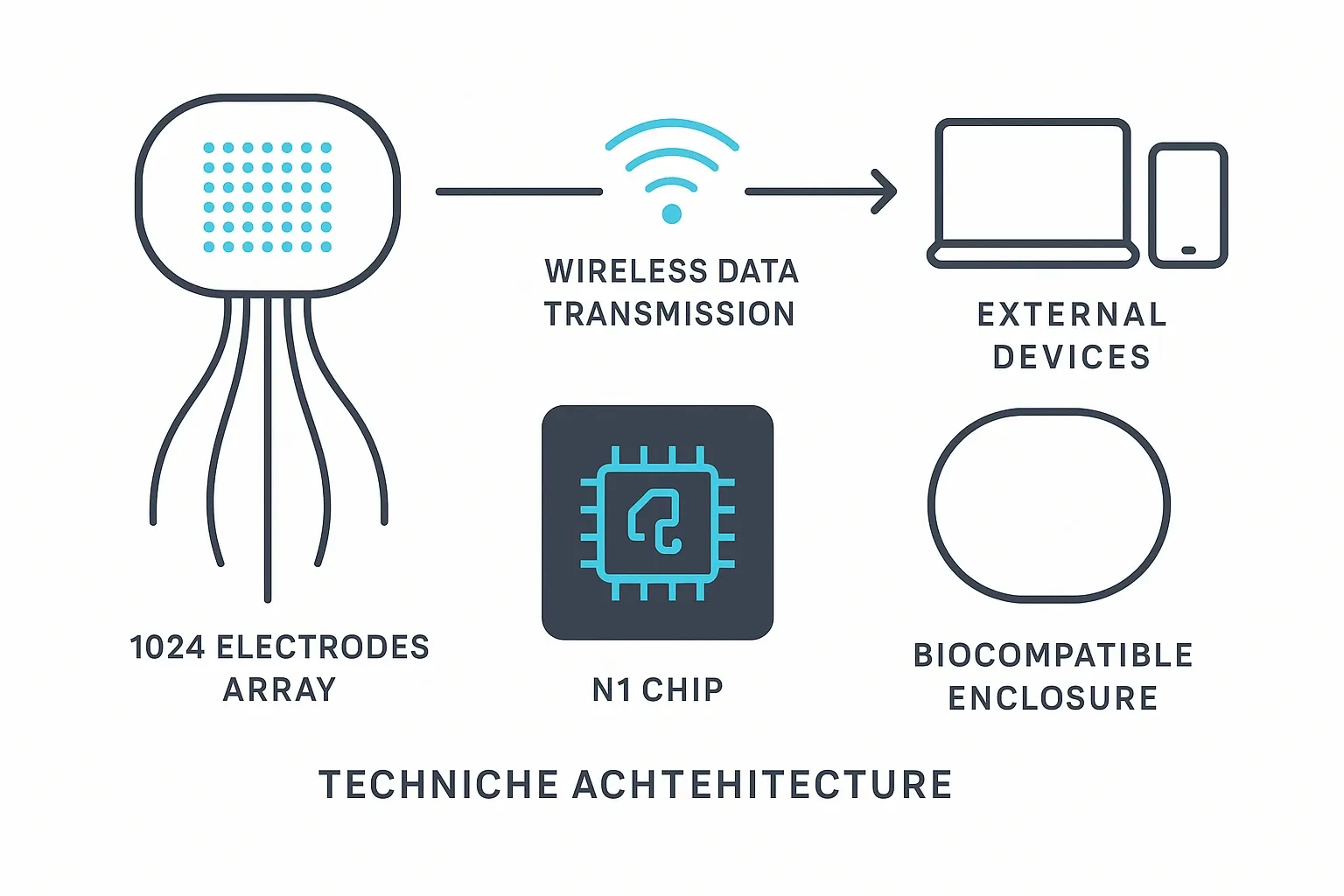
Neuralink’s greatest strength is the N1 chip with 1,024 electrodes. These electrodes are arranged on “threads” that are 4-6 micrometers wide—thinner than a human hair—minimizing damage to brain tissue while recording signals from numerous neurons simultaneously5.
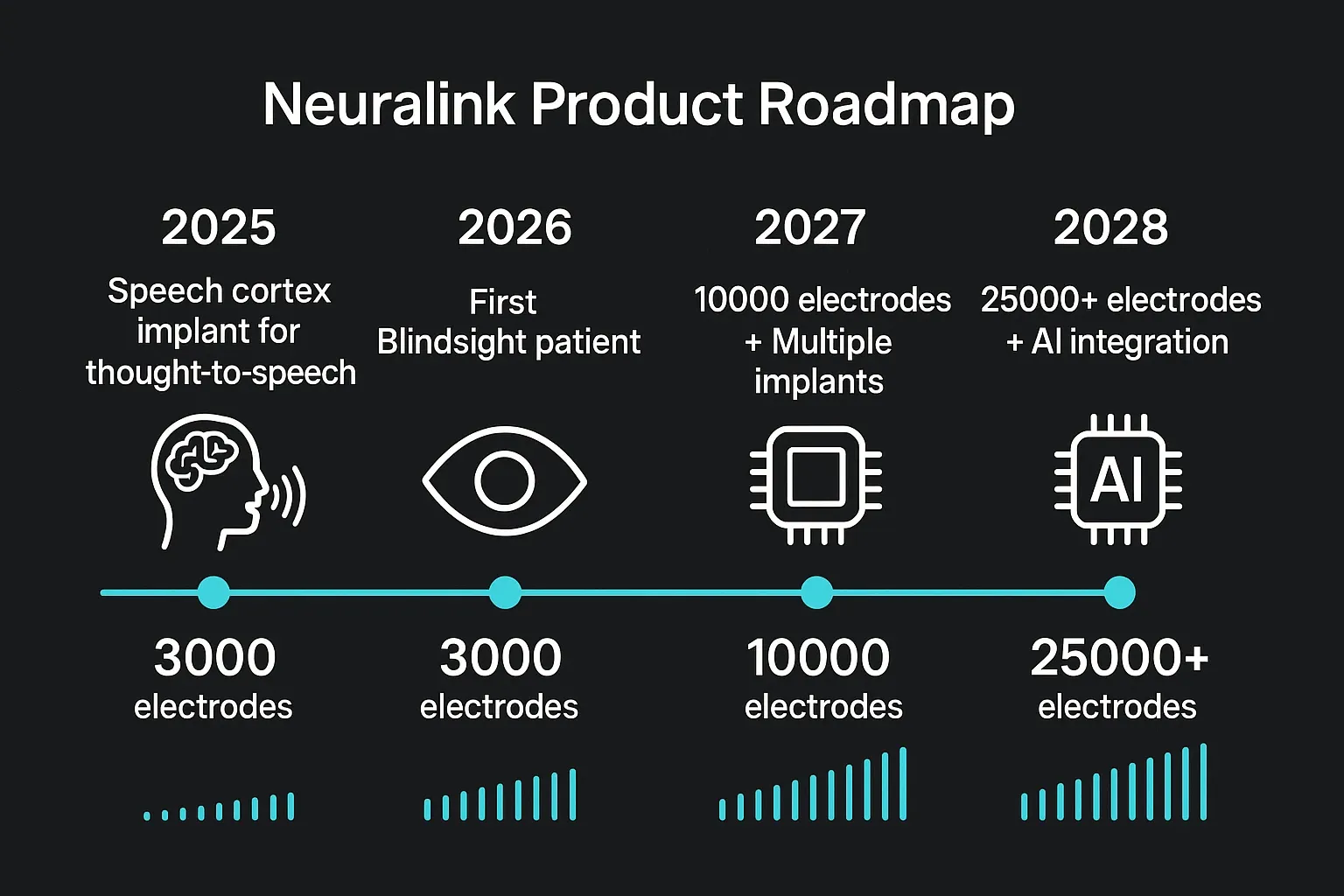
While current products have 1,000 channels, expansion is planned to 3,000 channels in 2026, 10,000 channels in 2027, and over 25,000 channels in 20283.
2. Revolutionary Surgical Robot “R1”
To insert threads with precision impossible for human hands, Neuralink developed a dedicated surgical robot. This robot can insert one thread in 17 seconds with the current model, and the next generation will reduce this to 1.5 seconds3.
The robot is equipped with five camera systems and an optical coherence tomography (OCT) system, capable of inserting threads more than 50mm deep from the brain surface. This depth enables access not only to the motor cortex but also to the visual cortex and deep brain structures.
3. Rapid Development Through Vertical Integration
Neuralink’s major strength lies in developing everything in-house—from chip design and electrode manufacturing to surgical robots, software, and machine learning algorithms. This vertical integration enables development at unthinkable speeds for other companies, allowing new feature development and patient testing to be conducted on the same day3.
4. Practical Application Development
Telepathy
A product that restores digital and physical independence for people with movement disorders. Already being used by 7 patients, with average usage of 50 hours per month and peak usage exceeding 100 hours per week (essentially all waking hours)3.
Blindsight
A product for people who have lost their vision. It holds the potential to restore sight even for those who have lost their retina or optic nerve, or who were born blind. Initially low resolution, but eventually high resolution with superhuman capabilities including infrared, ultraviolet, and radar vision3.
Speech Restoration
Technology to decode words directly from thoughts for people who have lost the ability to speak due to ALS, stroke, and other conditions. The first implant in the speech cortex is scheduled for Q1 20253.
Patient Voices: Life-Changing Technology
Noland Arbaugh (Patient 1)
“Through Neuralink, I found work. Just writing that sentence almost brought me to tears.”
Noland, who became quadriplegic from spinal cord injury, has regained the ability to work independently through Neuralink. He wakes up at 6-7 AM, works until his session, then works until 11 PM to midnight. He’s learning languages, relearning mathematics, writing, and doing things he “wouldn’t be able to do without Neuralink” every day3.
Alex Conley (Patient 2)
“I was a very creative person before my accident… the BCI allows me to push the boundaries of what I can create.”
Alex has been able to write again by controlling a robotic arm with Neuralink. Even more remarkably, he can now control individual finger movements, enabling him to play rock-paper-scissors and thumb wrestling3.
Brad Smith (Patient 3)
“The Neuralink experience has been fantastic! I am so happy to be involved in something big that will help many people.”
Brad, who lost his voice to ALS, previously relied on eye-tracking devices that only worked in dark rooms. But thanks to Neuralink, he can now go outside for the first time in six years. His time at the park with his children tells the true value that technology brings3.
Future Outlook: Expanding Consciousness and Human Evolution
Neuralink’s ultimate goal is to realize a “whole brain interface.” This means listening to neurons everywhere in the brain, writing information to neurons, enabling high-speed wireless data transfer, and creating a system available 24 hours a day with fully automated surgery3.
Musk believes this technology will help understand the nature of consciousness. The fundamental questions “What is consciousness? Where does it come from?” may find answers through Neuralink’s progress.
Furthermore, through integration with Tesla’s Optimus robot, paralyzed patients could “mentally inhabit a robot body,” and lost limbs could be replaced with robotic prostheses. The future depicted in Star Wars, where Luke Skywalker gets a robotic hand, is becoming reality3.
The New Era of Medicine Pioneered by Neuralink
Current Achievements and Future Developments
Currently, in addition to clinical trials in the United States, Neuralink has obtained approvals in Canada, the United Kingdom, and the United Arab Emirates3. The company is advancing global expansion in collaboration with world-class neurosurgical centers (Barrow Neurological Institute, Cleveland Clinic Abu Dhabi, University Health Network Canada, University of Miami Health System).
The 2025-2028 product roadmap includes the following plans:
| Year | Plans |
|---|---|
| 2025 Q1 | Direct thought-to-speech conversion with speech cortex implant |
| 2026 | Increase electrodes to 3,000, achieve navigation with first Blindsight patient |
| 2027 | Increase electrodes to 10,000, simultaneous implants in multiple locations |
| 2028 | 25,000+ electrodes, applications for psychiatric disorders and pain management, AI integration |
Social Impact and Ethical Considerations
Neuralink works closely with government regulatory authorities, going through thorough approval processes at every step. Musk emphasizes, “This technology will progress slowly. You won’t suddenly see numerous Neuralinks appearing all over the world. You’ll be able to watch the progress over several years”3.
The company’s cautious approach is evident from the fact that all human implants to date are functioning normally and operating well. They pay meticulous attention to each individual, striving never to fail.
Neuralink’s journey from ambitious startup to functioning brain-computer interface provider represents one of the most audacious technological undertakings of our time. In just eight years, the company has transformed science fiction concepts into clinical reality, with seven patients now living with implanted devices that restore communication and control capabilities.
The convergence of Musk’s vision, DJ Seo’s technical brilliance, and $680 million in funding has created a unique enterprise capable of developing everything from custom chips to surgical robots in-house. While immediate applications focus on medical needs - helping paralyzed patients control devices and potentially restoring vision and speech - the longer-term implications are profound.
As Neuralink progresses from treating disabilities to potentially enhancing human capabilities and enabling AI symbiosis, it raises fundamental questions about human evolution and identity. The company’s meticulous approach to safety and regulatory compliance suggests a measured path forward, but the destination remains revolutionary: a future where the boundaries between human consciousness and digital intelligence begin to blur.
Sources
- Timeline of Neuralink - Detailed timeline from Neuralink’s founding to 2024
- Neuralink Timeline: 12 Key Milestones from Founding to Human Trials - Major milestones from founding to human trials
- Neuralink Update, Summer 2025 - Neuralink’s official announcement video from Summer 2025
- Dongjin Seo | Innovators Under 35 - DJ Seo’s background and Neural Dust research
- Clinical Trials | Neuralink - Clinical trial information from Neuralink’s official website
Was this article helpful?
Thank you!
Received. Thank you!