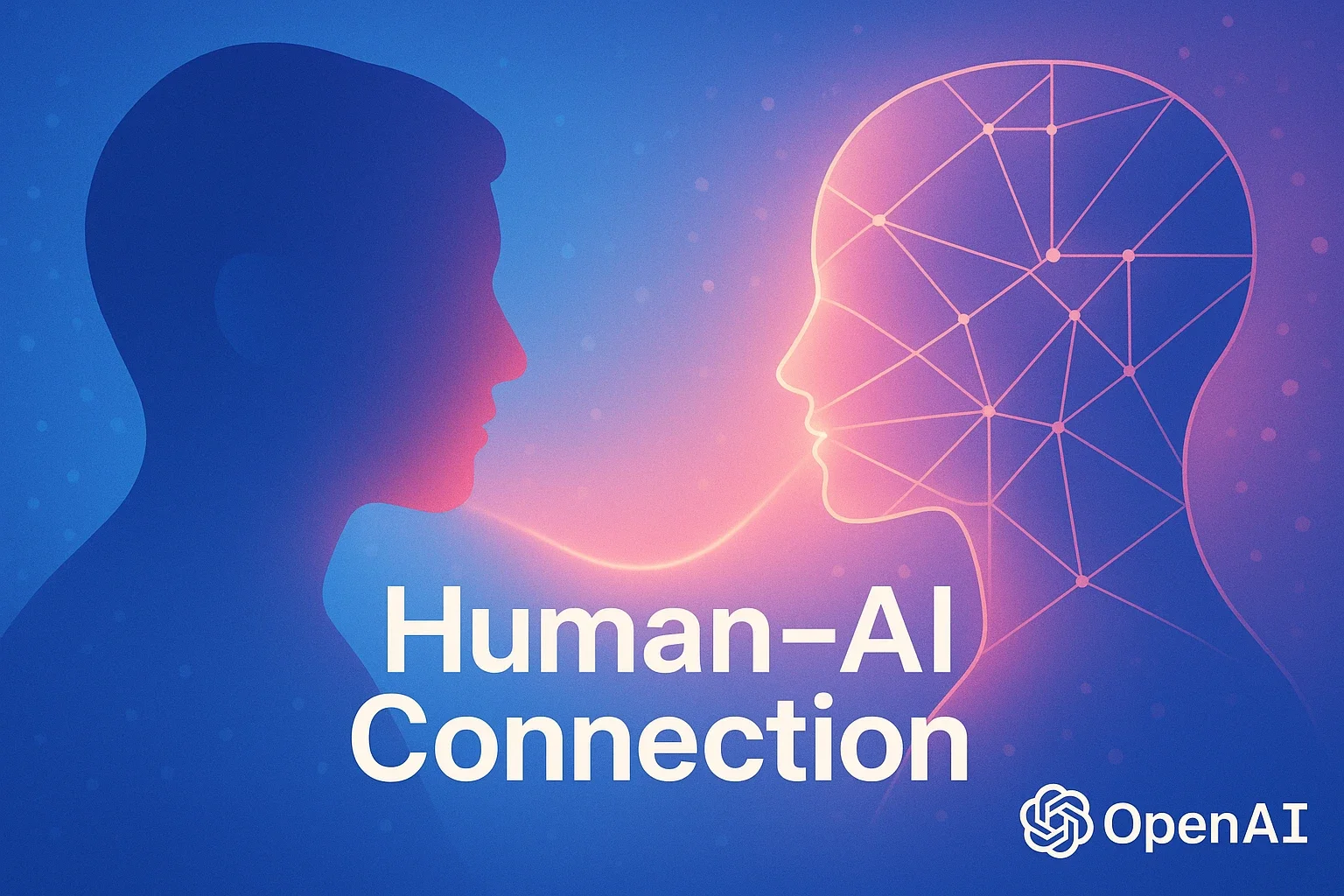
Human-AI Emotional Connections: OpenAI Reveals New Insights into Emerging Relationships
OpenAI publishes its first research findings on human-AI emotional relationships. Examining the impact of ChatGPT interactions on people's psychological well-being and new directions in AI design.
We stand at a crucial turning point in human-AI relationships. Joanne Jang, a data scientist at OpenAI, has published her observations on the phenomenon of people expressing gratitude to ChatGPT and confiding personal concerns. This article explores the possibilities and challenges of emotional connections with AI, based on the latest research findings.
In March 2025, OpenAI, in collaboration with MIT Media Lab, published its first large-scale study on how ChatGPT use affects people’s emotional well-being1. The research analyzed approximately 40 million ChatGPT interactions and surveyed the emotional responses of 4,076 participating users. While over 400 million people use ChatGPT weekly, the study found that only a small fraction engage in emotional interactions.
The Reality of Emotional Connections with AI
The phenomenon of humans forming emotional connections with AI is not new. We name our cars and feel sorry when robot vacuums bump into walls. However, with the emergence of advanced conversational AI like ChatGPT, this phenomenon has entered a new phase.
Jang presents two important aspects of AI consciousness. One is “ontological consciousness” (whether AI fundamentally possesses consciousness), and the other is “perceptual consciousness” (how conscious AI appears to be). OpenAI focuses on the latter, aiming to design AI that is “warm and approachable but does not imply an inner emotional life.”
Usage Patterns Revealed by Research
The OpenAI-MIT joint study conducted analysis using an automated classification system while protecting privacy1. The research was conducted in two phases: first analyzing approximately 40 million actual ChatGPT interactions, then MIT Media Lab conducting detailed experiments with about 1,000 participants over four weeks. Participants engaged with ChatGPT for at least 5 minutes daily and completed questionnaires about loneliness, social engagement, and emotional dependence at the end of the experiment.
Particularly interesting were the findings regarding Advanced Voice Mode. Research participants were assigned voice mode genders, and users who interacted with voices of a different gender than their own reported higher levels of loneliness and emotional dependence on AI at the experiment’s conclusion.
The Rise of Pseudo-Intimate Relationships
Research published in Frontiers in Psychology in November 2024 indicates that rapid advances in emotional AI are normalizing “pseudo-intimate relationships” in society2. These relationships partially fulfill human emotional needs while lacking the depth and complexity of human relationships due to technical limitations.
According to the research, humans have an inherent tendency to anthropomorphize non-human entities, and AI platforms can now provide “instant bidirectional interactions.” However, these relationships raise the following concerns:
- Private data security
- Algorithmic bias
- Potential for information manipulation
- Potential negative impacts on real-world interpersonal relationships
Risks and Concerns
Researchers identify three major risks posed by emotional relationships with AI.
1. Risk of Isolation
While AI can provide conversation and engagement, it lacks true reciprocity and emotional presence. If AI replaces rather than complements human relationships, it could exacerbate feelings of loneliness.
2. Unrealistic Expectations
Becoming too accustomed to frictionless dialogue with AI may lead to unrealistic expectations that human relationships should be equally simple. This could result in frustration or avoidance behaviors when facing the complexity of actual human relationships.
3. Emotional Over-dependence
Professor Kate Devlin (AI and Society) from King’s College London notes, “ChatGPT was designed as a productivity tool, but people are using it like a companion app”1. People who use it emotionally may engage with AI for an average of about 30 minutes per day, suggesting a risk of “emotional over-dependence.”
Impact and Outlook in Japan
A research team from Waseda University published a study in May 2025 analyzing human-AI relationships using attachment theory4. This research is a pioneering attempt to explore what kind of attachment relationships Japanese users form with AI.
For Japanese companies, this trend holds significant implications. Various applications are conceivable, including AI companions in elderly care, mental health support systems, and AI mentors in education. However, measures against the risks of weakening human relationships and addiction will also be necessary.
OpenAI’s Design Philosophy and Future Direction
OpenAI’s approach is based on the fundamental principle of “building models that provide services to people.” Jang states, “We prioritize users’ emotional well-being and will continue to share research findings transparently.”
Jason Phang, a safety researcher at OpenAI, says, “Much of what we’re doing here is preliminary, but we’re trying to start a dialogue with this field about what can be measured and the long-term effects on users”1.
Companies, researchers, and each of us must continue to explore healthy relationships with AI. We need to build a better future while balancing technological progress with human emotional needs.
Sources
- OpenAI has released its first research into how using ChatGPT affects people’s emotional wellbeing - MIT Technology Review (OpenAI-MIT joint research)
- Social and ethical impact of emotional AI advancement: the rise of pseudo-intimacy relationships and challenges in human interactions - Frontiers in Psychology (Published November 2024)
- Some thoughts on human-AI relationships - Joanne Jang (OpenAI) Substack
- Attachment theory: A new lens for understanding human-AI relationships - ScienceDaily (Waseda University research)
Was this article helpful?
Thank you!
Received. Thank you!