Google Cloud Launches Industry Editions of Gemini Enterprise - Financial Services and Legal First, Both in Preview
Google Cloud announced Gemini Enterprise for Financial Services and Gemini Enterprise for Legal on August 25. They are the first in a series of packaged industry solutions bundling domain agents, skills and connectors. Harvey, a legal AI rival, appears among the legal edition's connectors.
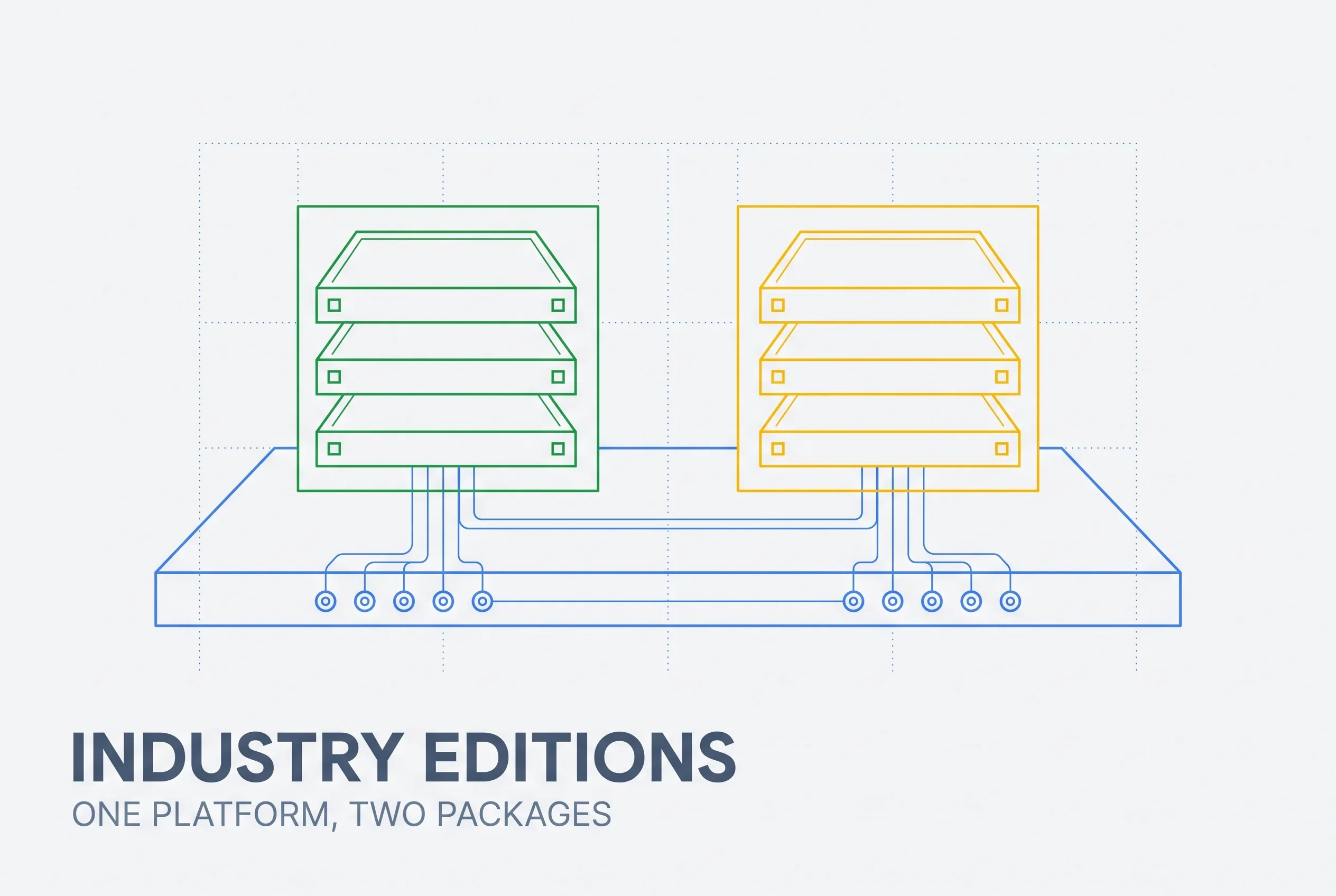
On August 25, Google Cloud announced Gemini Enterprise for Financial Services and Gemini Enterprise for Legal12. The company positions the two as the first in a series of packaged industry solutions built on top of the Gemini Enterprise platform1.
What a packaged solution contains, per Google, is tailored agents for that industry, specialized skills that act as shortcuts through workflows, data connectors, and model optimizations tuned for the sector1. The shift is from handing a general-purpose AI chat to everyone toward buying the industry’s workflows as a bundle.
Both are in preview, and neither announcement states pricing12.
Financial Services: 50 Skills, 13 Connectors, and a Research Agent You Can Audit
The financial edition entered preview for capital markets and corporate banking, and Google says CME Group and Deutsche Bank are already using it1. Deutsche Bank was also a key design partner for the Financial Research agent at its centre1.
The composition is a Google-managed Financial Research agent, more than 50 new skills carrying specialized agentic instructions for financial roles and workflows, enterprise data connectors, an expanding third-party agent ecosystem, and the underlying Gemini Enterprise platform1. The release states that it delivers the agent alongside 50 purpose-built skills and 13 connectors integrating securely with market data, news feeds, regulatory filings and internal databases, producing research grounded in verifiable sources with full data provenance1.
The explainability claim is specific. The agent is described as providing transparency into its reasoning through confidence scores, explicit methodologies, data snapshots for auditing, and precise source citations1. It can be reached directly through the Gemini Enterprise app or wired into existing agent workflows via Agent-to-Agent (A2A) APIs, with enterprise data reached through MCP integrations1.
Named connector sources include CoinDesk Data & Indices, Daloopa, Dun & Bradstreet, FactSet, Finnhub, Fiscal.ai, Guidepoint, LSEG, Moody’s, MSCI, PitchBook, S&P Global and SEC Edgar1.
Among the workflows Google puts forward: reducing complex bond portfolio risk exposure analysis to a sub-five-minute execution complete with automated duration-hedging suggestions, and compressing client pitch presentation timelines for bond issuance from days to minutes1. These are framed as what the solution is meant to enable; no measured results are supplied.
Deutsche Bank says it will use the Financial Research agent across its Corporate Bank division to uncover customer needs and identify market developments1. Marie-Jeanne Deverdun, Chief Technology, Data and Innovation Officer and a member of the bank’s Management Board, points to reducing manual research effort, improving consistency and auditability of outputs, and freeing time for client conversations1.
Legal: Not Making Firms Rebuild Permissions and Ethical Walls
The legal edition is described in a blog post under the name of Google Cloud CEO Thomas Kurian2. He writes that legal work sits inside privileged information, firm-specific playbooks and a constantly changing body of law, and that the systems supporting it inherit real obligations: ethical walls that cannot be crossed, matter permissions that cannot be flattened, and a duty of confidentiality that does not bend for convenience2. General-purpose AI, in his framing, “does not meet that standard on its own” — foundational model intelligence being necessary but, for legal work, nowhere near sufficient2.
The structure is four components over a governance layer: skills that enhance a firm’s own expertise, connections into the systems where matters actually live, agents that complete work rather than return suggestions, and an open ecosystem to extend all of it, with governance running underneath2.
Skills are defined as reusable packages of instructions and context designed by domain experts, teaching an agent to run a specialized task while enforcing the firm’s playbooks, citation rules and house style2. The listed coverage includes contract review and redlining, playbook creation, regulatory horizon scanning, legal research and DSAR fulfillment2.
The part likely to matter most in practice is how permissions are handled. MCP connectors link agents to document management systems, case repositories, research services and industry applications, inheriting each platform’s existing user permissions and access controls rather than working around them2. Access is bound by existing role-based access controls, document-level permissions, and trusted data controls inherited from document management and ediscovery systems2.
The governance layer is a single dashboard for legal IT and risk teams that natively enforces security policies (VPC, CMEK), maintains private data isolation, and holds every output to verifiable grounding with traceable citations2. On data handling, client data, firm-specific playbooks, intellectual property, custom agents and model outputs stay private to the organization and are never used to train or fine-tune Google’s foundation models2.
Cleary Gottlieb, Freshfields, Weil and Williams & Connolly are named as firms Google worked with in developing the capabilities2.
As a way of bringing automated judgment into a regulated field, inheriting permissions and tying outputs to citations is easy to follow. For what happens when automated decisions run without a human in the loop, the Dutch regulator’s roughly €825 million fine against Uber is recent.
A Rival Sits Inside the Platform as a Connector
The most striking part of the legal announcement is the connector list.
Google Workspace and Microsoft 365; iManage and NetDocuments for document management; Docusign for contract lifecycle; Everlaw and RelativityOne for ediscovery; Thomson Reuters HighQ, the Free Law Project’s CourtListener.com, and Courtroom5 for primary law and dockets2. And under specialized legal AI and intellectual property sits Harvey2. The description: bridging Harvey’s legal reasoning intelligence into Gemini Enterprise, supporting complex legal reasoning and research across Vault projects2. Solve Intelligence and Legora appear in the same group2.
Harvey had just released Harvey II on August 18, built around per-matter Spaces and a Memory the user can view, change or switch off. So this is not the simple picture of a platform vendor squaring off against specialist legal AI companies. At least as announced, specialist tools sit inside the platform as connection points.
Third-party agents named include Deloitte’s Contract Summarize Pro Agent and Clause Guard, and the Eudia Knowledge agent2. For deployment, Google lists strategic partnerships with Accenture, Deloitte, Devoteam, Factor Law, KPMG, Tribe.ai, Valtech, Zazmic, Zencore and 66degrees2.
Buy It, or Build It
Google says solutions for healthcare, life sciences and other professional services are on the horizon2. Finance and legal share a trait: high demands for regulation and auditability, which general-purpose tools struggle to reach.
For anyone already assembling their own agents, this announcement is a comparison point. What an industry package brings is not model quality but a state where the tedious surrounding parts — permission inheritance, citation tracking, audit logs — are already assembled. The question becomes the cost of building that yourself versus the portability you give up by leaning on a platform.
Both remain in preview, with no general availability date and no pricing12. What can be judged today is narrower: the model of selling industry workflows on top of a general platform has arrived with named customers and a published connector list attached.
Sources
- Google Cloud Launches Gemini Enterprise for Financial Services - Google Cloud official press release (August 25, 2026)
- Now introducing Gemini Enterprise for Legal - Google Cloud official blog (Thomas Kurian, announced August 25, 2026)
Was this article helpful?
Thank you!
Received. Thank you!