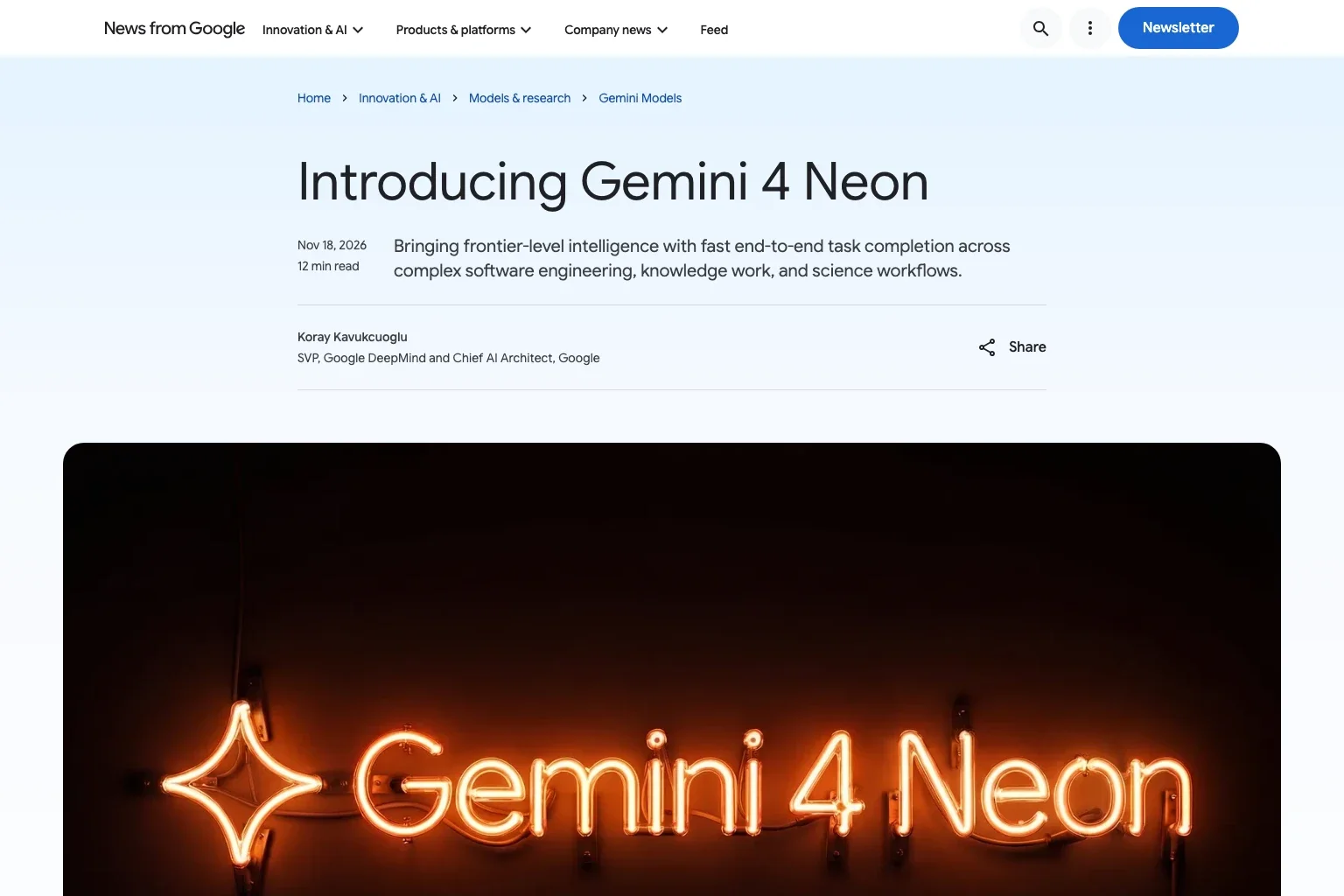
Gemini 4 Neon Launches at $3 Input and $15 Output - Pricier Than Carbon Through November 30, Cheaper From December 1
Google released Gemini 4 Neon on November 18, 2026. It is placed between Hydrogen and Carbon, the API is paid tier only, and it costs $3 per million input tokens and $15 per million output tokens. It is pricier than Carbon while Carbon's introductory price runs through November 30, and cheaper from December 1. This article covers the different default thinking level and Neon's new role as the recommended upgrade from 3.1 Pro Preview.
Google has released Gemini 4 Neon, with the model ID gemini-4-neon 1. The Gemini API documentation slots Neon in between Carbon and Gemini 4 Hydrogen and describes it as a model for complex tasks that run at high frequency 2. In Google’s framing, it is the pick for demanding coding, knowledge-work, and scientific tasks where Hydrogen falls short but Carbon’s additional verification is not needed 3.
The API is offered on the paid tier only. Neon is priced at $3 for each million input tokens and $15 for each million output tokens, with thinking tokens counted as output. The rate is flat across the whole 1 million-token context, and input served from the implicit cache gets a 95% discount, to $0.15 2.
The price order against Carbon flips after November 30
The “Choosing a model” page in the Gemini API docs lists the Gemini 4 models and 3.5 Flash-Lite as follows (prices per million tokens, USD) 3.
| Model | Speed label | Thinking levels (default) | Input / output |
|---|---|---|---|
| Carbon | Deliberate | low, medium (default), high | $2.00 / $10.00 (introductory through November 30) |
| Neon | Moderate | low, medium, high (default), xhigh | $3.00 / $15.00 |
| Hydrogen | Fast | low, medium, high (default), xhigh | $1.50 / $7.50 |
| 3.5 Flash-Lite | Fastest | minimal (default), low, medium, high | $0.30 / $2.50 |
The same page notes that Carbon’s rate is an introductory price that lasts through November 30 and becomes $4 input and $20 output from December 1, and that Neon carries no introductory pricing. Working from those numbers, Neon’s per-token price is 1.5 times Carbon’s through November 30 and 25% below Carbon’s from December 1. Against Hydrogen, Neon costs twice as much in both periods. Hydrogen and Flash-Lite can be used on the free tier; Carbon and Neon cannot.
Per-token prices do not translate directly into bills, though. Google says that at its default high level, Neon posts a high score on the Artificial Analysis Intelligence Index while its cost per task is 32% lower than Carbon’s 1. That part of the announcement does not say which thinking level Carbon was run at. The same announcement says that at xhigh, the top level, Neon scored 61 on that index and placed third overall. It also says Neon ranked first overall on the Artificial Analysis Coding Agent Index with 58.6, without stating the thinking level for that result. All of these figures come from Google’s announcement.
Switching from Carbon or Argon raises the default thinking level
The migration guide says that moving from another Gemini 4 model to Neon requires no change to the request schema; you swap the model ID 2. What it flags is the difference in defaults. Like Hydrogen, Neon defaults to the high thinking level and supports xhigh. Carbon and Argon, by contrast, default to medium and top out at high. Because thinking tokens are billed at the output rate, switching from Carbon without setting thinking_level could push up the number of thinking tokens per call. The migration guide asks you to set thinking_level explicitly if you want to keep the previous behavior.
On xhigh, the guide says to hold it for difficult multi-step problems that high cannot handle, and warns that it adds latency and token use. The process it recommends is to test every one of the four levels using a generous max_output_tokens, then settle on the lowest level that still clears your quality threshold.
Output handling is also worth checking. Neon has one 1,048,576-token context window that input, thinking, and output all draw from, and a synchronous response can be at most 65,536 tokens. For longer output, you either set background to true with max_output_tokens above 65,536, or rely on the SDKs’ client-side continuation. If you turn on background without setting max_output_tokens, generation stops at 65,536 tokens. Apps that hardcode a low cap such as 8,192 are told to remove it or raise it to 65,536, and to lower the thinking level instead if they want fewer tokens. Difficult prompts may run for several minutes, and the guide asks for HTTP client timeouts of at least 15 minutes.
Recommended upgrade from 3.1 Pro Preview
The “Choosing a model” page includes a table of upgrade targets for Gemini 3 and 2.5 models 3. It lists Neon as the recommended upgrade for gemini-3.1-pro-preview, with Carbon for the hardest problems. The recommended target for 3.8 Flash, 3.6 Flash, and 3 Flash Preview remains Hydrogen, and 2.5 Pro also points to Hydrogen, with Carbon for the hardest problems.
Moving from Gemini 3 or earlier involves more changes than switching within Gemini 4 2.
- No explicit context caching:
cachedContentsandcaches.createare not supported. Implicit caching applies by default to prompts of 4,096 tokens or more - Drop sampling parameters: In-range values for temperature, top_p, and top_k are ignored, and out-of-range values return a 400 error
- Thinking level: The default is
highrather thanmedium, andminimalis rejected with an error - Tools: Avoid having the model emit raw-text JSON tool calls through system instructions with no tools declared; declare tools through function calling or structured outputs
Gemini Managed Agents’ Antigravity agent can run on Neon, but its default model is still Hydrogen; to use Neon, you set the model in agent_config 3. The docs also explain that Carbon, Neon, and Hydrogen use a common request format, context window, and tool set, so each stage of a workflow can be routed to a different model.
The app and Antigravity are open from AI Pro
Beyond the API, Google’s announcement lists Gemini for business (through the API and the model menu), Google Antigravity, and the Gemini app 1. In Antigravity and the Gemini app, people on the Google AI Pro and Ultra plans are eligible, and AI Studio access is also open to those plans. A cyber-defense version, Neon for cyber, is to start reaching eligible Fairwind Program members within the next few days. The announcement does not give its price.
For API users, two things are worth checking first. One is the expected bill for workloads currently on Carbon. Through November 30, Carbon is cheaper on per-token price alone; from December 1, Neon is. If you run the same workload on Neon at medium and high and compare token counts and quality before Carbon’s introductory price ends, you can decide with numbers which model to lean on from December. The other is to find the places in 3.1 Pro Preview workloads that depend on explicit caching or sampling parameters, among the changes listed in the migration guide.
Sources
- Introducing Gemini 4 Neon - Google official blog (November 18, 2026)
- What’s new in Gemini 4 Neon - Gemini API documentation (migration guide and pricing; checked November 20, 2026)
- Choosing a model - Gemini API documentation (model comparison table and upgrade targets; checked November 20, 2026)
Was this article helpful?
Thank you!
Received. Thank you!