Twenty-Five Fields Medalists Sign a Declaration - Objecting to AI Companies Racing to Crack Math Problems
A declaration titled 'A Severe Misalignment of AI in Mathematics,' signed by 25 Fields Medalists including Terence Tao, Peter Scholze and Shigefumi Mori. It argues that treating hard problems as a benchmark to be solved is harmful to mathematics as a science, and that the goals of AI companies and of the mathematical community are severely misaligned. In the same week, a dispute over credit surrounding OpenAI's Navier–Stokes announcement came into the open.
A declaration titled “A Severe Misalignment of AI in Mathematics,” signed by 25 Fields Medalists, has been published. TechCrunch reported it on September 11, 2026. Its argument is that when AI firms chase mathematical problems in order to post a benchmark score, the practice does harm — to mathematics as a science, and to the people who do it — and that what those firms are after and what the field is after have come badly apart1.
Among the signatories are Terence Tao, Peter Scholze, Maryna Viazovska, Shigefumi Mori and Cédric Villani. All are Fields Medalists, with award years running from 1978 to 20261. TechCrunch, introducing the Fields Medal as what is considered mathematics’ most prestigious prize, notes that all 25 signatories hold one2.
Solving Problems Is Not the Point
The declaration starts from a premise: over the past few months, the mathematical abilities of LLMs have improved to the point where they can settle major open problems across many fields1. What it objects to is not AI doing mathematics, but the treatment of that work as a benchmark.
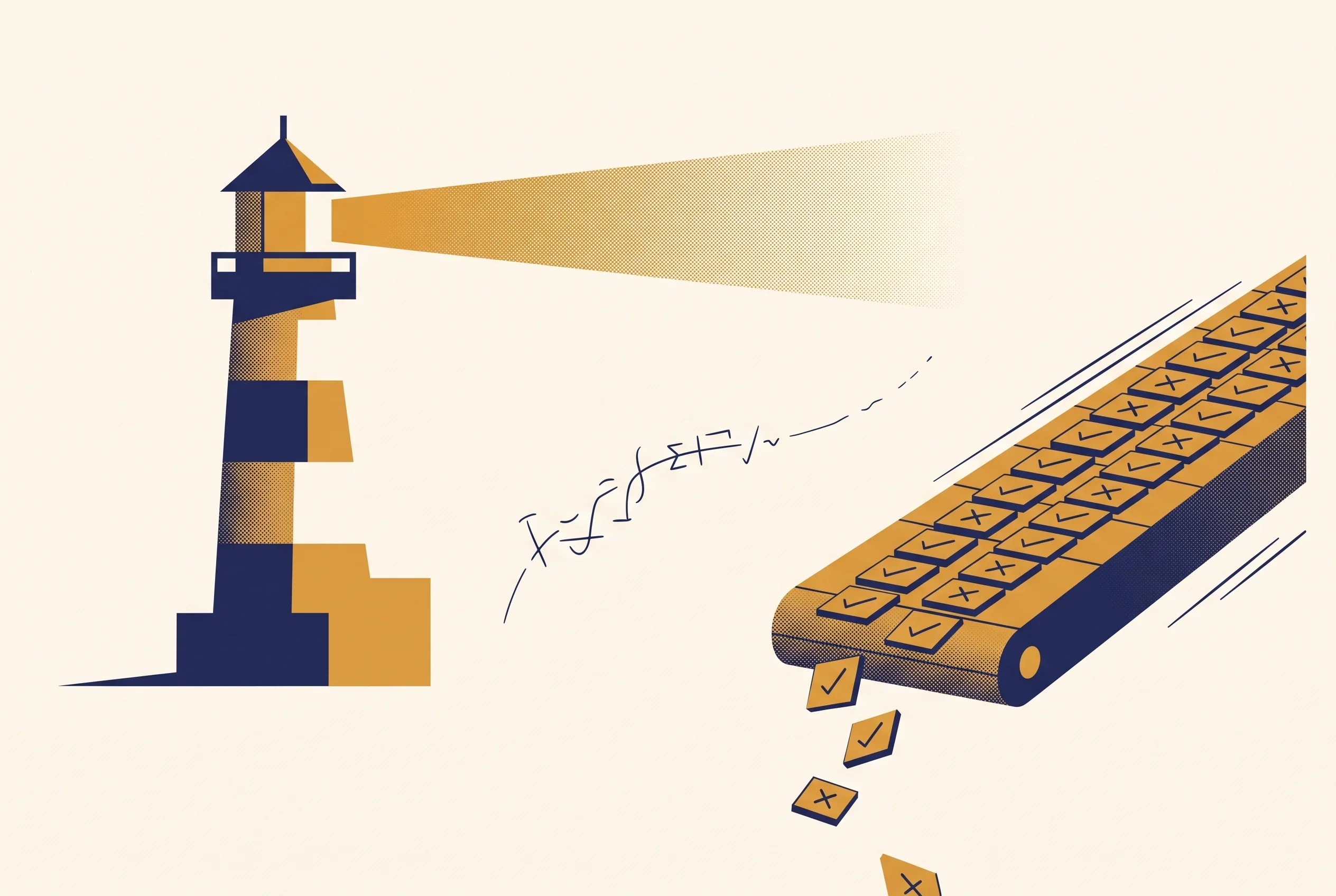
Famous problems, the declaration says, have long served as “landmarks and lighthouses” against which improved understanding of the terrain can be measured1. When one falls, that has been a reliable sign that fresh insight and interesting methods exist — and those then get worked over by a community, through a long and difficult process of talks, discussion and simplification. At the end of it, ideally, sits a textbook treatment a graduate or even an undergraduate student can learn from; decades or centuries later, some of those ideas become tools the wider public uses.
The sentence at the center of the document is this one: solving problems is “only a tool and proxy for achieving the primary goal of conceptual understanding and insight”1. Forget that in a world with AI, it continues, and the tool may be turned against the goal it was meant to serve. Churning out true-or-false verdicts ever faster could destroy fertile ground rather than breathe life into new ideas.
Three specific harms follow from announcements made in a hurry. There is no time for a proper write-up, none for isolating what is actually new in the method, and none for citing the prior work of others. As in every creative profession, the declaration says, this “raises severe attribution and plagiarism questions.” It adds that without mathematicians willing to develop AI-conceived ideas and fold them into the canon, those ideas never come fully alive, and the chain by which mathematics passes from one person to the next is broken.
In the Same Week, a Fight Over a Millennium Prize Problem Broke Open
In its article on the declaration, TechCrunch lines up a sequence of events from the preceding days2. The declaration itself names no company and no problem, but the events are worth having in view.
On September 8, 2026, OpenAI put up a post saying it had settled the Millennium Prize question of whether Navier–Stokes solutions exist and stay smooth3. An internal system, the company says, produced a proof that a three-dimensional fluid can, within a finite span of time, reach a singularity. Released alongside it were a prose write-up and a machine-checkable version in Lean.
The model behind it, according to the company, was an internal one “significantly more capable than GPT-6 Astra,” in training since August 283. Word reached the company on Tuesday, September 1, it says, that a pair of the Millennium problems had fallen — and on the strength of that rumor it pointed the model at every unsolved item on the list. Roughly 10,000 agents were running in parallel in the group that cracked Navier–Stokes, and they landed on their answer on Saturday, September 5, some 88 hours from the moment the first of them went live. Putting it into Lean and checking it there added another 17 hours on GPT-6 Astra. Counting everything attempted, message traffic came to 4.9 million and output to roughly 300 billion tokens. As for the prize itself, the company says flatly that it will not be filing a claim.
This is where the trouble starts. TechCrunch reported on September 8 that Tristan Buckmaster, a mathematics professor at NYU, had put out three proofs written jointly with Levent Alpöge, a mathematician employed by Anthropic — and had used the occasion to take OpenAI to task4. In the account the outlet gives of Buckmaster’s claims, the pair learned while finalizing their results that “information about our progress had been passed to OpenAI.” He further alleges that Sébastien Bubeck, a mathematician at OpenAI, floated a compromise that would have stripped Alpöge’s name from the credits. Alpöge draws a salary from Anthropic, the outlet notes, but this was not work he did for his employer.
OpenAI tells it differently. On its announcement page, the company writes that it only later realized the rumor concerned Alpöge and Buckmaster3. It states that “We (the researchers and the agents) did not see any of their work through any means until they released it publicly — in particular, no specific user data was accessed in order to solve this problem,” and says that after looking into it, the company established there was no route — training among them — by which Buckmaster’s Codex prompts from the two months leading up to the September 8 announcement and paper could have shaped the system. The company notes that the “Concurrent work” section was updated on September 10. The company also recognizes the priority of the pair’s forced Euler result and congratulates them on it.
The two accounts contradict each other head-on, and there is no material available from outside to settle which is right. The question Buckmaster raised — whether one’s own Codex usage might feed back into the provider’s models — has a generality independent of this dispute, though. TechCrunch notes alongside it that OpenAI keeps for itself the right to use Codex interactions in training, and that users may opt out4.
What “Unverified” Means Here
TechCrunch writes that OpenAI’s proof remains unverified2. OpenAI, meanwhile, has published a Lean formalization3. These two statements do not conflict.
Whether a proof assistant like Lean accepts something is a mechanical yes-or-no question: does this formal claim follow from these formal premises? Passing that check says nothing about whether the formal statement faithfully captures the original mathematical question, or whether the method contains insight the field can use. What the declaration is worried about is precisely the latter — the process of talks, discussion and simplification through which a result becomes common property.
The gap is visible in contrast with Anthropic’s September 2026 announcement that Claude formalized Fermat’s Last Theorem in Lean in 11 days. There, the company said plainly that no new mathematics had been produced and that what was new lay on the verification side. OpenAI’s claim is of a different character: a new result in its own right.
Three Months After the Leiden Declaration
This is not the first time mathematicians have gone on record. According to TechCrunch, the new letter comes after the Leiden Declaration, which a group of mathematicians working together released in June; that text likewise took up the question of how proofs written by LLMs will change the job, and offered advice aimed at researchers, at institutions, and at the people who write policy2.
OpenAI published ten results in mathematics and theoretical computer science on August 1. What separates the present moment from that one: the most senior figures in the field have now signed their names, and a concrete dispute over credit surfaced between the parties involved around the same time.
TechCrunch also reports that OpenAI, on Thursday, September 10, backed out as a sponsor of a mathematics event held at CalTech, following criticism from researchers there2.
One more dynamic the outlet points to is the asymmetry in resources. A frontier lab that sees a plausible path to a discovery can throw tens of millions of dollars at it and reach the proof ahead of whoever started down that path — a pressure that, as the outlet reads it, rewards keeping quiet2.
The Declaration Says This Is Not Only About Mathematics
What keeps this document from being an in-house protest is that it widens its own scope.
The declaration describes what it calls “a general threat to intellectual work”1. Across a great many occupations, the long apprenticeship has done double duty: it produces the finished answer or artifact, and it also builds the understanding out of which fresh questions and ideas come. AI systems, standing on an enormous body of prior human work, are increasingly able to produce the outputs of that labor directly — and at that point the two purposes stop coinciding.
Its closing passage holds that the problems now facing mathematicians resemble those confronting other scientific and creative professions, and point to problems all of humanity may face. The question it leaves open: with AI reshaping how work gets done, how does anyone keep hold of the purpose the work had to begin with1?
It is not a rejection of AI. The declaration grants that AI “offers the potential of enhancing and accelerating genuine mathematical study and understanding,” says the profession will have to adapt in several ways, and concludes that whether the changes benefit the field or prove destructive “will in large part be determined by the decisions of the humans in control of this new technology”1. It addresses three parties by name: the mathematical community, the companies building these technologies, and a society that will meet the same problems in many other guises.
Read from the position of someone using coding agents at work, the points of contention are concrete. Who gets credit for what a model produced; who verifies the output and how; what to do about the possibility that your own usage logs feed the provider’s training. None of the three resolves itself no matter how far benchmark numbers climb. Mathematics simply got there first — the same questions, the declaration argues, will reach other fields in turn.
Sources
- A Severe Misalignment of AI in Mathematics - The declaration itself (25 signatories; accessed September 13, 2026)
- OpenAI’s feud with mathematicians is only escalating - TechCrunch (September 11, 2026)
- On the Navier–Stokes Millennium Prize Problem - OpenAI (September 8, 2026; updated September 10)
- OpenAI fought dirty on career-making math problem, says NYU mathematician - TechCrunch (September 8, 2026)
Was this article helpful?
Thank you!
Received. Thank you!